


Sitting Sideways Causes Different Femoral-Tibial Rotations in Each Knee
- PMID: 38836162
- PMCID: PMC11149726
- DOI: 10.7759/cureus.59678
Sitting Sideways Causes Different Femoral-Tibial Rotations in Each Knee
Abstract
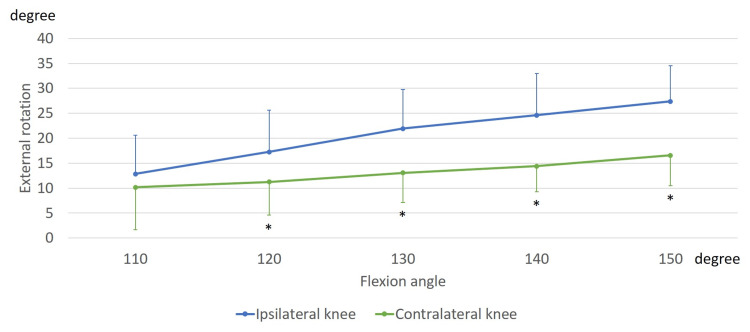
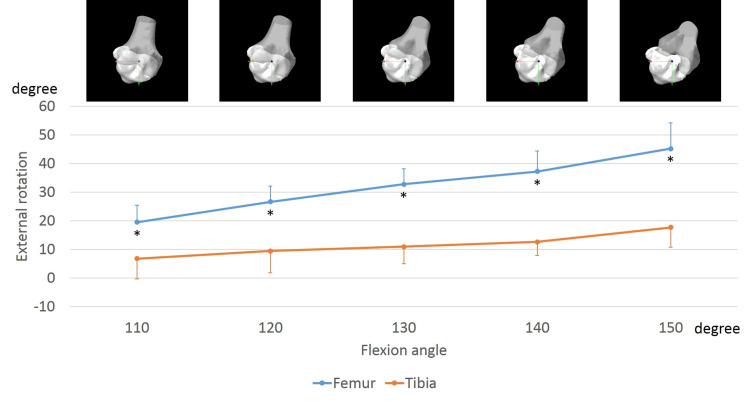
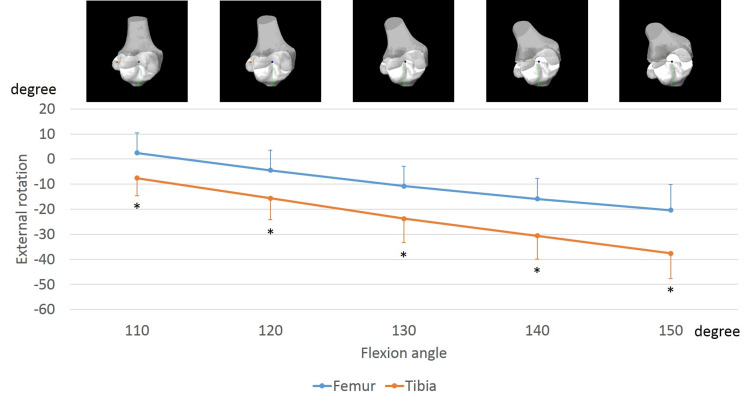
Purpose According to a previous study, asymmetrical kneeling, such as sitting sideways, does not exhibit asymmetrical movements. Rotational analyses of each femur and tibia help explain why rotational knee kinematics while sitting sideways do not exhibit asymmetrical movement. We aimed to assess the rotation of the femur and tibia in normal knees while sitting sideways. Methods Each volunteer sat sideways under fluoroscopy. Two-dimensional and three-dimensional registration techniques were used. After evaluating the femoral rotation angle relative to the tibia at each flexion angle, the femoral and tibial sole rotation angles at each flexion angle were compared between the ipsilateral and contralateral knees. Results While sitting sideways, both knees showed femoral external rotation relative to the tibia with flexion. In the ipsilateral knees, the femurs exhibited an external rotation of 26.3 ± 8.0°, from 110° to 150° of flexion. Conversely, the tibia exhibited an external rotation of 12.2 ± 7.8°, from 110° to 150° of flexion. From 110° to 150° of flexion, femoral external rotation was significantly larger than tibial external rotation. In the contralateral knees, the femurs exhibited an internal rotation of 23.8 ± 6.3°, from 110° to 150° of flexion (110°, p < 0.001; 120°, p < 0.001; 130°, p < 0.001; 140°, p < 0.001; and 150°, p < 0.001). Contrastingly, the tibia exhibited an internal rotation of 30.4 ± 8.8°, from 110° to 150° of flexion, which was significantly larger than femoral internal rotation (110°, p = 0.002; 120°, p < 0.001; 130°, p < 0.001; 140°, p < 0.001; and 150°, p < 0.001). Conclusions Although bilateral knees exhibited femoral external rotation relative to the tibia while sitting sideways, the ipsilateral and contralateral knees showed femoral and tibial sole rotations in opposite directions. In particular, the contralateral knees might show a strained movement because both femurs and tibias exhibited internal rotation with flexion. Patients who have undergone guided-motion total knee arthroplasty (TKA) or medial-pivot TKAs might be advised to avoid sitting sideways.
Keywords: axial rotation; kinematics; kneeling; normal knee; sitting sideways.
Copyright © 2024, Kono et al.
Conflict of interest statement
The authors have declared that no competing interests exist.
Figures
References
-
- In vivo fluoroscopic analysis of the normal human knee. Komistek RD, Dennis DA, Mahfouz M. Clin Orthop Relat Res. 2003:69–81. - PubMed
-
- Hip, knee, and ankle kinematics of high range of motion activities of daily living. Hemmerich A, Brown H, Smith S, Marthandam SS, Wyss UP. J Orthop Res. 2006;24:770–781. - PubMed
-
- Dynamic activity dependence of in vivo normal knee kinematics. Moro-oka TA, Hamai S, Miura H, et al. J Orthop Res. 2008;26:428–434. - PubMed
LinkOut - more resources
Full Text Sources
Research Materials