


Effects of undergraduate ultrasound education on cross-sectional image understanding and visual-spatial ability - a prospective study
- PMID: 38840140
- PMCID: PMC11151628
- DOI: 10.1186/s12909-024-05608-7
Effects of undergraduate ultrasound education on cross-sectional image understanding and visual-spatial ability - a prospective study
Abstract
Introduction/aim: Radiological imaging is crucial in modern clinical practice and requires thorough and early training. An understanding of cross-sectional imaging is essential for effective interpretation of such imaging. This study examines the extent to which completing an undergraduate ultrasound course has positive effects on the development of visual-spatial ability, knowledge of anatomical spatial relationships, understanding of radiological cross-sectional images, and theoretical ultrasound competencies.
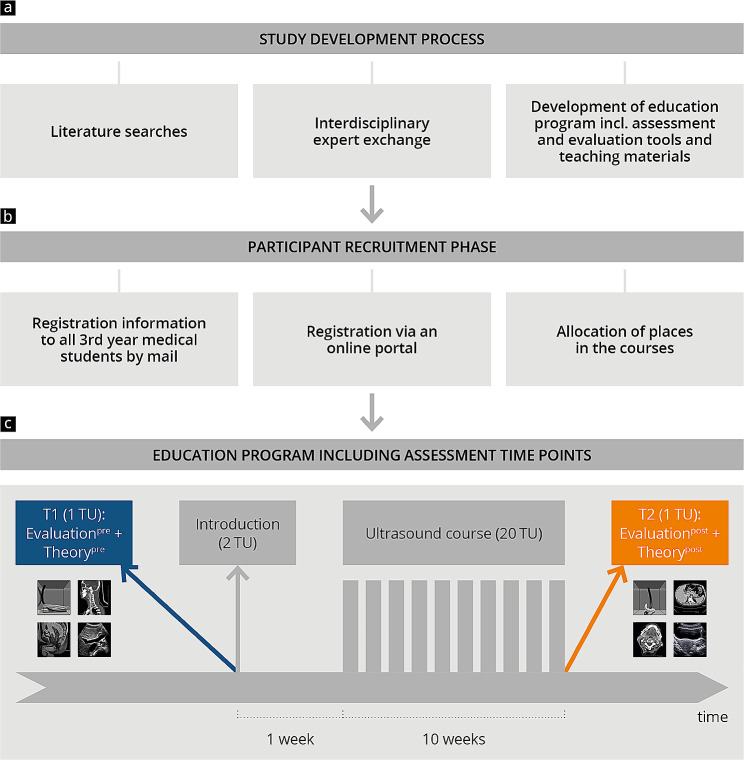
Material and methods: This prospective observational study was conducted at a medical school with 3rd year medical students as part of a voluntary extracurricular ultrasound course. The participants completed evaluations (7-level Likert response formats and dichotomous questions "yes/no") and theoretical tests at two time points (T1 = pre course; T2 = post course) to measure their subjective and objective cross-sectional imaging skills competencies. A questionnaire on baseline values and previous experience identified potential influencing factors.
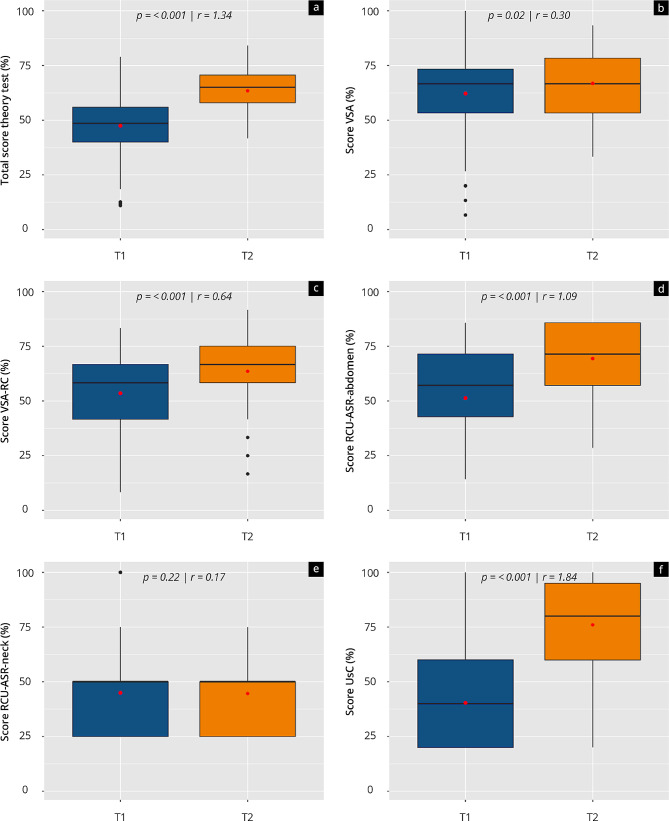
Results: A total of 141 participants were included in the study. Most participants had no previous general knowledge of ultrasound diagnostics (83%), had not yet performed a practical ultrasound examination (87%), and had not attended any courses on sonography (95%). Significant subjective and objective improvements in competencies were observed after the course, particularly in the subjective sub-area of "knowledge of anatomical spatial relationships" (p = 0.009). Similarly, participants showed improvements in the objective sub-areas of "theoretical ultrasound competencies" (p < 0.001), "radiological cross-section understanding and knowledge of anatomical spatial relationships in the abdomen" (p < 0.001), "visual-spatial ability in radiological cross-section images" (p < 0.001), and "visual-spatial ability" (p = 0.020).
Conclusion: Ultrasound training courses can enhance the development of visual-spatial ability, knowledge of anatomical spatial relationships, radiological cross-sectional image understanding, and theoretical ultrasound competencies. Due to the reciprocal positive effects of the training, students should receive radiology training at an early stage of their studies to benefit as early as possible from the improved skills, particularly in the disciplines of anatomy and radiology.
Keywords: Anatomical spatial relationships; Cross-sectional image understanding; Interpretation of radiological images; Ultrasound; Undergraduate Radiology Education; Undergraduate Ultrasound Education; Visual–spatial ability.
© 2024. The Author(s).
Conflict of interest statement
The authors declare no competing interests.
Figures

References
-
- Katsurada T, Nishida M, Sakamoto N. Imaging (X-ray - CT - MRI - ultrasound) Nihon Rinsho Japanese J Clin Med. 2017;75(3):387–91. - PubMed
-
- Krestel E. Imaging systems for medical diagnostics. Erlangen: Siemens Aktiengesellschaft; 1990. p. 636.
-
- Bundesamt DS. Fallpauschalenbezogene Krankenhausstatistik (DRG-Statistik) / Operationen und Prozeduren der vollstationären Patientinnen und Patienten in Krankenhäusern 2007 Wiesbaden2007 [ https://www.statistischebibliothek.de/mir/receive/DEHeft_mods_00022749.
-
- Bundesamt DS. Fallpauschalenbezogene Krankenhausstatistik (DRG-Statistik) / Operationen und Prozeduren der vollstationären Patientinnen und Patienten in Krankenhäusern 2021 Wiesbaden2021 [ https://www.statistischebibliothek.de/mir/receive/DEHeft_mods_00144855.
Publication types
MeSH terms
LinkOut - more resources
Full Text Sources
