


Optimizing Short Sprint Interval Training for Young Soccer Players: Unveiling Optimal Rest Distributions to Maximize Physiological Adaptations
- PMID: 38841640
- PMCID: PMC11149070
- DOI: 10.52082/jssm.2024.475
Optimizing Short Sprint Interval Training for Young Soccer Players: Unveiling Optimal Rest Distributions to Maximize Physiological Adaptations
Abstract
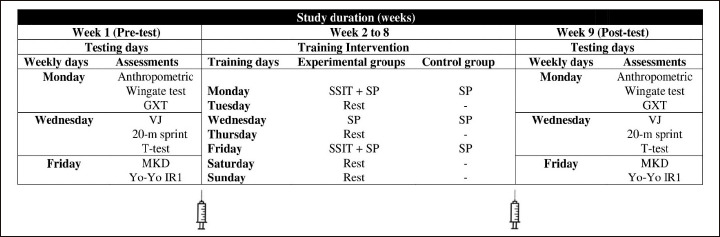
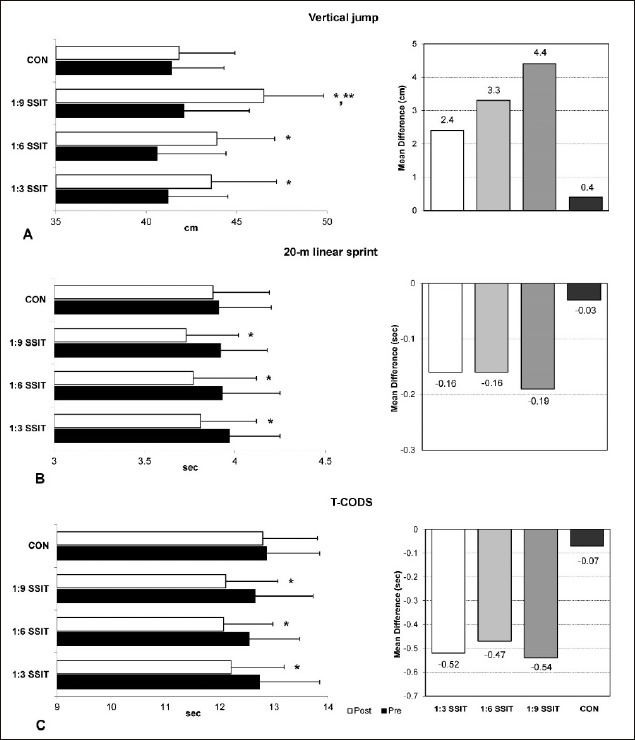
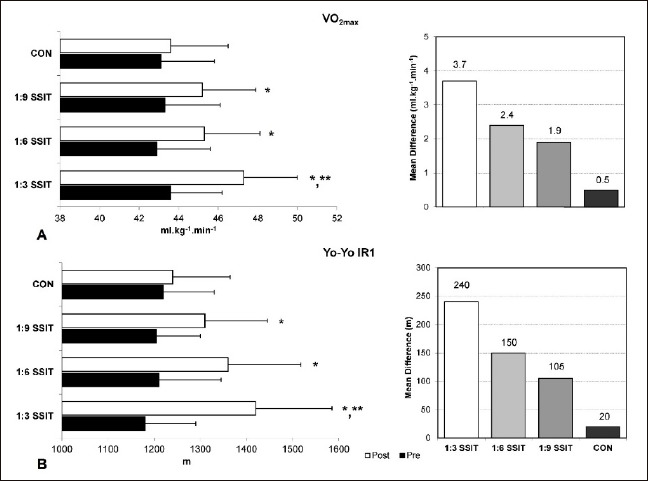
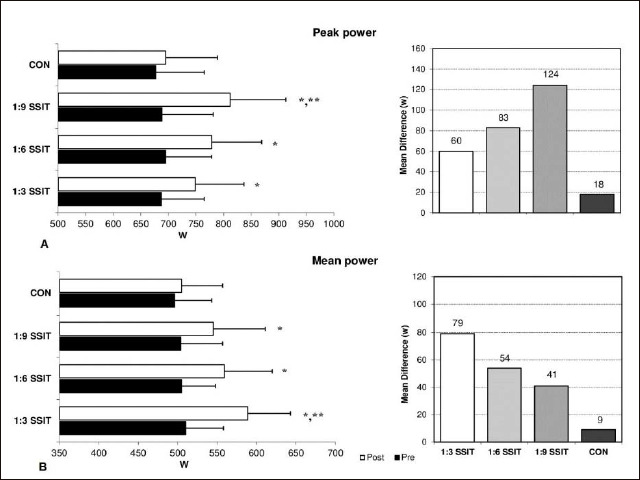
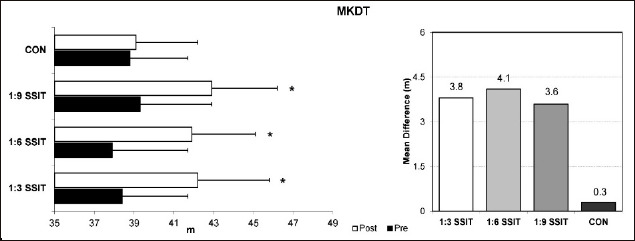
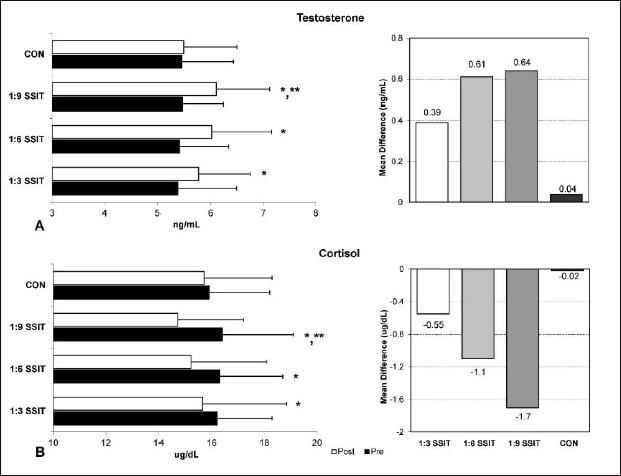
Present study aimed to compare the effects of SSIT intervention with varying rest distributions on hormonal, physiological, and performance adaptations in soccer players. Thirty-six players were randomly divided into three SSIT groups, each performing 4 sets of 6-10 repetitions of 6-second all-out running with rest intervals at ratios of 1:3, 1:6, and 1:9. Prior to and following the 7-week training period, aerobic fitness indices and anaerobic power were evaluated using a graded exercise test with a gas collection system and a lower-body Wingate test, respectively. Also, sport-specific bio-motor abilities were determined by measuring vertical jump, 20-m sprint, and T-test change of direction speed, Yo-Yo IR1 and maximal kicking distance. Hormonal status was also monitored by evaluating testosterone and cortisol levels. Following the 7-week training period, all SSIT interventions resulted in significant enhancements (p < 0.05) in soccer-related performance, physiological parameters, and hormonal adaptations, exhibiting effect sizes that ranged from small to large. Comparative analysis indicated that the 1:9 SSIT results in greater adaptive responses (p < 0.05) in the vertical jump, peak power, testosterone, and cortisol compared to the 1:3 SSIT group. By contrast, the 1:3 SSIT group induced more adaptive responses (p < 0.05) in the mean power output, maximum oxygen consumption (V̇O2max), and Yo-Yo IR1 compared to the 1:9 SSIT group. Hence, for enhancing physical performance, especially vertical jump height, anaerobic peak power, and hormonal adaptations, the 1:9 SSIT ratio is preferable. Conversely, shorter rest intervals (specifically, the 1:3 SSIT ratio) are better suited for eliciting heightened adaptive responses in mean power output, V̇O2max, and Yo-Yo IR1 over the 7-week training period among young male soccer players.
Keywords: Sprint interval training; aerobic capacity; metabolic conditioning; power.
© Journal of Sports Science and Medicine.
Figures
References
-
- Ambroży T., Rydzik Ł., Obmiński Z., Błach W., Błach B. (2021) The effect of high-intensity interval training periods on morning serum testosterone and cortisol levels and physical fitness in men aged 35-40 years. Journal of Clinical Medicine 10, 2143. https://doi.org/10.3390/jcm10102143 10.3390/jcm10102143 - DOI - PMC - PubMed
-
- Arazi H., Asadi A., Khalkhali F., Boullosa D., Hackney A. C., Granacher U., Zouhal H. (2020) Association between the acute to chronic workload ratio and injury occurrence in young male team soccer players: a preliminary study. Frontiers in Physiology 11, 608. https://doi.org/10.3389/fphys.2020.00608 10.3389/fphys.2020.00608 - DOI - PMC - PubMed
-
- Arazi H., Keihaniyan A., Eatemady-Brooujeni A., Oftade A., Takhsha A., Asadi A., Ramirez-Campillo R. (2017) Effects of heart rate vs. speed based high intensity interval training on aerobic and anaerobic capacity of female soccer players. Sports 57, 1-8. https://doi.org/10.3390/sports5030057 10.3390/sports5030057 - DOI - PMC - PubMed
-
- Asadi A., Ramirez-Campillo R., Arazi H., Seaz de Villarreal E. (2018) The effects of maturation on jumping ability and sprint adaptations to plyometric training in youth soccer players. Journal of Sport Sciences 36, 2405-2411. https://doi.org/10.1080/02640414.2018.1459151 10.1080/02640414.2018.1459151 - DOI - PubMed
-
- Ball K. (2009) Use of weighted balls for improving kicking for distance. In: Science and football. Proceedings of the sixth world congress on science and football. London. Eds: Reilly T., Kurkusuz F. 285-289.
Publication types
MeSH terms
Substances
LinkOut - more resources
Full Text Sources