


Improving prevalence estimates of mental health and well-being indicators among sexual minority men: a propensity-weighting approach
- PMID: 38844559
- PMCID: PMC11637521
- DOI: 10.1093/aje/kwae107
Improving prevalence estimates of mental health and well-being indicators among sexual minority men: a propensity-weighting approach
Abstract
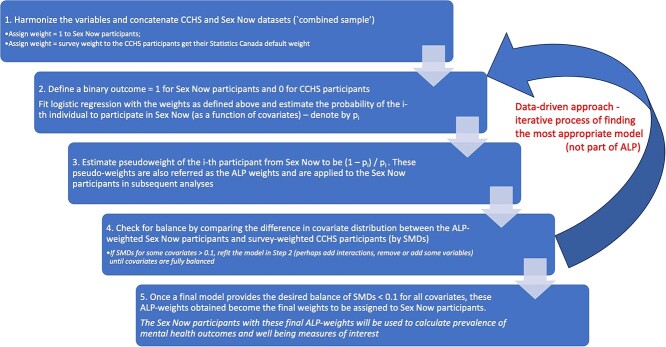
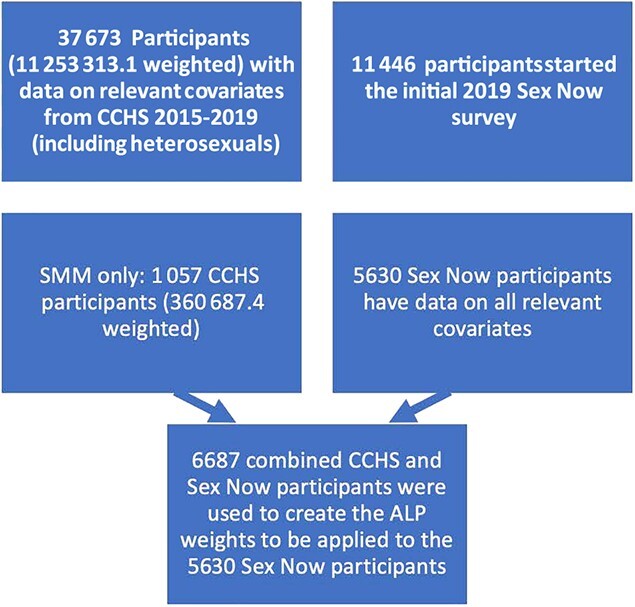
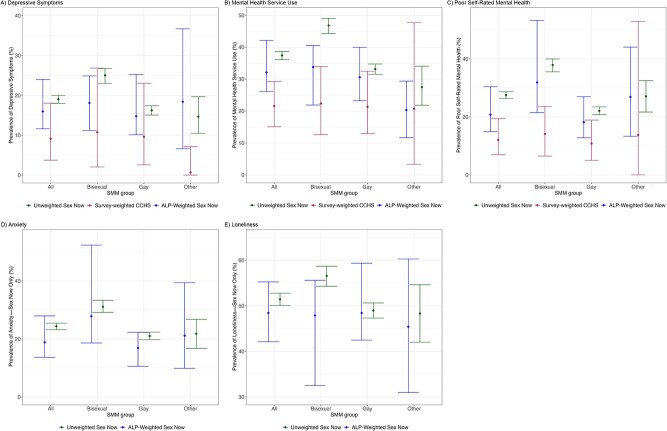
The prevalence and relative disparities of mental health outcomes and well-being indicators are often inconsistent across studies of sexual minority men (SMM) due to selection biases in community-based surveys (nonprobability sample), as well as misclassification biases in population-based surveys where some SMM often conceal their sexual orientation identities. The present study estimated the prevalence of mental health related outcomes (depressive symptoms, mental health service use, anxiety) and well-being indicators (loneliness and self-rated mental health) among SMM, broken down by sexual orientation using the adjusted logistic propensity score (ALP) weighting. We applied the ALP to correct for selection biases in the 2019 Sex Now data (a community-based survey of SMMs in Canada) by reweighting it to the 2015-2018 Canadian Community Health Survey (a population survey from Statistics Canada). For all SMMs, the ALP-weighted prevalence of depressive symptoms was 15.96% (95% CI, 11.36%-23.83%), while for mental health service use, it was 32.13% (95% CI, 26.09%-41.20%). The ALP estimates lie in between the crude estimates from the two surveys. This method was successful in providing a more accurate estimate than relying on results from one survey alone. We recommend to the use of ALP on other minority populations under certain assumptions. This article is part of a Special Collection on Mental Health.
Keywords: LGBTQ+; depressive symptoms; health services; measurement bias; mental health; propensity scores; selection bias; sexual orientation.
© The Author(s) 2024. Published by Oxford University Press on behalf of the Johns Hopkins Bloomberg School of Public Health.
Conflict of interest statement
The authors have no relevant conflict of interest to declare.
Figures
References
-
- Salway T, Plöderl M, Liu J, et al. Effects of multiple forms of information bias on estimated prevalence of suicide attempts according to sexual orientation: an application of a Bayesian misclassification correction method to data from a systematic review. Am J Epidemiol. 2019;188(1):239-249. 10.1093/aje/kwy200 - DOI - PubMed
-
- Tjepkema M. Health care use among gay, lesbian and bisexual Canadians. Health Rep. 2008;19(1):53-64. https://www150.statcan.gc.ca/n1/en/pub/82-003-x/2008001/article/10532-en... - PubMed
MeSH terms
Grants and funding
LinkOut - more resources
Full Text Sources
Medical
