


Synergistic effects of boron and saponin in mitigating salinity stress to enhance sweet potato growth
- PMID: 38844823
- PMCID: PMC11156973
- DOI: 10.1038/s41598-024-63840-z
Synergistic effects of boron and saponin in mitigating salinity stress to enhance sweet potato growth
Abstract
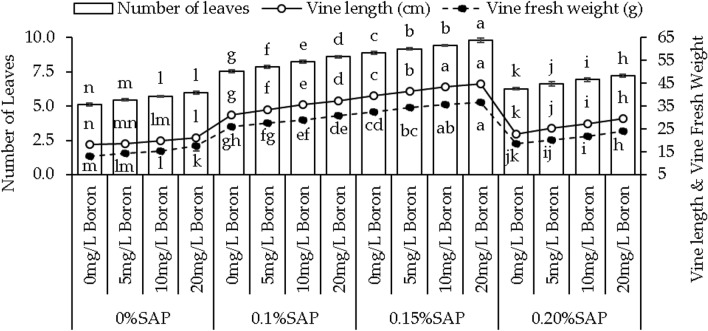
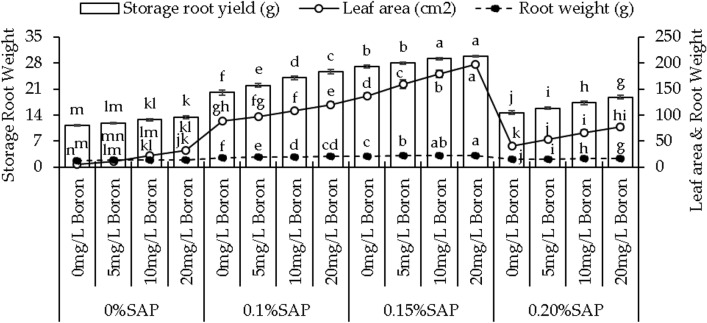
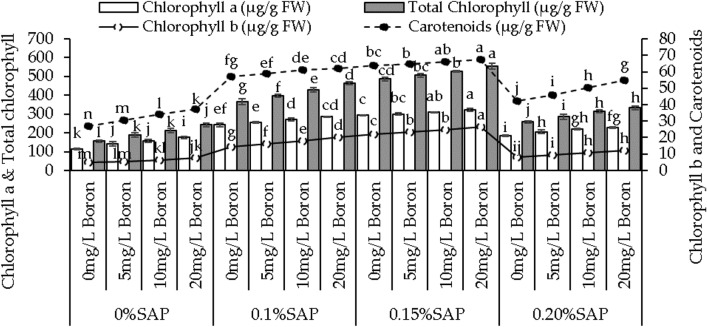
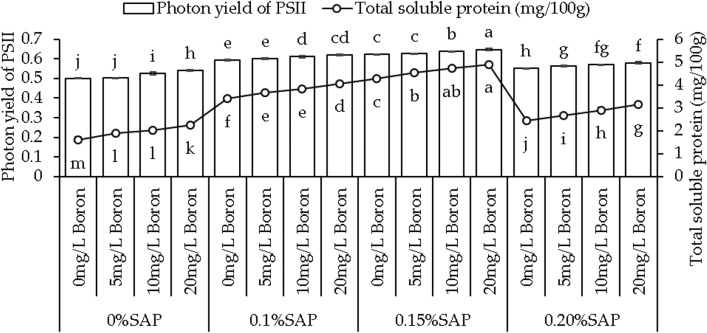
Salinity stress significantly hinders plant growth by disrupting osmotic balance and inhibiting nutrient uptake, leading to reduced biomass and stunted development. Using saponin (SAP) and boron (B) can effectively overcome this issue. Boron decreases salinity stress by stabilizing cell walls and membranes, regulating ion balance, activating antioxidant enzymes, and enhancing water uptake. SAP are bioactive compounds that have the potential to alleviate salinity stress by improving nutrient uptake, modulating plant hormone levels, promoting root growth, and stimulating antioxidant activity. That's why the current study was planned to use a combination of SAP and boron as amendments to mitigate salinity stress in sweet potatoes. Four levels of SAP (0%, 0.1%, 0.15%, and 0.20%) and B (control, 5, 10, and 20 mg/L B) were applied in 4 replications following a completely randomized design. Results illustrated that 0.15% SAP with 20 mg/L B caused significant enhancement in sweet potato vine length (13.12%), vine weight (12.86%), root weight (8.31%), over control under salinity stress. A significant improvement in sweet potato chlorophyll a (9.84%), chlorophyll b (20.20%), total chlorophyll (13.94%), photosynthetic rate (17.69%), transpiration rate (16.03%), and stomatal conductance (17.59%) contrast to control under salinity stress prove the effectiveness of 0.15% SAP + 20 mg/L B treatment. In conclusion, 0.15% SAP + 20 mg/L B is recommended to mitigate salinity stress in sweet potatoes.
Keywords: Antioxidant activity; Boron; Chlorophyll content; Photosynthetic rate; Saponin; Sweet potato.
© 2024. The Author(s).
Conflict of interest statement
The authors declare no competing interests.
Figures

References
-
- Paz AM, et al. Salt-affected soils: Field-scale strategies for prevention, mitigation, and adaptation to salt accumulation. Ital. J. Agron. 2023 doi: 10.4081/ija.2023.2166. - DOI
-
- Naorem A, et al. Soil constraints in an arid environment—Challenges, prospects, and implications. Agronomy. 2023;13:220. doi: 10.3390/agronomy13010220. - DOI
-
- Milani, M. H., Feyzi, H., Ghobadloo, F. C., Gohari, G. & Vita, F. Recent advances in nano-enabled agriculture for improving plant performances under abiotic stress condition., in EngineeredNanoparticlesinAgriculture:FromLaboratorytoField, 197 (2023).
-
- Abdoli M. Effects of micronutrient fertilization on the overall quality of crops. In: Aftab T, Hakeem KR, editors. Plant Micronutrients Deficiency and Toxicity Management. Springer; 2020. pp. 31–71.
MeSH terms
Substances
LinkOut - more resources
Full Text Sources
Miscellaneous
