


Determinants of sedentary behavior in community-dwelling older adults with type 2 diabetes based on the behavioral change wheel: a path analysis
- PMID: 38844849
- PMCID: PMC11157943
- DOI: 10.1186/s12877-024-05076-0
Determinants of sedentary behavior in community-dwelling older adults with type 2 diabetes based on the behavioral change wheel: a path analysis
Abstract
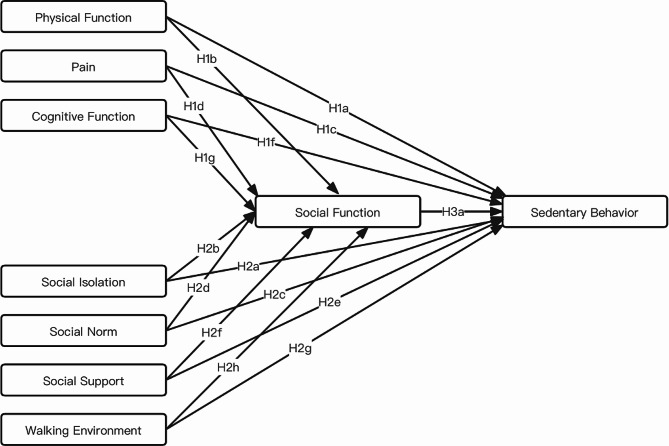
Background: Sedentary behavior (SB) is deeply ingrained in the daily lives of community-dwelling older adults with type 2 diabetes mellitus (T2DM). However, the specific underlying mechanisms of the determinants associated with SB remain elusive. We aimed to explore the determinants of SB based on the behavior change wheel framework as well as a literature review.
Methods: This cross-sectional study recruited 489 community-dwelling older adults with T2DM in Jinan City, Shandong Province, China. Convenience sampling was used to select participants from relevant communities. This study used the Measure of Older Adults' Sedentary Time-T2DM, the Abbreviated-Neighborhood Environment Walkability Scale, the Social Support Rating Scale, the Lubben Social Network Scale 6, the Subjective Social Norms Questionnaire for Sedentary Behavior, the Functional Activities Questionnaire, the Numerical Rating Scale, the Short Physical Performance Battery, and the Montreal Cognitive Assessment Text to assess the levels of and the determinants of SB. Descriptive statistical analysis and path analysis were conducted to analyze and interpret the data.
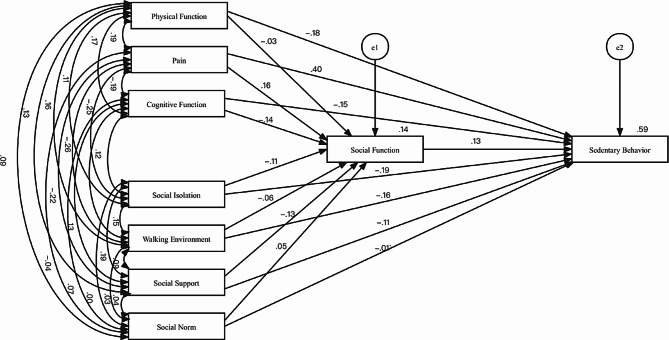
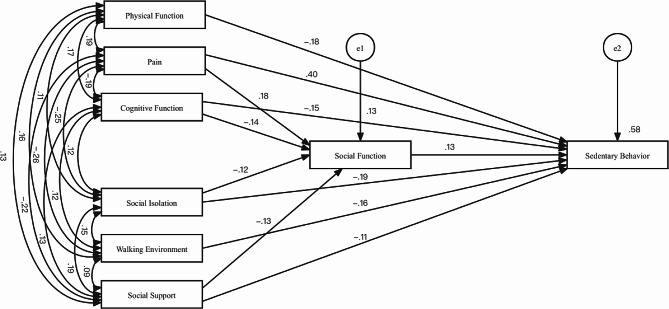
Results: Pain, cognitive function, social isolation, and social support had direct and indirect effects on SB in community-dwelling older adults with T2DM (total effects: β = 0.426, β = -0.171, β = -0.209, and β = -0.128, respectively), and physical function, walking environment, and social function had direct effects on patients' SB (total effects: β = -0.180, β = -0.163, and β = 0.127, respectively). All the above pathways were statistically significant (P < 0.05). The path analysis showed that the model had acceptable fit indices: RMSEA = 0.014, χ 2/df = 1.100, GFI = 0.999, AGFI = 0.980, NFI = 0.997, RFI = 0.954, IFI = 1.000, TLI = 0.996, CFI = 1.000.
Conclusion: Capability (physical function, pain, and cognitive function), opportunity (social isolation, walking environment, and social support), and motivation (social function) were effective predictors of SB in community-dwelling older adults with T2DM. Deeper knowledge regarding these associations may help healthcare providers design targeted intervention strategies to decrease levels of SB in this specific population.
Keywords: Behavior change wheel; Community; Determinants; Older adults; Path analysis; Sedentary behavior; Type 2 diabetes.
© 2024. The Author(s).
Conflict of interest statement
The authors declare that they have no competing interests.
The authors declare no competing interests.
Figures
References
-
- Alberti KGMM, Zimmet PZ. Definition, diagnosis and classification of diabetes mellitus and its complications. Part 1: diagnosis and classification of diabetes mellitus provisional report of a who consultation. Diabet Med. 1998;15(7):539–53. doi: 10.1002/(SICI)1096-9136(199807)15:7<539::AID-DIA668>3.0.CO;2-S. - DOI - PubMed
-
- Chinese Diabetes Society. Guideline for the prevention and treatment of type 2 diabetes mellitus in China(2020 edition)(part 1). Chin J Practical Intern Med. 2021(008):41.
MeSH terms
Grants and funding
LinkOut - more resources
Full Text Sources
Medical
Miscellaneous
