


Nocturnal hypoxemic burden and micro- and macrovascular disease in patients with type 2 diabetes
- PMID: 38844945
- PMCID: PMC11157751
- DOI: 10.1186/s12933-024-02289-w
Nocturnal hypoxemic burden and micro- and macrovascular disease in patients with type 2 diabetes
Abstract
Background: Micro- and macrovascular diseases are common in patients with type 2 diabetes mellitus (T2D) and may be partly caused by nocturnal hypoxemia. The study aimed to characterize the composition of nocturnal hypoxemic burden and to assess its association with micro- and macrovascular disease in patients with T2D.
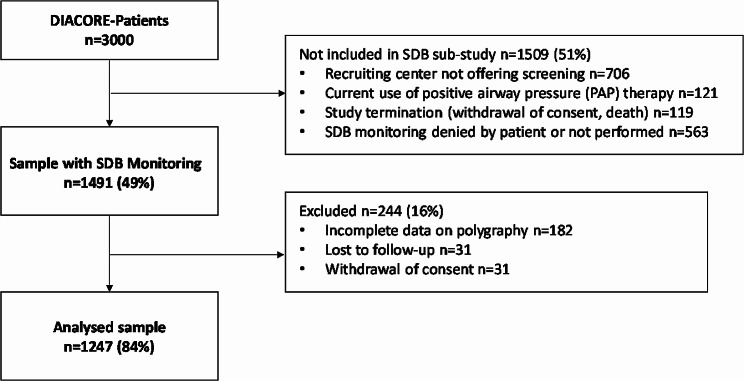
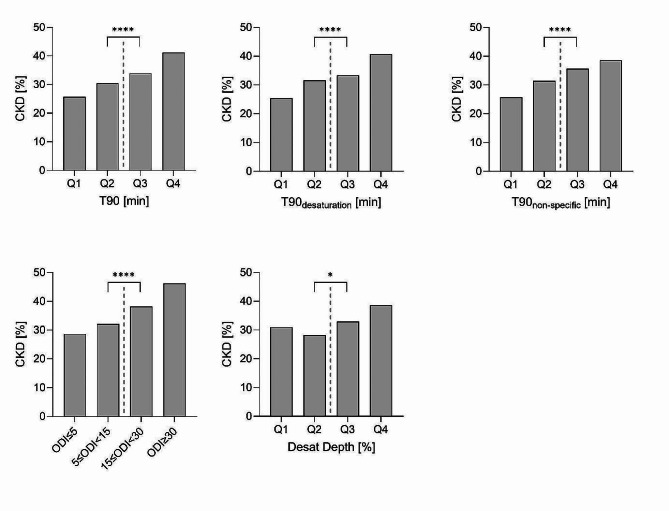
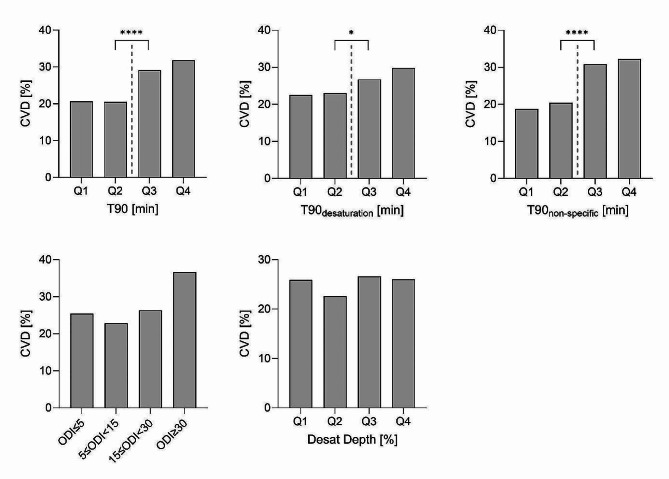
Methods: This cross-sectional analysis includes overnight oximetry from 1247 patients with T2D enrolled in the DIACORE (DIAbetes COhoRtE) study. Night-time spent below a peripheral oxygen saturation of 90% (T90) as well as T90 associated with non-specific drifts in oxygen saturation (T90non - specific), T90 associated with acute oxygen desaturation (T90desaturation) and desaturation depths were assessed. Binary logistic regression analyses adjusted for known risk factors (age, sex, smoking status, waist-hip ratio, duration of T2D, HbA1c, pulse pressure, low-density lipoprotein, use of statins, and use of renin-angiotensin-aldosterone system inhibitors) were used to assess the associations of such parameters of hypoxemic burden with chronic kidney disease (CKD) as a manifestation of microvascular disease and a composite of cardiovascular diseases (CVD) reflecting macrovascular disease.
Results: Patients with long T90 were significantly more often affected by CKD and CVD than patients with a lower hypoxemic burden (CKD 38% vs. 28%, p < 0.001; CVD 30% vs. 21%, p < 0.001). Continuous T90desaturation and desaturation depth were associated with CKD (adjusted OR 1.01 per unit, 95% CI [1.00; 1.01], p = 0.008 and OR 1.30, 95% CI [1.06; 1.61], p = 0.013, respectively) independently of other known risk factors for CKD. For CVD there was a thresholdeffect, and only severly and very severly increased T90non-specific was associated with CVD ([Q3;Q4] versus [Q1;Q2], adjusted OR 1.51, 95% CI [1.12; 2.05], p = 0.008) independently of other known risk factors for CVD.
Conclusion: While hypoxemic burden due to oxygen desaturations and the magnitude of desaturation depth were significantly associated with CKD, only severe hypoxemic burden due to non-specific drifts was associated with CVD. Specific types of hypoxemic burden may be related to micro- and macrovascular disease.
Keywords: Cardiovascular disease; Chronic kidney disease; Hypoxemic burden; Hypoxia; Type 2 diabetes.
© 2024. The Author(s).
Conflict of interest statement
M.A. reports grants from the Else-Kröner Fresenius Foundation, the Federal Ministry of Education and Research (Bundesministerium für Bildung und Forschung, BMBF) the German Academic Exchange Service (Deutscher Akademischer Austauschdienst, DAAD) and the Resmed Foundation, grants and personal fees from Philips Respironics and ResMed, and personal fees from Inspire, outside the submitted work. S.D., S.S., F.Z., I.M.H. and M.B. have nothing to disclose.
Figures
References
Publication types
MeSH terms
LinkOut - more resources
Full Text Sources
Medical
