


Effects of evening smartphone use on sleep and declarative memory consolidation in male adolescents and young adults
- PMID: 38846535
- PMCID: PMC11154150
- DOI: 10.1093/braincomms/fcae173
Effects of evening smartphone use on sleep and declarative memory consolidation in male adolescents and young adults
Abstract
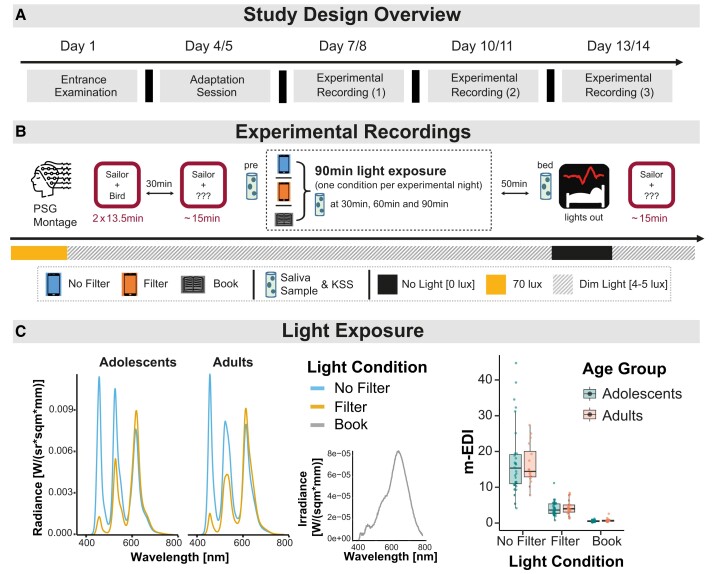
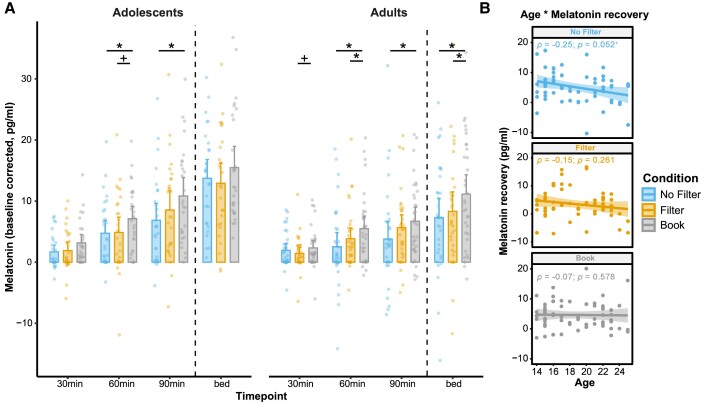
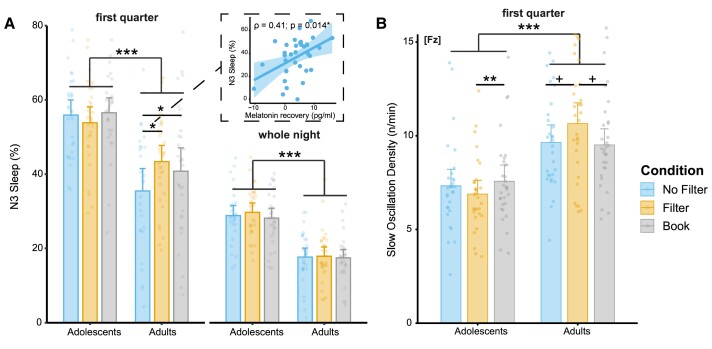
Exposure to short-wavelength light before bedtime is known to disrupt nocturnal melatonin secretion and can impair subsequent sleep. However, while it has been demonstrated that older adults are less affected by short-wavelength light, there is limited research exploring differences between adolescents and young adults. Furthermore, it remains unclear whether the effects of evening short-wavelength light on sleep architecture extend to sleep-related processes, such as declarative memory consolidation. Here, we recorded polysomnography from 33 male adolescents (15.42 ± 0.97 years) and 35 male young adults (21.51 ± 2.06 years) in a within-subject design during three different nights to investigate the impact of reading for 90 min either on a smartphone with or without a blue-light filter or from a printed book. We measured subjective sleepiness, melatonin secretion, sleep physiology and sleep-dependent memory consolidation. While subjective sleepiness remained unaffected, we observed a significant melatonin attenuation effect in both age groups immediately after reading on the smartphone without a blue-light filter. Interestingly, adolescents fully recovered from the melatonin attenuation in the following 50 min before bedtime, whereas adults still, at bedtime, exhibited significantly reduced melatonin levels. Sleep-dependent memory consolidation and the coupling between sleep spindles and slow oscillations were not affected by short-wavelength light in both age groups. Nevertheless, adults showed a reduction in N3 sleep during the first night quarter. In summary, avoiding smartphone use in the last hour before bedtime is advisable for adolescents and young adults to prevent sleep disturbances. Our research empirically supports general sleep hygiene advice and can inform future recommendations regarding the use of smartphones and other screen-based devices before bedtime.
Keywords: melatonin; memory consolidation; short-wavelength light; sleep; smartphone.
© The Author(s) 2024. Published by Oxford University Press on behalf of the Guarantors of Brain.
Conflict of interest statement
The authors report no competing interests.
Figures



References
-
- Olson JA, Sandra DA, Colucci ÉS, et al. Smartphone addiction is increasing across the world: A meta-analysis of 24 countries. Comput Human Behav. 2022;129:107138.
-
- Rideout V, Robb MB. The common sense census: Media use by tweens and teens. Common Sense Media; 2019.
-
- Cajochen C, Frey S, Anders D, et al. Evening exposure to a light-emitting diodes (LED)-backlit computer screen affects circadian physiology and cognitive performance. J Appl Physiol Respir Environ Exerc Physiol. 2011;110(5):1432–1438. - PubMed
-
- Higuchi S, Nagafuchi Y, Lee S, Harada T. Influence of light at night on melatonin suppression in children. J Clin Endocrinol Metab. 2014;99(9):3298–3303. - PubMed
LinkOut - more resources
Full Text Sources