Associations between Sleep Quality and Serum Levels of Neurofilament Light in Individuals with Premanifest Huntington Disease
- PMID: 38846594
- PMCID: PMC11152634
- DOI: 10.1055/s-0043-1777783
Associations between Sleep Quality and Serum Levels of Neurofilament Light in Individuals with Premanifest Huntington Disease
Abstract
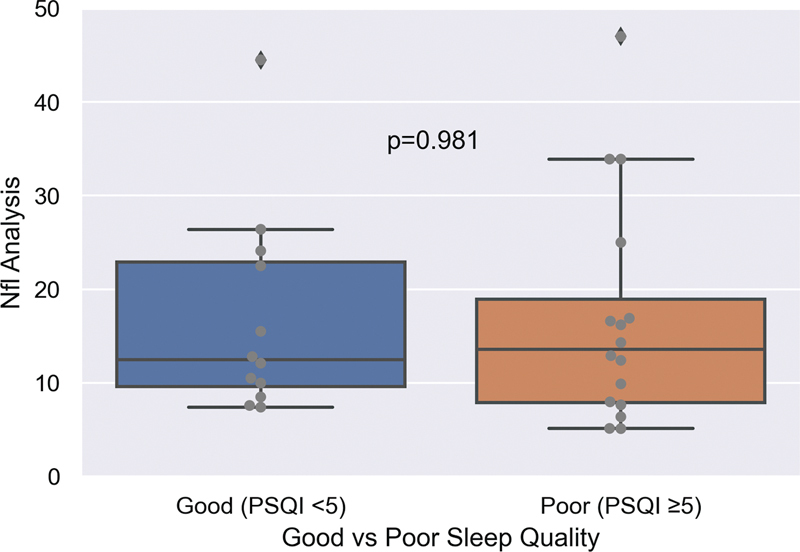
Objectives To evaluate the associations between sleep quality and serum levels of neurofilament light (NfL) protein in individuals with premanifest Huntington disease (HD). Materials and Methods We recruited 28 individuals with premanifest HD from a pre-existing database (of the Huntington's Environmental Research Optimisation Scheme, HEROs). The participants filled out the Pittsburgh Sleep Quality Index (PSQI), a subjective measure of sleep quality, and blood was collected via routine venepuncture to measure peripheral NfL levels. Results The PSQI scores (median: 5.0; interquartile range: 4.0-7.5) indicated poor sleep quality. General linear modelling revealed no significant ( p = 0.242) association between PSQI scores and NfL levels. No significant differences were found between individuals with good and poor sleep quality for any demographic variable collected. Discussion Contrary to studies on other neurological conditions, there was no association between sleep quality and NfL levels in individuals with premanifest HD. This was unexpected, given the influence of environmental factors (such as social network size) on neurodegeneration in individuals with premanifest HD.
Keywords: Huntington disease; neurofilament proteins; sleep quality.
Brazilian Sleep Association. This is an open access article published by Thieme under the terms of the Creative Commons Attribution-NonDerivative-NonCommercial License, permitting copying and reproduction so long as the original work is given appropriate credit. Contents may not be used for commercial purposes, or adapted, remixed, transformed or built upon. ( https://creativecommons.org/licenses/by-nc-nd/4.0/ ).
Conflict of interest statement
Conflicts of Interests The authors have no conflict of interests to declare.
Figures

References
-
- Neutel D, Tchikviladzé M, Charles P et al. Nocturnal agitation in Huntington disease is caused by arousal-related abnormal movements rather than by rapid eye movement sleep behavior disorder. Sleep Med. 2015;16(06):754–759. - PubMed
-
- Goodman A O, Rogers L, Pilsworth S et al. Asymptomatic sleep abnormalities are a common early feature in patients with Huntington's disease. Curr Neurol Neurosci Rep. 2011;11(02):211–217. - PubMed
-
- Piano C, Della Marca G, Losurdo A et al. Subjective assessment of sleep in Huntington disease: reliability of sleep questionnaires compared to polysomnography. Neurodegener Dis. 2017;17(06):330–337. - PubMed
LinkOut - more resources
Full Text Sources