


Comparison of effects of Otago exercise program vs gaze stability exercise on balance and fear of fall in older adults: A randomized trial
- PMID: 38847714
- PMCID: PMC11155577
- DOI: 10.1097/MD.0000000000038345
Comparison of effects of Otago exercise program vs gaze stability exercise on balance and fear of fall in older adults: A randomized trial
Abstract
Background: Fall occurrences and the associated risk of injury are debilitating and major health concerns in the older population. Several interventions have been investigated and implemented to address the needs of balance impairments and to reduce the increased risk of falls. This study aimed to compare the effectiveness of the Otago exercise program (OEP) and gaze stability exercises (GSE) on balance and the risk of falls in older adults residing at an old age home facility.
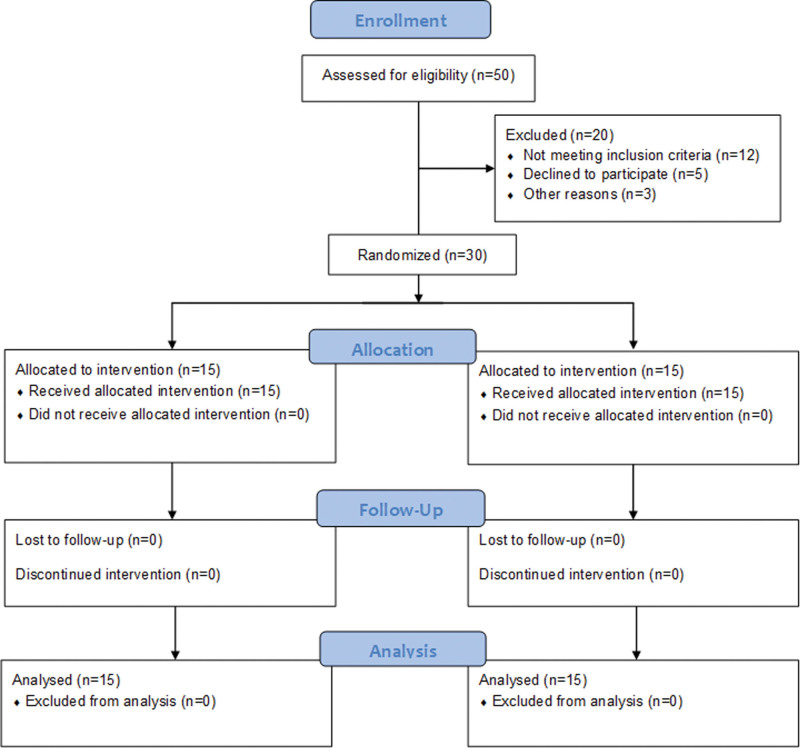
Methods: Thirty elderly participants were equally and randomly divided into 2 groups: Group OEP received the OEP, and group GSE received GSE for 8 weeks (thrice a week). In addition, both groups also performed core muscle-strengthening exercises. The outcome measures were the Berg balance scale (BBS) and the Fall efficacy scale-International (FES-I).
Results: The interventions resulted in significant improvements (P < .001) in both outcome measures in both groups. The mean pretest BBS scores of groups OEP and GSE increased from 40.4 and 39.2 to the mean post-test scores of 48 and 45.2, respectively. Similarly, the mean pretest FES-I scores of groups OEP and GSE also improved from 39.47 and 40.4 to the mean post-test scores of 32.73 and 36.07. The between-group comparison showed greater improvement (P < .05) in OEP group in both variables.
Conclusions: OEP and GSE were found to be beneficial rehabilitation programs in improving balance and fear of falls in healthy older adults. However, the OEP was found to be a more effective intervention and may allow better balance and fall prevention improvements.
Trial registration: The study has been registered in clinicaltrials.gov (ID: NCT05781776; on 23/03/2023).
Copyright © 2024 the Author(s). Published by Wolters Kluwer Health, Inc.
Conflict of interest statement
The authors have no conflicts of interest to disclose.
Figures
References
-
- Oeppen J, Vaupel JW. Broken limits to life expectancy. Science. 2002;296:1029–31. - PubMed
-
- Arzhane SSD, Hazrati M, Ashraf A. The effect of Otago exercise program training on balance and fear of falling in elderly individuals. 2019.
-
- Bhardwaj V, Vats M. Effectiveness of gaze stability exercise on balance in healthy elderly population. Int J Physiother Res. 2014;2:642–7.
-
- Herdman SJ. Role of vestibular adaptation in vestibular rehabilitation. Otolaryngol Head Neck Surg. 1998;119:49–54. - PubMed
Publication types
MeSH terms
Associated data
LinkOut - more resources
Full Text Sources
Medical
Miscellaneous
