Review
. 2024 Jul 9;45(26):2294-2305.
doi: 10.1093/eurheartj/ehae362.

Alcoholic cardiomyopathy: an update

Affiliations
Review

Alcoholic cardiomyopathy: an update

Fernando Domínguez et al. Eur Heart J. .

Abstract

Alcohol-induced cardiomyopathy (AC) is an acquired form of dilated cardiomyopathy (DCM) caused by prolonged and heavy alcohol intake in the absence of other causes. The amount of alcohol required to produce AC is generally considered as >80 g/day over 5 years, but there is still some controversy regarding this definition. This review on AC focuses on pathogenesis, which involves different mechanisms. Firstly, the direct toxic effect of ethanol promotes oxidative stress in the myocardium and activation of the renin-angiotensin system. Moreover, acetaldehyde, the best-studied metabolite of alcohol, can contribute to myocardial damage impairing actin-myosin interaction and producing mitochondrial dysfunction. Genetic factors are also involved in the pathogenesis of AC, with DCM-causing genetic variants in patients with AC, especially titin-truncating variants. These findings support a double-hit hypothesis in AC, combining genetics and environmental factors. The synergistic effect of alcohol with concomitant conditions such as hypertension or liver cirrhosis can be another contributing factor leading to AC. There are no specific cardiac signs and symptoms in AC as compared with other forms of DCM. However, natural history of AC differs from DCM and relies directly on alcohol withdrawal, as left ventricular ejection fraction recovery in abstainers is associated with an excellent prognosis. Thus, abstinence from alcohol is the most crucial step in treating AC, and specific therapies are available for this purpose. Otherwise, AC should be treated according to current guidelines of heart failure with reduced ejection fraction. Targeted therapies based on AC pathogenesis are currently being developed and could potentially improve AC treatment in the future.

Keywords: Alcohol; Alcoholic cardiomyopathy; Pathogenesis; Treatment.


Figures

Graphical Abstract
Graphical Abstract
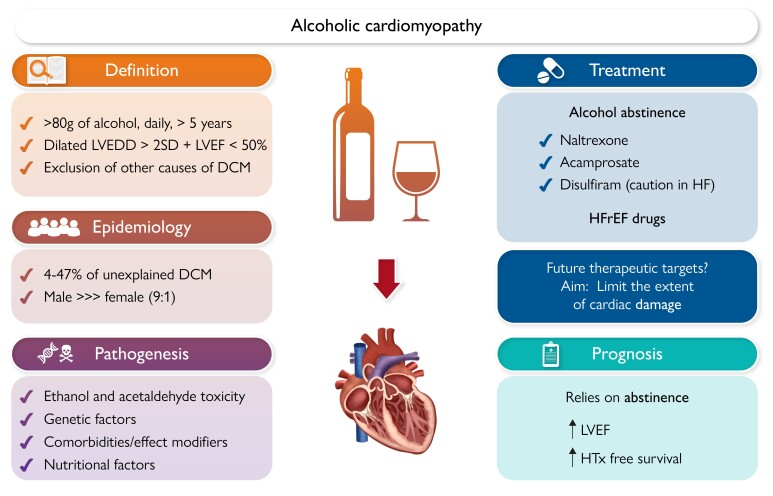
Clinical overview, pathogenesis, treatment and prognosis of alcoholic cardiomyopathy. DCM, dilated cardiomyopathy; HF, heart failure; HFrEF, heart failure with reduced ejection fraction; HTx, heart transplant; LVEDD, left ventricular end-diastolic diameter; LVEF, left ventricular ejection fraction; SD, standard deviation.
Figure 1
Figure 1
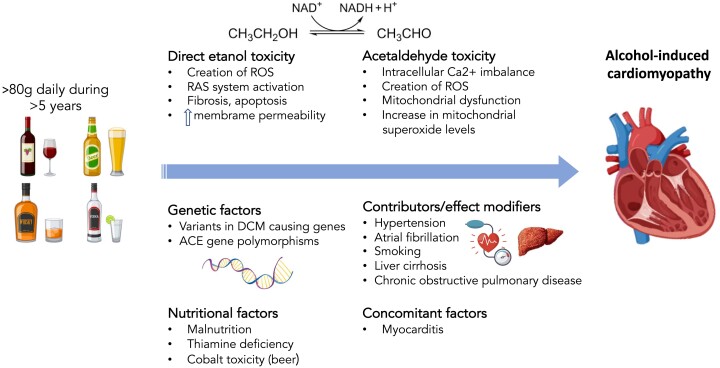
Pathogenic mechanisms of alcohol-induced cardiomyopathy. ACE, angiotensin-converting enzyme; DCM, dilated cardiomyopathy; RAS, renin–angiotensin system; ROS, reactive oxygen species
Figure 2
Figure 2
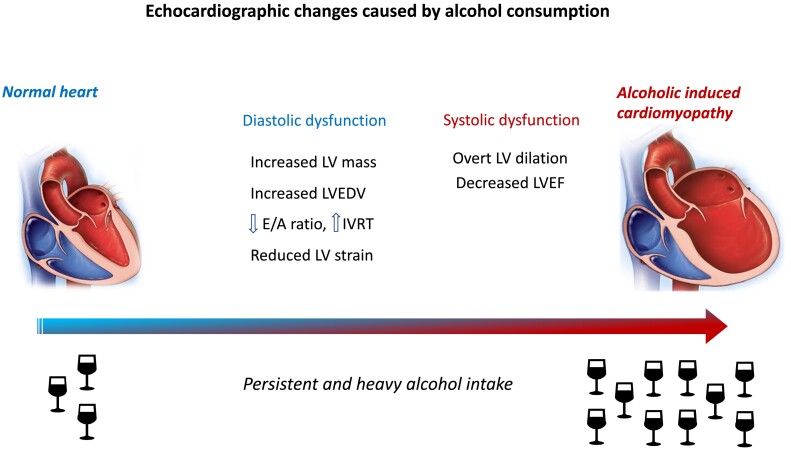
Echocardiographic consequences of heavy and persistent alcohol consumption. IVRT, isovolumic relaxation time; LVEDV, left ventricular end-diastolic volume; LVEF, left ventricular ejection fraction
Figure 3
Figure 3
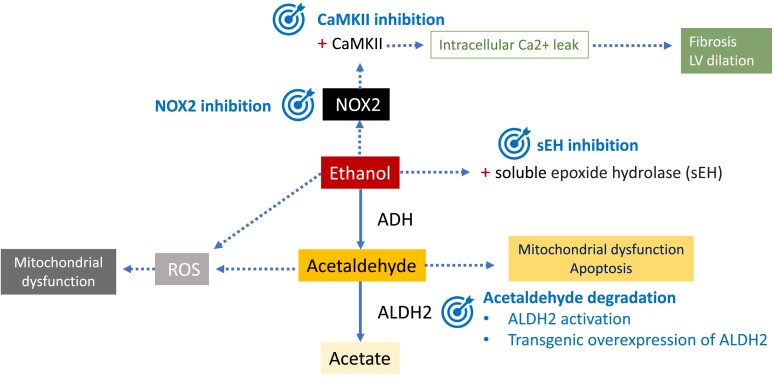
Potential therapeutic targets in alcohol-induced cardiomyopathy. Ethanol has direct toxic effects in the heart, as well as acetaldehyde, which is its most important metabolite. Ethanol is metabolized to acetaldehyde by alcohol dehydrogenase. Aldehyde dehydrogenase is responsible for the oxidation of acetaldehyde and its conversion into acetate. Ethanol produces activation of NOX2 and subsequent oxidation of Ca/calmodulin-dependent kinase II, inducing intracellular calcium (Ca2+) leak. Ca/calmodulin-dependent kinase II has been related to ethanol-induced cell death, with consequent fibrosis and dilation. Thus, calmodulin-dependent kinase II inhibition is an important therapeutic target. Ethanol also activates soluble epoxide hydrolases that turn epoxyeicosatrienoic acids into to less bioactive diols. Epoxyeicosatrienoic acids have cardioprotective properties, and soluble epoxide hydrolase inhibition can promote them. Both ethanol and acetaldehyde induce reactive oxygen species molecules and NOX2, which can be potentially targeted. Another therapeutic target in alcohol-induced cardiomyopathy is acetaldehyde degradation, by aldehyde dehydrogenase 2 activation or overexpression. AC, alcohol-induced cardiomyopathy; ADH, alcohol dehydrogenase; ALDH, aldehyde dehydrogenase; CaMKII, Ca/calmodulin-dependent kinase II; LV, left ventricle; ROS, reactive oxygen species; sEH, soluble epoxide hydrolase

References

    1. Poznyak V, Reve D. Global status report on alcohol and health 2018 n.d. https://www.who.int/publications/i/item/9789241565639. Date accessed 9 June 2023.
    1. Ram P, Lo KB, Shah M, Patel B, Rangaswami J, Figueredo VM. National trends in hospitalizations and outcomes in patients with alcoholic cardiomyopathy. Clin Cardiol 2018;41:1423–9. 10.1002/clc.23067 - DOI - PMC - PubMed
    1. Iacovoni A, De Maria R, Gavazzi A. Alcoholic cardiomyopathy. J Cardiovasc Med 2010;11:884–92. 10.2459/JCM.0b013e32833833a3 - DOI - PubMed
    1. McKenna CJ, Codd MB, McCann HA, Sugrue DD. Alcohol consumption and idiopathic dilated cardiomyopathy: a case control study. Am Heart J 1998;135:833–7. 10.1016/S0002-8703(98)70042-0 - DOI - PubMed
    1. Prazak P, Pfisterer M, Osswald S, Buser P, Burkart F. Differences of disease progression in congestive heart failure due to alcoholic as compared to idiopathic dilated cardiomyopathy. Eur Heart J 1996;17:251–7. 10.1093/oxfordjournals.eurheartj.a014842 - DOI - PubMed

MeSH terms