doi: 10.1038/s44319-024-00156-z.
Epub 2024 Jun 7.
An ounce of prevention is better : Monitoring wildlife health as a tool for pandemic prevention
Affiliations
- PMID: 38849672
- PMCID: PMC11239677
- DOI: 10.1038/s44319-024-00156-z
Item in Clipboard
An ounce of prevention is better : Monitoring wildlife health as a tool for pandemic prevention
EMBO Rep.
2024 Jul.
Abstract
Long-term observations of wildlife are key to understanding the ecological foundations of disease emergence. They provide unique opportunities to detect pathogens with zoonotic potential that could threaten human health but also pose a threat for the animals.
Conflict of interest statement
The authors declare no competing interests.
Figures
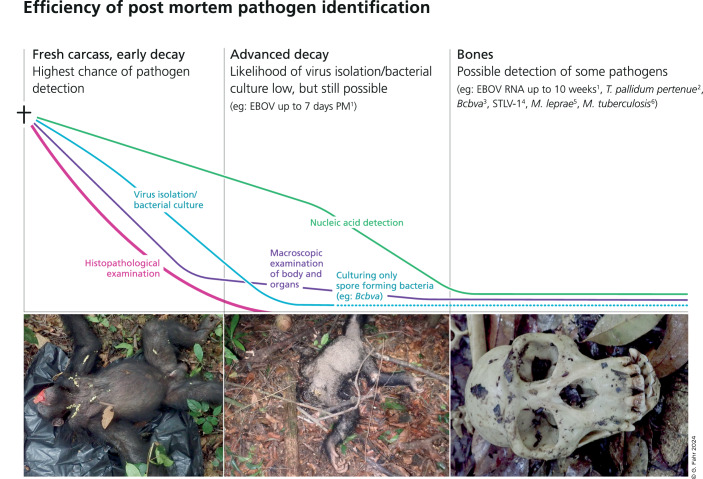
When monitoring wildlife based on animal carcasses, the likelihood of pathogen detection is strongly influenced by decomposition, that is, diagnostic options become increasingly limited and less sensitive as the carcass decomposes. For example, while histopathology requires fresh tissues to evaluate cellular structures, nucleic acids of pathogens might be detected throughout and even after carcass putrefaction and skeletonization. Pathogen culture predominantly necessitates relatively fresh specimens; however, spore-forming bacteria may even be efficiently cultured from bone samples. Initially, a carcass is often mostly intact (left) and without evident signs of decomposition or rigor mortis, but flies can rapidly start laying their eggs even before an animal dies. At this early stage, samples from all organs can still be easily collected. After some time (middle), the carcass becomes bloated, internal organs decompose, and scavengers often begin feeding on it. Maggots (fly larvae) begin to appear and accelerate decomposition, and there is a strong odor. At this stage, it can sometimes still be possible to sample the remaining organs, but pathogens can also be detected in swabs or maggots collected from the carcass. At later stages of decomposition, when only hair and bones remain (right), maggots can sometimes still be present even after the flesh has decomposed and can be collected for testing. Otherwise, bones and bone swabs can be collected. The speed of decomposition is influenced by many environmental factors such as temperature, humidity, scavengers, or arthropods. The likelihood of detecting a pathogen shown in these curves thus represents a rough approximation based on our experience and published data on great apes, including humans, as well as from other animals (see Further Reading).
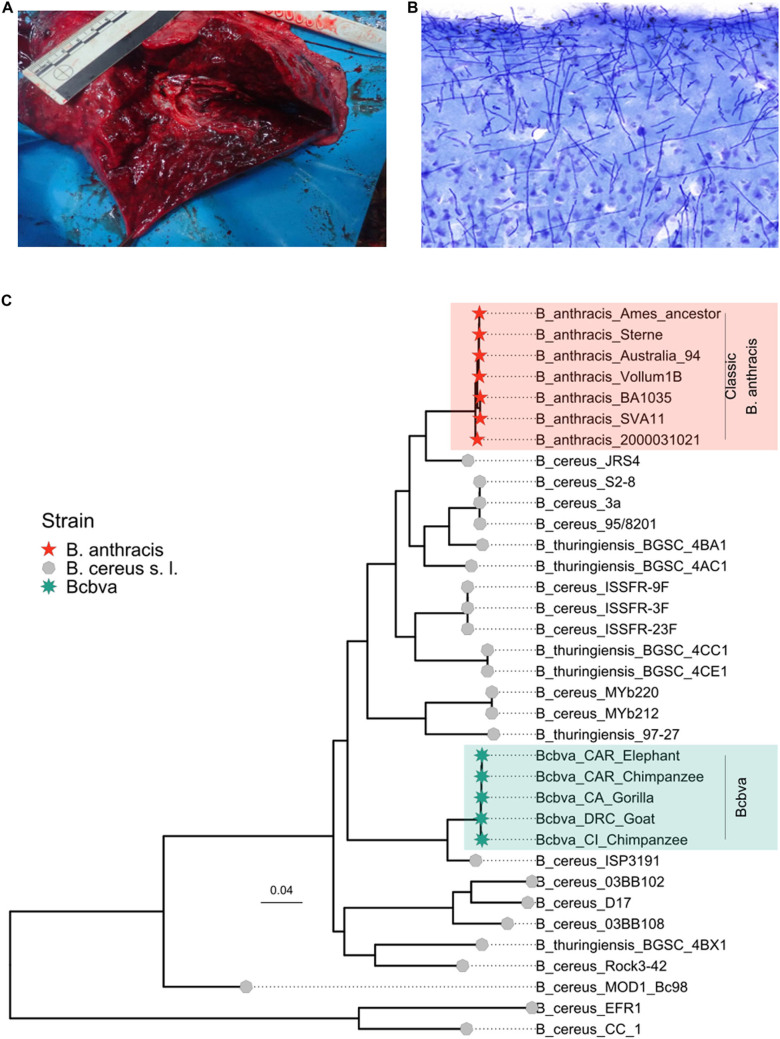
Box 1 (A) Severe hemorrhagic pneumonia in a wild chimpanzee caused by a Bcbva infection. (B) Bcbva invading and multiplying in a chimpanzee brain c) Bcbva ’s distinct phylogenetic placement outside the B. anthracis monophyly. Photo credit: Jenny Jaffe (A) and Carsten Jäger (B). Reproduced with permission.
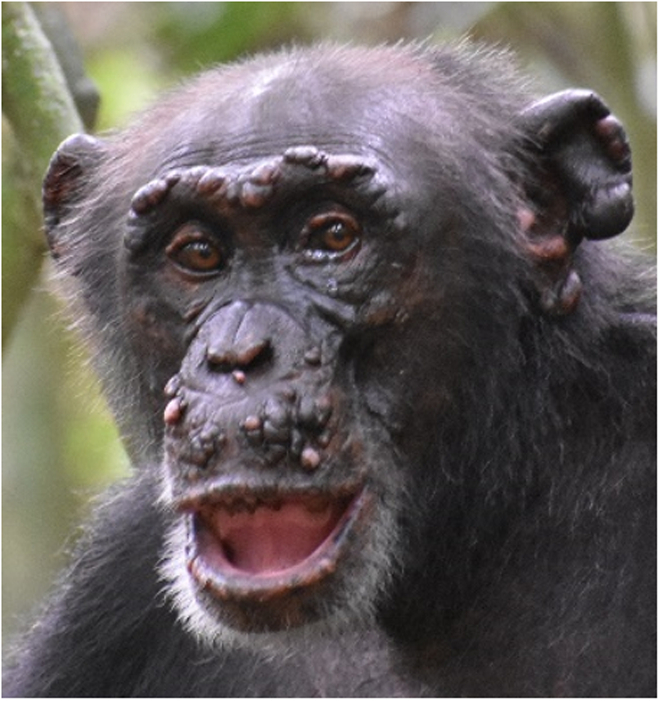
Box 2 Leprosy, with typical skin lesions, in a wild chimpanzee. Photo credit: Taï Chimpanzee Project. Reproduced with permission.
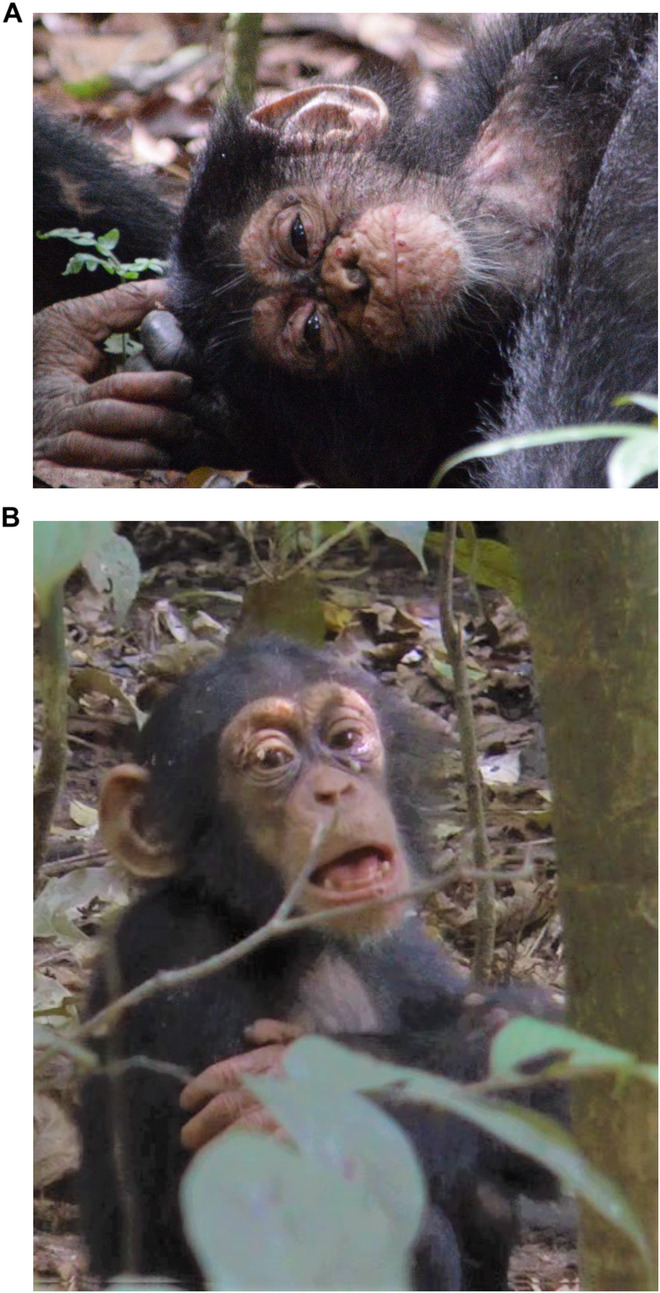
Box 3 (A) Classical Mpox manifestation with lesions on the 6th day after first observed signs of disease in an infant chimpanzee. (B) Predominantly respiratory manifestation: labored breathing in an infant chimpanzee. Photo credit: Taï Chimpanzee Project. Reproduced with permission.
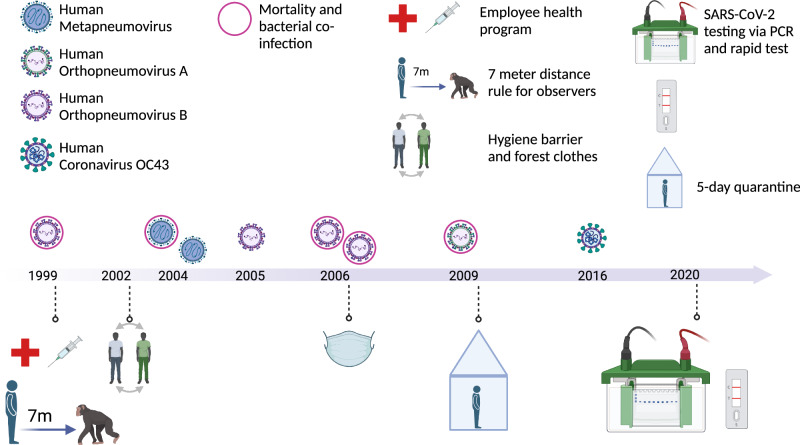
Box 4 Respiratory disease outbreaks in Taï chimpanzees and implementation of hygiene measures for staff and visitors (created with BioRender.com).
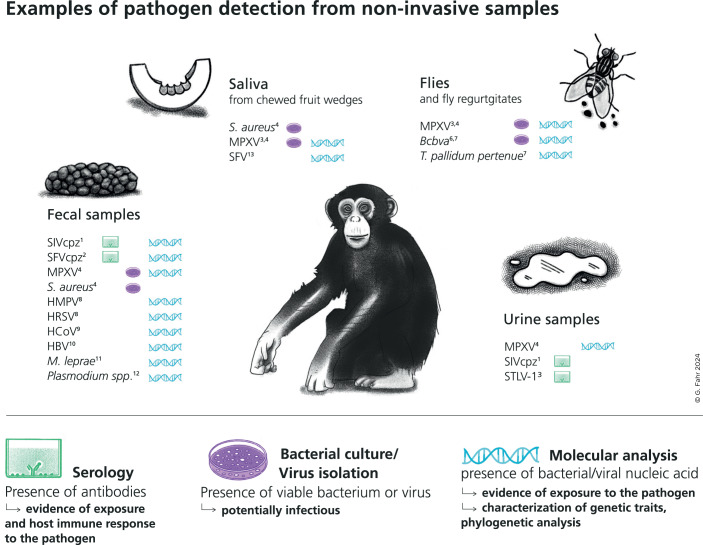
All examples of pathogens shown here were previously detected using noninvasive samples from primates, such as feces, urine, saliva or flies. This evidence has been obtained through serology, bacterial culture/virus isolation and/or molecular analysis, highlighting the potential and versatility of noninvasive samples for both health and biodiversity monitoring. Note that not detecting a pathogen does not necessarily imply its absence, and a large sample size is required to decrease the likelihood of a false negative result. For fecal samples, we included examples of pathogens not initially expected to be present in this sample type: fecally transmitted pathogens shed in feces in high copy numbers are not listed here. Examples presented here are based on unpublished results and published literature (see Further Reading).
References
-
- Ayouba A, Ahuka-Mundeke S, Butel C, Mbala Kingebeni P, Loul S, Tagg N, Villabona-Arenas C-J, Lacroix A, Ndimbo-Kumugo S-P, Keita AK, et al. Extensive serological survey of multiple African nonhuman primate species reveals low prevalence of immunoglobulin G antibodies to 4 Ebola virus species. J Infect Dis. 2019;220:1599–1608. doi: 10.1093/infdis/jiz006. - DOI - PubMed
-
- Boesch C, Wittig R, Crockford C, Vigilant L, Deschner T, Leendertz FH (2019) The chimpanzees of the Taï Forest: 40 years of research. Cambridge University Press, Cambridge, UK
-
- Calvignac-Spencer S, Düx A, Gogarten JF, Leendertz FH, Patrono LV (2021) A great ape perspective on the origins and evolution of human viruses. In: Kielian M, Mettenleiter TC, Roossinck MJ (eds) Advances in virus research. Academic Press: Cambridge, USA, pp 1–26 - PubMed
MeSH terms
Grants and funding
LinkOut - more resources
Full Text Sources
Medical