


Spatiotemporal heterogeneity of LMOD1 expression summarizes two modes of cell communication in colorectal cancer
- PMID: 38849852
- PMCID: PMC11161970
- DOI: 10.1186/s12967-024-05369-3
Spatiotemporal heterogeneity of LMOD1 expression summarizes two modes of cell communication in colorectal cancer
Abstract
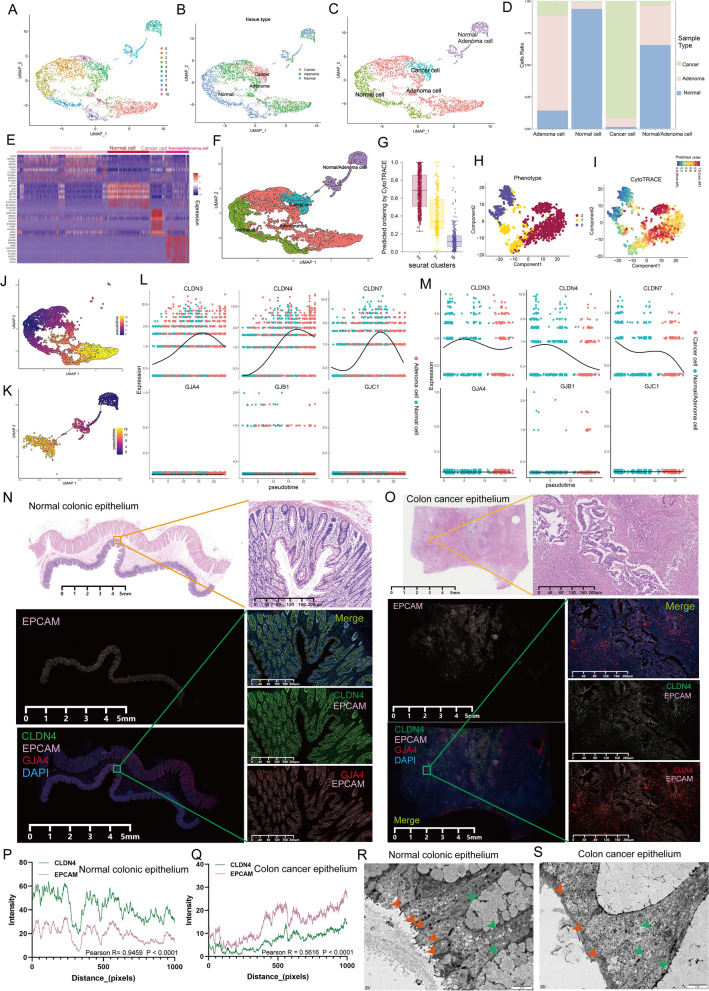
Cellular communication (CC) influences tumor development by mediating intercellular junctions between cells. However, the role and underlying mechanisms of CC in malignant transformation remain unknown. Here, we investigated the spatiotemporal heterogeneity of CC molecular expression during malignant transformation. It was found that although both tight junctions (TJs) and gap junctions (GJs) were involved in maintaining the tumor microenvironment (TME), they exhibited opposite characteristics. Mechanistically, for epithelial cells (parenchymal component), the expression of TJ molecules consistently decreased during normal-cancer transformation and is a potential oncogenic factor. For fibroblasts (mesenchymal component), the expression of GJs consistently increased during normal-cancer transformation and is a potential oncogenic factor. In addition, the molecular profiles of TJs and GJs were used to stratify colorectal cancer (CRC) patients, where subtypes characterized by high GJ levels and low TJ levels exhibited enhanced mesenchymal signals. Importantly, we propose that leiomodin 1 (LMOD1) is biphasic, with features of both TJs and GJs. LMOD1 not only promotes the activation of cancer-associated fibroblasts (CAFs) but also inhibits the Epithelial-mesenchymal transition (EMT) program in cancer cells. In conclusion, these findings demonstrate the molecular heterogeneity of CC and provide new insights into further understanding of TME heterogeneity.
Keywords: Colorectal cancer; Epithelial cells; Fibroblasts; Gap junctions; LMOD1; Tight junctions.
© 2024. The Author(s).
Conflict of interest statement
The authors declare no conflicts of interest. All authors contributed to data analysis, drafting, or revising of the article; agree on the journal to which the article is being submitted; provided final approval of the version to be published; agree to be accountable for all aspects of the work.
Figures



References
MeSH terms
Substances
Grants and funding
- ZDXYS202208/Jiangsu Provincial Medical Key Laboratory
- 82205212/Natural Science Foundation of China
- 82174379/Natural Science Foundation of China
- 035062005002-11/Advantageous Disciplines of Jiangsu Province
- y2021rc19/Jiangsu Province Hospital of Chinese Medicine Peak Academic Talent Project
- ZD2022070/Jiangsu Provincial Health and Medical Committee Key Projects
- Y2020CX62/Science and Technology Program of the Affiliated Hospital of Nanjing University of Traditional Chinese Medicine
- Y2020CX38/Science and Technology Program of the Affiliated Hospital of Nanjing University of Traditional Chinese Medicine
- 20085-9-3/State Administration of Traditional Chinese Medicine Program
- SJCX230886/Jiangsu Provincial Degree Committee and Jiangsu Provincial Department of Education
- SJCX220710/Jiangsu Provincial Degree Committee and Jiangsu Provincial Department of Education
- JD2023SZ04/National Clinical Research Base of Tradiional Chinese Medicine in Jiangsu Province
- JD2023SZ0/National Clinical Research Base of Tradiional Chinese Medicine in Jiangsu Province
- KYCX23-2169/Jiangsu Postgraduate Research Innovation Program
LinkOut - more resources
Full Text Sources
Medical
Molecular Biology Databases
Miscellaneous
