


Behavioral dishonesty in multiscenes: Associations with trait honesty and neural patterns during (dis)honesty video-watching
- PMID: 38853713
- PMCID: PMC11163231
- DOI: 10.1002/hbm.26710
Behavioral dishonesty in multiscenes: Associations with trait honesty and neural patterns during (dis)honesty video-watching
Abstract
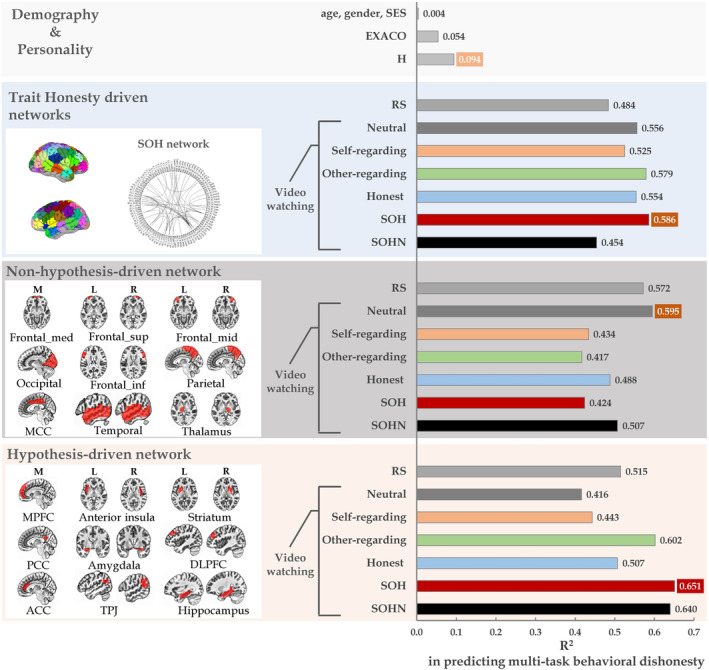
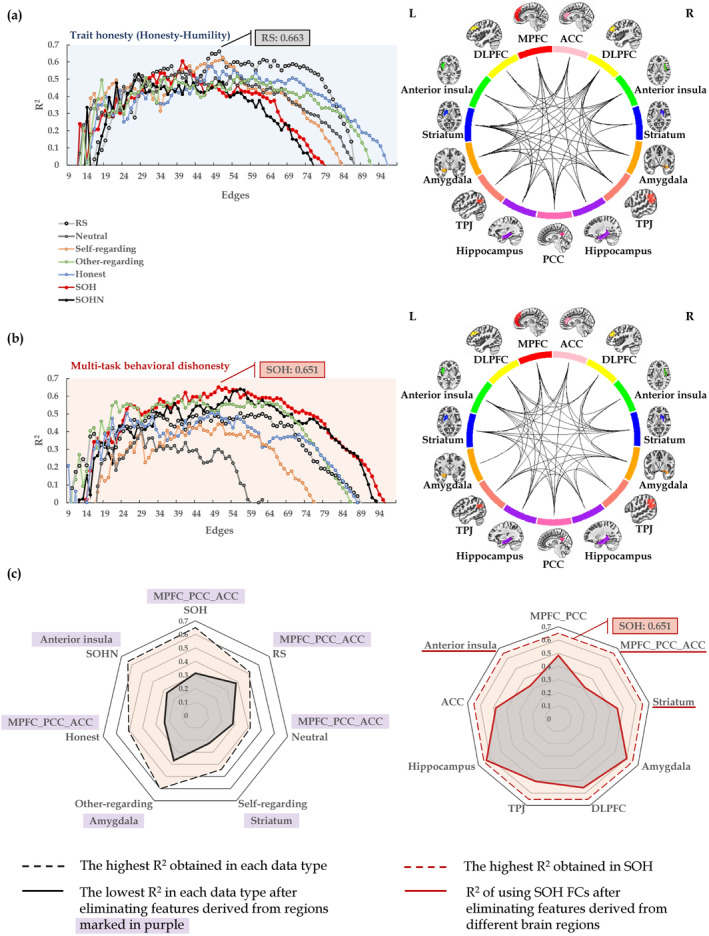
Cross-situational inconsistency is common in the expression of honesty traits; yet, there is insufficient emphasis on behavioral dishonesty across multiple contexts. The current study aimed to investigate behavioral dishonesty in various contexts and reveal the associations between trait honesty, behavioral dishonesty, and neural patterns of observing others behave honestly or dishonestly in videos (abbr.: (dis)honesty video-watching). First, the results revealed limitations in using trait honesty to reflect variations in dishonest behaviors and predict behavioral dishonesty. The finding highlights the importance of considering neural patterns in understanding and predicting dishonest behaviors. Second, by comparing the predictive performance of seven types of data across three neural networks, the results showed that functional connectivity in the hypothesis-driven network during (dis)honesty video-watching provided the highest predictive power in predicting multitask behavioral dishonesty. Last, by applying the feature elimination method, the midline self-referential regions (medial prefrontal cortex, posterior cingulate cortex, and anterior cingulate cortex), anterior insula, and striatum were identified as the most informative brain regions in predicting behavioral dishonesty. In summary, the study offered insights into individual differences in deception and the intricate connections among trait honesty, behavioral dishonesty, and neural patterns during (dis)honesty video-watching.
Keywords: anterior insula; behavioral dishonesty; medial prefrontal cortex; striatum; trait honesty.
© 2024 The Author(s). Human Brain Mapping published by Wiley Periodicals LLC.
Conflict of interest statement
We have no known conflict of interest to disclose.
Figures
References
-
- Allport, G. W. (1937). Personality: A psychological interpretation. American Psychological Association.
-
- Archambeault, D. S. , Webber, S. , & Greenlee, J. (2015). Fraud and corruption in U.S. nonprofit entities:A summary of press reports 2008–2011. Nonprofit and Voluntary Sector Quarterly, 44(6), 1194–1224.
-
- Ashton, M. C. , & Lee, K. (2009). The HEXACO–60: A short measure of the major dimensions of personality. Journal of Personality Assessment, 91(4), 340–345. - PubMed
-
- Ashton, M. C. , Lee, K. , & de Vries, R. E. (2014). The HEXACO honesty‐humility, agreeableness, and emotionality factors. Personality and Social Psychology Review, 18, 139–152. - PubMed
-
- Burger, J. M. (2014). Personality. Cengage Learning.
MeSH terms
Grants and funding
LinkOut - more resources
Full Text Sources
Medical
