


This is a preprint.
Reduced temporal and spatial stability of neural activity patterns predict cognitive control deficits in children with ADHD
- PMID: 38854066
- PMCID: PMC11160739
- DOI: 10.1101/2024.05.29.596493
Reduced temporal and spatial stability of neural activity patterns predict cognitive control deficits in children with ADHD
Update in
-
Reduced temporal and spatial stability of neural activity patterns predict cognitive control deficits in children with ADHD.Nat Commun. 2025 Mar 8;16(1):2346. doi: 10.1038/s41467-025-57685-x. Nat Commun. 2025. PMID: 40057478 Free PMC article.
Abstract
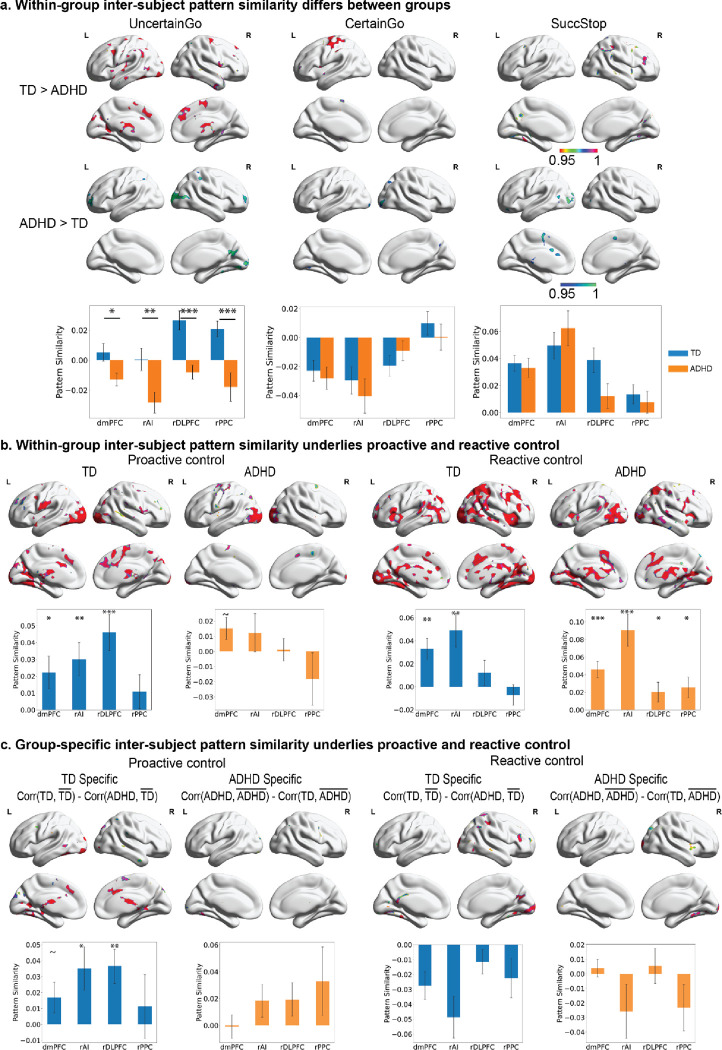
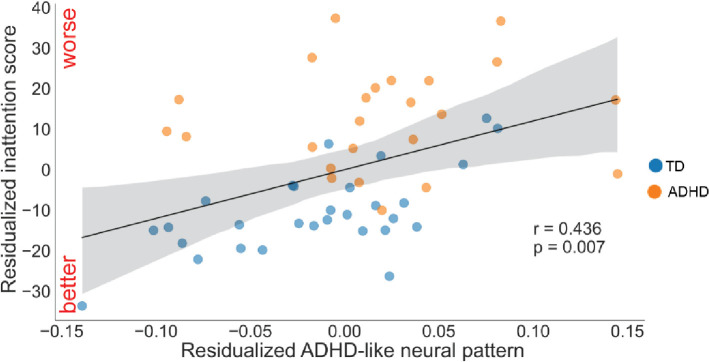
This study explores the neural underpinnings of cognitive control deficits in ADHD, focusing on overlooked aspects of trial-level variability of neural coding. We employed a novel computational approach to neural decoding on a single-trial basis alongside a cued stop-signal task which allowed us to distinctly probe both proactive and reactive cognitive control. Typically developing (TD) children exhibited stable neural response patterns for efficient proactive and reactive dual control mechanisms. However, neural coding was compromised in children with ADHD. Children with ADHD showed increased temporal variability and diminished spatial stability in neural responses in salience and frontal-parietal network regions, indicating disrupted neural coding during both proactive and reactive control. Moreover, this variability correlated with fluctuating task performance and with more severe symptoms of ADHD. These findings underscore the significance of modeling single-trial variability and representational similarity in understanding distinct components of cognitive control in ADHD, highlighting new perspectives on neurocognitive dysfunction in psychiatric disorders.
Keywords: ADHD; proactive control; reactive control; representational similarity analysis; stability; variability.
Conflict of interest statement
Competing financial interests The authors declare no competing financial interests.
Figures
References
-
- Polanczyk G., De Lima M. S., Horta B. L., Biederman J. & Rohde L. A. The worldwide prevalence of ADHD: a systematic review and metaregression analysis. American journal of psychiatry 164, 942–948 (2007). - PubMed
-
- Barkley R. A. Behavioral inhibition, sustained attention, and executive functions: constructing a unifying theory of ADHD. Psychological bulletin 121, 65 (1997). - PubMed
-
- Castellanos F. X. & Tannock R. Neuroscience of attention-deficit/hyperactivity disorder: the search for endophenotypes. Nature Reviews Neuroscience 3, 617–628 (2002). - PubMed
-
- Lijffijt M., Kenemans J. L., Verbaten M. N. & van Engeland H. A meta-analytic review of stopping performance in attention-deficit/hyperactivity disorder: deficient inhibitory motor control? Journal of abnormal psychology 114, 216 (2005). - PubMed
Publication types
Grants and funding
LinkOut - more resources
Full Text Sources
