


Knowledge, attitude, and practice toward ultrasound screening for breast cancer among women
- PMID: 38855455
- PMCID: PMC11160319
- DOI: 10.3389/fpubh.2024.1309797
Knowledge, attitude, and practice toward ultrasound screening for breast cancer among women
Abstract
Background: Several obstacles can hinder breast cancer screening. This study aimed to investigate the knowledge, attitude, and practice (KAP) toward ultrasound screening for breast cancer in women.
Methods: This cross-sectional study recruited women who visited the breast specialist clinic of Zhongshan City People's Hospital (a tertiary hospital) between August 2022 and April 2023 through convenience sampling. KAP scores ≥70% were considered adequate.
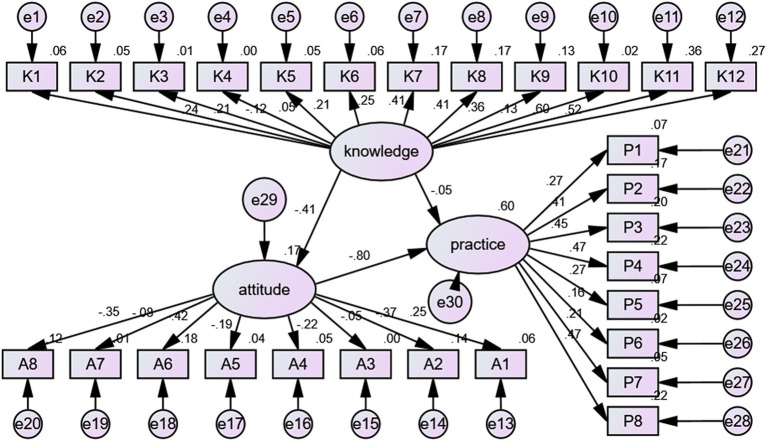
Results: This study enrolled 501 participants. The mean knowledge, attitude, and practice levels were 8.56 ± 1.81/12 (possible range 0-12, 71.33%), 29.80 ± 2.71 (possible range 8-40, 74.50%), and 32.04 ± 3.09 (possible range 8-40, 80.10%). Senior high school education (vs. junior high school and below, coefficient = 1.531, 95%CI: 1.013-2.312, p = 0.044), bachelor's education and above (vs. junior high school and below, coefficient = 5.315, 95%CI: 3.546-7.966, p < 0.001), housewife or unemployed (vs. employed, coefficient = 0.671, 95%CI: 0.466-0.966, p = 0.032), and a history of breast ultrasound (vs. no, coefficient = 1.466, 95%CI: 1.121-1.917, p = 0.005) were independently and positively associated with knowledge. Knowledge (coefficient = 1.303, 95%CI: 1.100-1.544, p = 0.002) and monthly income >10,000 (vs. <5,000, coefficient = 4.364, 95%CI: 1.738-10.956, p = 0.002) were independently and positively associated with attitude. Only attitude (coefficient = 1.212, 95%CI: 1.096-1.340, p < 0.001) was independently and positively associated with the practice. A structural equation modeling (SEM) analysis was used to estimate causality among KAP dimensions, showing that knowledge directly influenced attitude (β = -1.090, p = 0.015), knowledge did not directly influence practice (β = -0.117, p = 0.681) but had an indirect influence (β = 0.826, p = 0.028), and attitude directly influenced practice (β = -0.757, p = 0.016).
Conclusion: Women in Zhongshan City had good knowledge, favorable attitudes, and active practice toward breast ultrasound screening for breast cancer. Women's characteristics associated with a poorer KAP were identified, allowing for more targeted interventions.
Keywords: attitude; breast cancer; cross-sectional study; knowledge; practice; screening; ultrasound.
Copyright © 2024 Liu, Zheng, Qin, Xie, Yang and Liu.
Conflict of interest statement
The authors declare that the research was conducted in the absence of any commercial or financial relationships that could be construed as a potential conflict of interest.
Figures
References
-
- NCCN Clinical Practice Guidelines in Oncology (NCCN Guidelines) . Breast Cancer. Version 4.2023. Fort Washington: National Comprehensive Cancer Network; (2023).
-
- NCCN Clinical Practice Guidelines in Oncology (NCCN Guidelines) . Breast Cancer risk reduction. Version 1.2023. Fort Washington: National Comprehensive Cancer Network; (2022).
-
- NCCN Clinical Practice Guidelines in Oncology (NCCN Guidelines) . Breast Cancer screening and diagnosis. Version 1.2022. Fort Washington: National Comprehensive Cancer Network; (2022).
MeSH terms
LinkOut - more resources
Full Text Sources
Medical
Miscellaneous
