


Association between triglyceride-glucose index and chronic kidney disease: results from NHANES 1999-2020
- PMID: 38856937
- PMCID: PMC11464617
- DOI: 10.1007/s11255-024-04103-8
Association between triglyceride-glucose index and chronic kidney disease: results from NHANES 1999-2020
Abstract
Aims: Examining the connection between the triglyceride-glucose (TyG) index and chronic kidney disease (CKD) was the aim of this investigation.
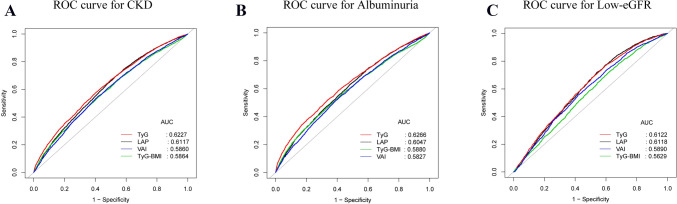
Methods: Data from the National Health and Nutrition Examination Survey (NHANES) covering the years 1999-2020 were analyzed in this study. The TyG index was calculated as Ln (triglycerides (mg/dl) * fasting glucose (mg/dl)/2). The two criteria used to diagnose CKD were low estimated glomerular filtration rate (eGFR) (eGFR < 60 mL/min/1.73m2) or albuminuria (urine albumin-to-creatinine ratio (ACR) ≥ 30 mg/g). To look into the independent associations between TyG index levels with CKD, albuminuria, and low-eGFR, weighted multivariable logistic regression and generalized additive models were employed. To assess and contrast the diagnostic ability, receiver operating characteristic (ROC) curves were employed.
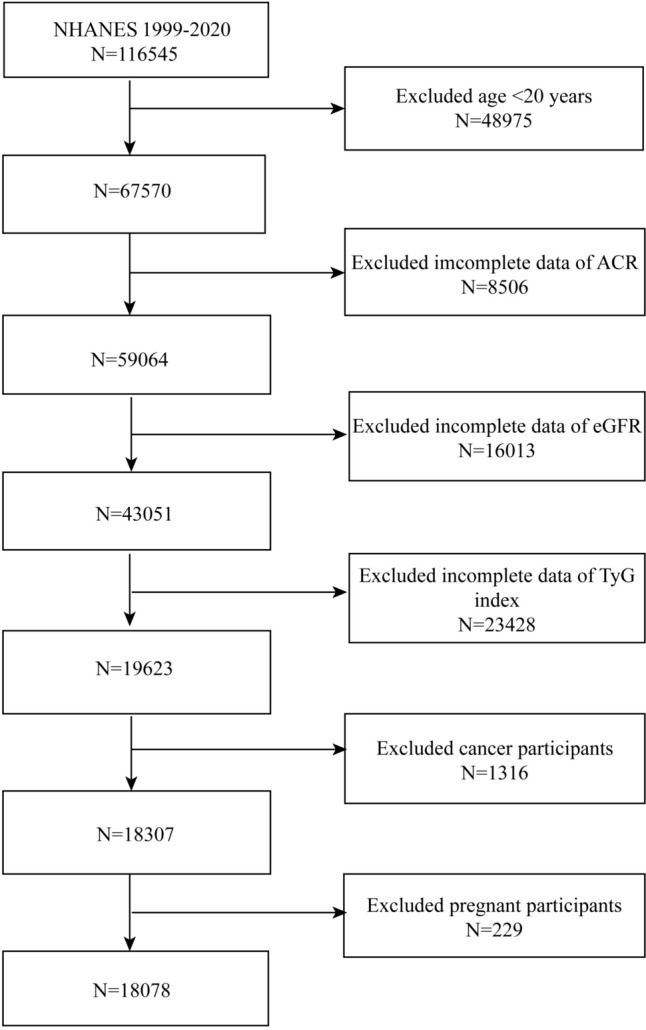
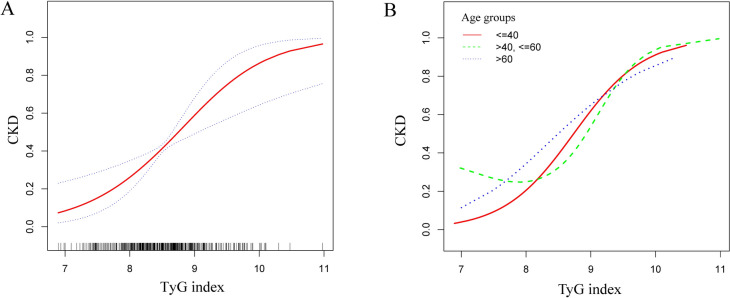
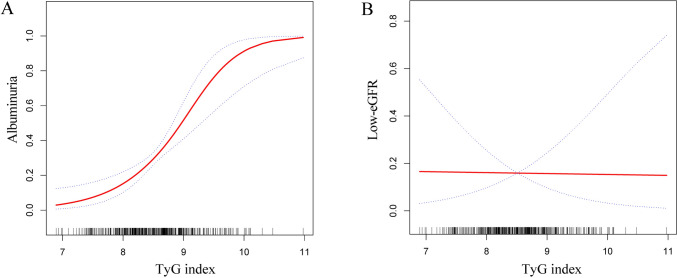
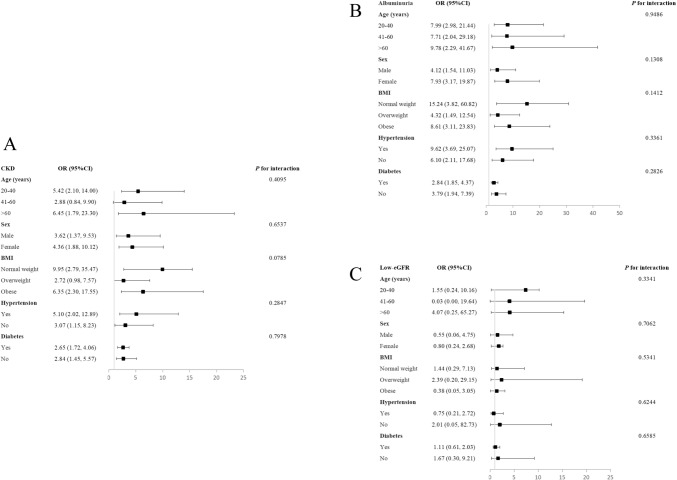
Results: Out of 18,078 total participants recruited, 48.54% were male. 8.48 + 0.68 was the mean value of the TyG index. CKD, albuminuria, and low-eGFR were common, with respective prevalences of 17.06%, 11.26%, and 8.03%, respectively. The TyG index and CKD were observed to positively correlate (OR = 4.03; 95% CI 1.81, 8.96). In US adults between the ages of 41 and 60, a J-shaped connection was found between the two. Furthermore, a higher TyG index is associated with a higher prevalence of albuminuria (OR = 6.11; 95% CI 2.64, 14.14). Subgroup analyses and interaction tests revealed that different stratifications did not significantly affect the relationship between TyG index and CKD, albuminuria, and low-eGFR. Comparing the TyG index to other indicators [lipid accumulation product (LAP), Visceral adiposity index (VAI), and the triglyceride glucose-body mass index (TyG-BMI)], it may be more accurate and discriminative in predicting CKD and albuminuria.
Conclusion: When predicting CKD and albuminuria, the TyG index may be a more useful marker when compared to other markers (LAP, VAI, and TyG-BMI index). In addition, in American adults aged 41-60, the TyG index shows a J-shaped relationship with CKD. As a result, when assessing the kidney health of US adults, we must pay close attention to the significance of the TyG index.
Keywords: Albuminuria; Chronic kidney disease; Cross-sectional study; Estimated-glomerular filtration rate; Triglyceride-glucose index.
© 2024. The Author(s).
Conflict of interest statement
The authors declare that the research was conducted in the absence of any commercial or financial relationships that could be construed as a potential conflict of interest.
Figures
References
-
- Foreman KJ, Marquez N, Dolgert A, Fukutaki K, Fullman N, McGaughey M et al (2018) Forecasting life expectancy, years of life lost, and all-cause and cause-specific mortality for 250 causes of death: reference and alternative scenarios for 2016–40 for 195 countries and territories. Lancet 392:2052–2090. 10.1016/S0140-6736(18)31694-5 - DOI - PMC - PubMed
MeSH terms
Substances
LinkOut - more resources
Full Text Sources
Medical
Research Materials
Miscellaneous
