


In search of the best method to detect carriage of carbapenem-resistant Pseudomonas aeruginosa in humans: a systematic review
- PMID: 38858708
- PMCID: PMC11163693
- DOI: 10.1186/s12941-024-00707-1
In search of the best method to detect carriage of carbapenem-resistant Pseudomonas aeruginosa in humans: a systematic review
Abstract
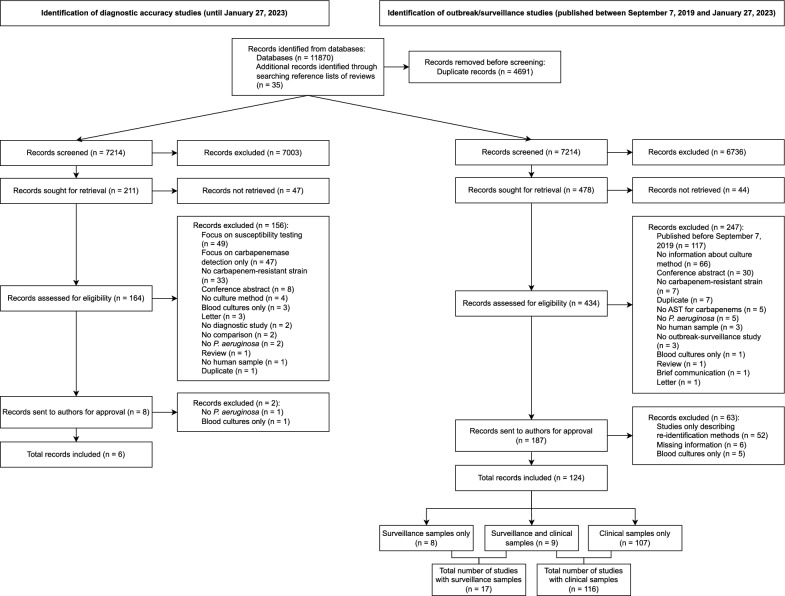
Background: Detection of carbapenem-resistant Pseudomonas aeruginosa (CR-PA) in humans is important to prevent transmission. However, the most optimal culture method to detect CR-PA is unknown. This systematic review aims to determine which culture method is most sensitive and which culture methods are used to detect CR-PA in humans. Second, to establish the most feasible culture method taking into account the turnaround time (TAT), and third, to provide an overview of the sampling sites used to detect carriage.
Methods: We systematically searched the electronic databases Embase, Medline Ovid, Cochrane, Scopus, CINAHL, and Web of Science until January 27, 2023. All diagnostic accuracy studies comparing two or more culture methods to detect CR-PA and recent outbreak or surveillance reports on CR-PA carriage or infection in humans, which describe culture methods and their results, were eligible for inclusion. We used QUADAS-2 guideline for diagnostic accuracy studies and the STROBE or ORION guideline for outbreak-surveillance studies to assess the risk of bias.
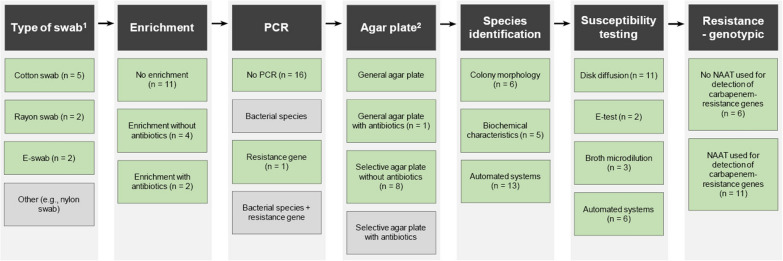
Results: Six diagnostic accuracy studies were included. An enrichment broth was found to increase the detection of CR-PA. Using an enrichment broth extended the TAT by 18-24 h, yet selective media could reduce the TAT by 24 h compared to routine media. In total, 124 outbreak-surveillance studies were included, of which 17 studies with surveillance samples and 116 studies with clinical samples. In outbreak-surveillance studies with surveillance samples, perianal, rectal swabs or stools were the most common sampling site/specimen (13/17, 76%). A large variety was observed in whether and which kind of enrichment broth and selective media were used.
Conclusions: We found a benefit of using an enrichment step prior to inoculation of the material onto selective media for the detection of CR-PA. More research is needed to determine the most sensitive sampling site and culture method.
Trail registration: This study was registered in the PROSPERO International prospective register of systematic reviews (registration number: CRD42020207390, http://www.crd.york.ac.uk/PROSPERO/display_record.asp?ID=CRD42020207390 ).
Keywords: Pseudomonas aeruginosa; Bacterial drug resistance; Carbapenem; Contact screening; Culture media.
© 2024. The Author(s).
Conflict of interest statement
JAS was involved in a collaborative project on whole-genome sequencing of
Figures
References
-
- Quartin AA, Scerpella EG, Puttagunta S, Kett DH. A comparison of microbiology and demographics among patients with healthcare-associated, hospital-acquired, and ventilator-associated pneumonia: a retrospective analysis of 1184 patients from a large, international study. BMC Infect Dis. 2013;13:561. doi: 10.1186/1471-2334-13-561. - DOI - PMC - PubMed
-
- Saharman YR, Pelegrin AC, Karuniawati A, Sedono R, Aditianingsih D, Goessens WHF, et al. Epidemiology and characterisation of carbapenem-non-susceptible Pseudomonas aeruginosa in a large intensive care unit in Jakarta, Indonesia. Int J Antimicrob Agents. 2019;54(5):655–660. doi: 10.1016/j.ijantimicag.2019.08.003. - DOI - PubMed
Publication types
MeSH terms
Substances
Grants and funding
LinkOut - more resources
Full Text Sources
