


Hepatitis E Virus RNA Detection in Liver and Muscle Tissues Sampled from Home Slaughtered Domestic Pigs in Central Italy
- PMID: 38862750
- PMCID: PMC11525307
- DOI: 10.1007/s12560-024-09606-2
Hepatitis E Virus RNA Detection in Liver and Muscle Tissues Sampled from Home Slaughtered Domestic Pigs in Central Italy
Abstract
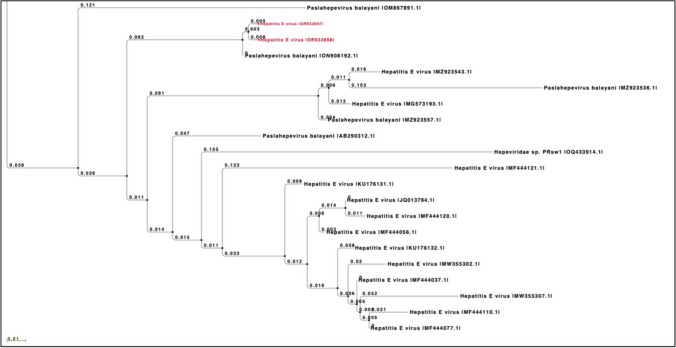
Hepatitis E virus is a worldwide emerging foodborne pathogen; raw or undercooked meats and liver pork products can cause infection through the orofecal route. In Central-Southern Italy, small traditional farming method, associated with the possibility of environmental sharing with wild species, can facilitate HEV diffusion and persistence. The aim of this study was to determine HEV genotype and subtype in Marche region from home slaughtered domestic pigs involved in small and traditional food chains. A total of 236 liver and muscle tissues and 6 pooled salami samples were screened. Laboratory workflow started with homogenization, followed by RNA extraction. Nested reverse transcription PCR and qRT-PCR were used to amplify specific parts of overlapping open reading frames belonging to the HEV genome. A total of 42/236 (17.79%) liver and 8/236 (3.39%) diaphragm specimens were positive; none of the pooled salami specimens showed positive HEV signal. The discovered HEV3c presented high nucleotide similarities with ones amplified from wild boar populations hunted in the same province. Extensive farming methods and environmental sharing with wild animal species support cross-infection infections, as observed in the present study. Although salami resulted negative for HEV RNA detection, the effects of food technologies on viral loads remain unclear. Therefore, further scientific investigations coupled with efficacious standardized laboratory procedures will be the next challenge.
Keywords: Environmental sharing; Food safety; Hepatitis E virus; Liver and muscle; Molecular biology; One-health.
© 2024. The Author(s).
Conflict of interest statement
The authors declare that they have no competing interests.
Figures

References
-
- Ahmed, R., & Nasheri, N. (2023). Animal reservoirs for hepatitis E virus within the Paslahepevirus genus. Veterinary Microbiology,278, 109618. 10.1016/j.vetmic.2022.109618 - PubMed
-
- Aprea, G., Amoroso, M. G., Di Bartolo, I., D’Alessio, N., Di Sabatino, D., Boni, A., Cioffi, B., D’Angelantonio, D., Scattolini, S., De Sabato, L., Cotturone, G., Pomilio, F., Migliorati, G., Galiero, G., & Fusco, G. (2018). Molecular detection and phylogenetic analysis of hepatitis E virus strains circulating in wild boars in south-central Italy. Transboundary and Emerging Diseases,65(1), e25–e31. 10.1111/tbed.12661 - PubMed
-
- Arnaboldi, S., Righi, F., Carta, V., Bonardi, S., Pavoni, E., Bianchi, A., Losio, M. N., & Filipello, V. (2021). Hepatitis E virus (HEV) spread and genetic diversity in game animals in Northern Italy. Food and Environmental Virology,13(2), 146–153. 10.1007/s12560-021-09467-z - PubMed
-
- Aspinall, E. J., Couturier, E., Faber, M., Said, B., Ijaz, S., Tavoschi, L., Takkinen, J., Adlhoch, C., & Experts, T. C. (2017). Hepatitis E virus infection in Europe: surveillance and descriptive epidemiology of confirmed cases, 2005 to 2015. Euro Surveillance,22(26), 30561. 10.2807/1560-7917.ES.2017.22.26.30561 - PMC - PubMed
MeSH terms
Substances
LinkOut - more resources
Full Text Sources
