


Relationship between the magnitude of haemoglobin changes and long-term mortality in patients with sepsis: a retrospective cohort study
- PMID: 38862875
- PMCID: PMC11167884
- DOI: 10.1186/s12879-024-09476-w
Relationship between the magnitude of haemoglobin changes and long-term mortality in patients with sepsis: a retrospective cohort study
Abstract
Background: Sepsis is a common and severe disease with a high mortality rate in intensive care unit (ICU). The hemoglobin (HGB) level is a key parameter for oxygen supply in sepsis. Although HGB is associated with the progression of inflammation in sepsis patients, its role as a marker following sepsis treatment remains unclear. Here, we studied the correlation between early temporal changes in HGB levels and long-term mortality rates in septic patients.
Method: In this retrospective study of data on patients with sepsis from the Medical Information Mart for Intensive Care (MIMIC) IV database, the outcome was long-term mortality. Patients were divided based on the cut-off of the HGB percentage for receiver operating characteristic (ROC) curve calculation. Kaplan-Meier (KM) survival curves and Cox proportional hazards regression models were used to analyse the associations between groups and outcomes. Propensity score matching (PSM) was used to verify the results.
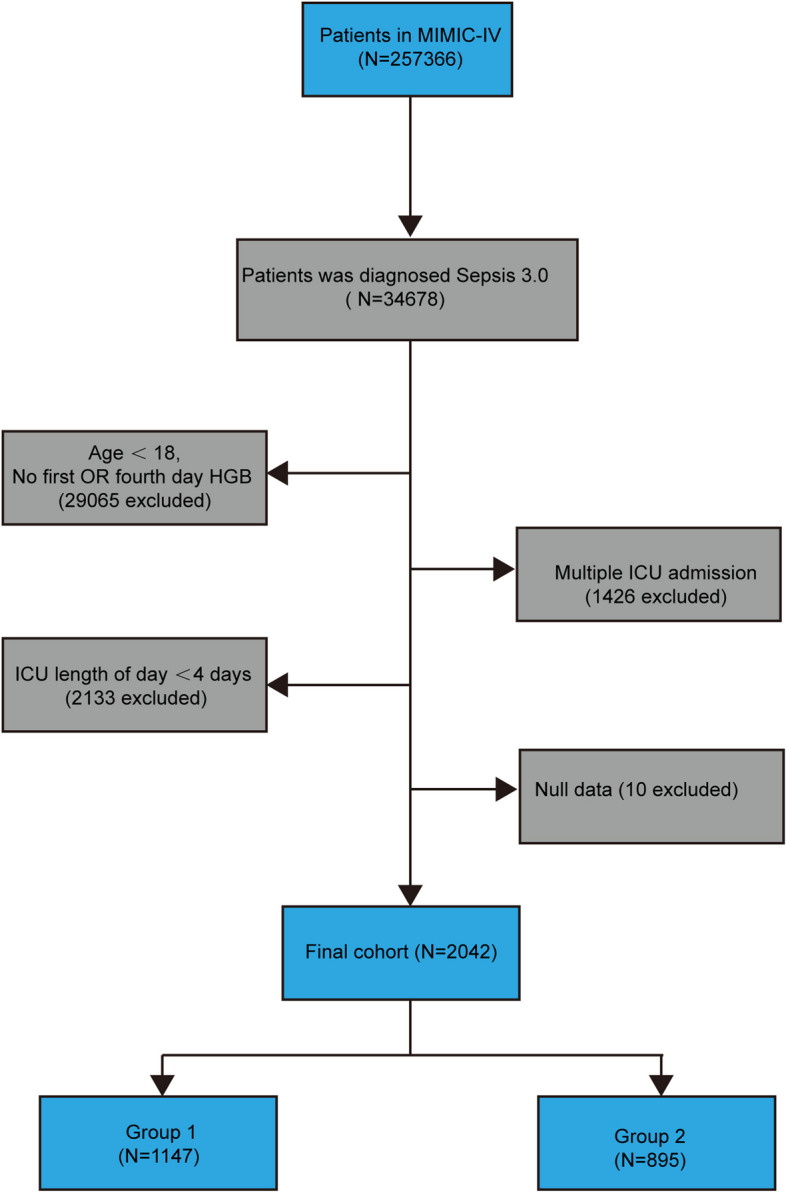
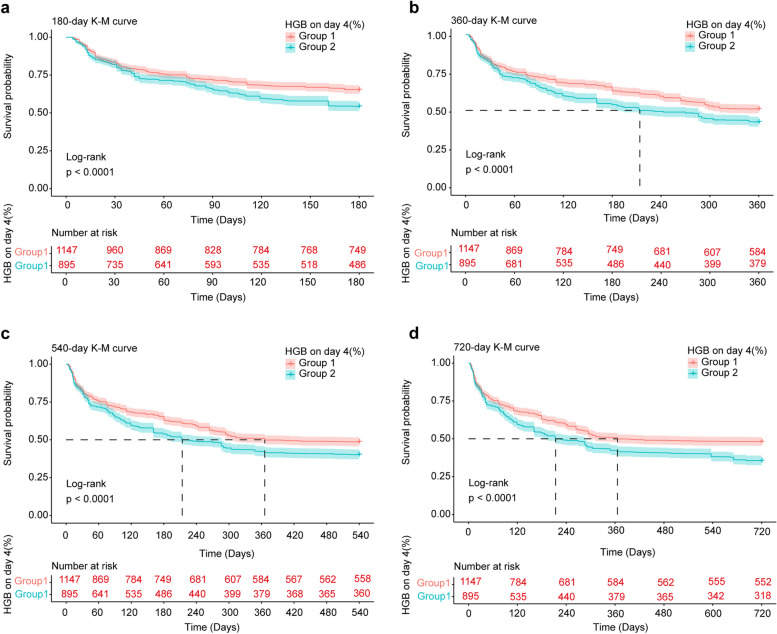
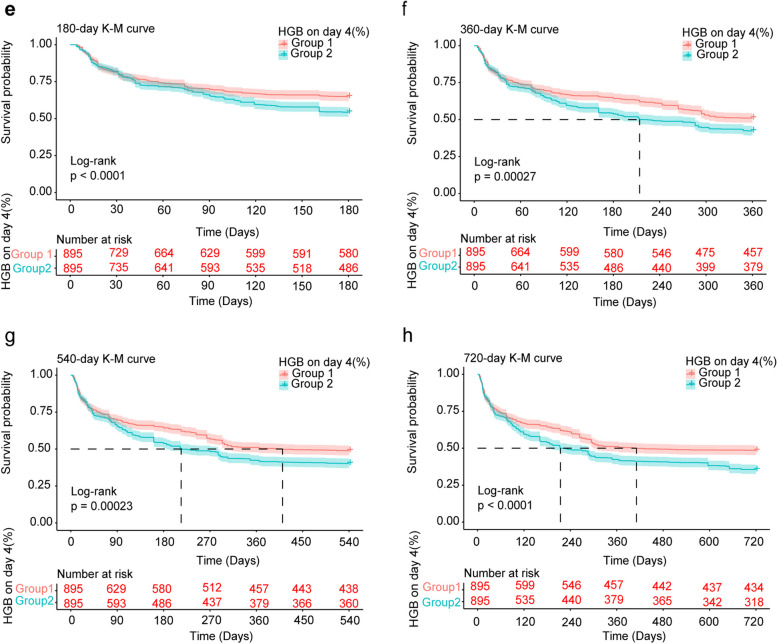
Results: In this study, 2042 patients with sepsis and changes in HGB levels at day 4 after admission compared to day 1 were enrolled and divided into two groups: group 1 (n = 1147) for those with reduction of HGB < 7% and group 2 (n = 895) for those with dropping ≥ 7%. The long-term survival chances of sepsis with less than a 7% reduction in the proportion of HGB at day four were significantly higher than those of patients in the group with a reduction of 7% or more. After adjusting for covariates in the Cox model, the hazard ratios (HRs) with 95% confidence intervals (CIs) for long-term all-cause mortality in the group with a reduction of 7% or more were as follows: 180 days [HR = 1.41, 95% CI (1.22 to 1.63), P < 0.001]; 360 days [HR = 1.37, 95% CI (1.21 to 1.56), P < 0.001]; 540 days [HR = 1.35, 95% CI (1.20 to 1.53), P < 0.001]; 720 days [HR = 1.45, 95% CI (1.29 to 1.64), P < 0.001]. Additionally, the long-term survival rates, using Kaplan-Meier analysis, for the group with a reduction of 7% or more were lower compared to the group with less than 7% reduction at 180 days (54.3% vs. 65.3%, P < 0.001), 360 days (42.3% vs. 50.9%, P < 0.001), 540 days (40.2% vs. 48.6%, P < 0.001), and 720 days (35.5% vs. 46.1%, P < 0.001). The same trend was obtained after using PSM.
Conclusion: A ≥ 7% decrease in HGB levels on Day 4 after admission was associated with worse long-term prognosis in sepsis patients admitted to the ICU.
Keywords: HGB; Long-term; MIMIC-IV database; Propensity score matching; Sepsis.
© 2024. The Author(s).
Conflict of interest statement
The authors declare that they have no competing interests.
Figures
References
-
- Rudd KE, Johnson SC, Agesa KM, Shackelford KA, Tsoi D, Kievlan DR, Colombara DV, Ikuta KS, Kissoon N, Finfer S, et al. Global, regional, and national sepsis incidence and mortality, 1990–2017: analysis for the Global Burden of Disease Study. Lancet. 2020;395(10219):200–211. doi: 10.1016/S0140-6736(19)32989-7. - DOI - PMC - PubMed
-
- Fleischmann C, Scherag A, Adhikari NK, Hartog CS, Tsaganos T, Schlattmann P, Angus DC, Reinhart K. Assessment of global incidence and mortality of hospital-treated sepsis. Current estimates and limitations. Am J Respir Crit Care Med. 2016;193(3):259–272. doi: 10.1164/rccm.201504-0781OC. - DOI - PubMed
MeSH terms
Substances
Grants and funding
LinkOut - more resources
Full Text Sources
Medical
Miscellaneous
