Revolutionizing GPCR-ligand predictions: DeepGPCR with experimental validation for high-precision drug discovery
- PMID: 38864340
- PMCID: PMC11167311
- DOI: 10.1093/bib/bbae281
Revolutionizing GPCR-ligand predictions: DeepGPCR with experimental validation for high-precision drug discovery
Erratum in
-
Correction to: Revolutionizing GPCR-ligand predictions: DeepGPCR with experimental validation for high-precision drug discovery.Brief Bioinform. 2024 Jul 25;25(5):bbae427. doi: 10.1093/bib/bbae427. Brief Bioinform. 2024. PMID: 39147393 Free PMC article. No abstract available.
Abstract
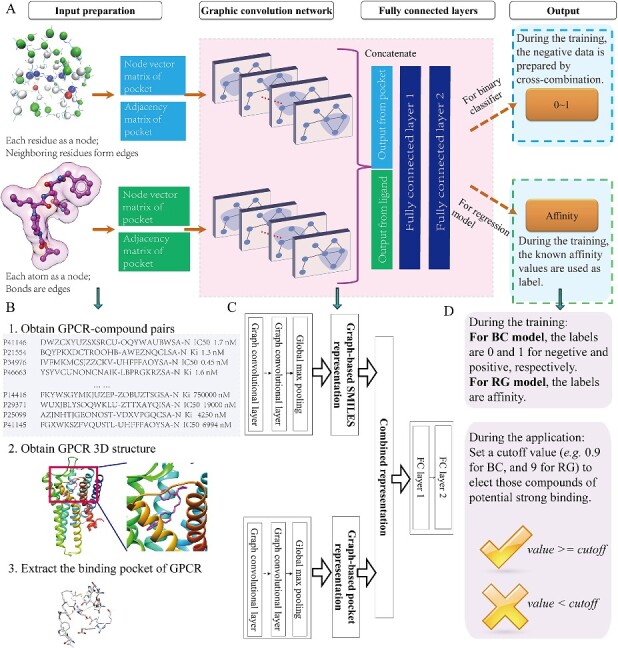
G-protein coupled receptors (GPCRs), crucial in various diseases, are targeted of over 40% of approved drugs. However, the reliable acquisition of experimental GPCRs structures is hindered by their lipid-embedded conformations. Traditional protein-ligand interaction models falter in GPCR-drug interactions, caused by limited and low-quality structures. Generalized models, trained on soluble protein-ligand pairs, are also inadequate. To address these issues, we developed two models, DeepGPCR_BC for binary classification and DeepGPCR_RG for affinity prediction. These models use non-structural GPCR-ligand interaction data, leveraging graph convolutional networks and mol2vec techniques to represent binding pockets and ligands as graphs. This approach significantly speeds up predictions while preserving critical physical-chemical and spatial information. In independent tests, DeepGPCR_BC surpassed Autodock Vina and Schrödinger Dock with an area under the curve of 0.72, accuracy of 0.68 and true positive rate of 0.73, whereas DeepGPCR_RG demonstrated a Pearson correlation of 0.39 and root mean squared error of 1.34. We applied these models to screen drug candidates for GPR35 (Q9HC97), yielding promising results with three (F545-1970, K297-0698, S948-0241) out of eight candidates. Furthermore, we also successfully obtained six active inhibitors for GLP-1R. Our GPCR-specific models pave the way for efficient and accurate large-scale virtual screening, potentially revolutionizing drug discovery in the GPCR field.
Keywords: GLP-1R; GPCR; GPR35; drug screening; graph convolutional network.
© The Author(s) 2024. Published by Oxford University Press.
Figures