. 2024 Jul;23(7):100799.
doi: 10.1016/j.mcpro.2024.100799. Epub 2024 Jun 11.

Improved Mass Spectrometry-Based Methods Reveal Abundant Propionylation and Tissue-Specific Histone Propionylation Profiles

Affiliations

Improved Mass Spectrometry-Based Methods Reveal Abundant Propionylation and Tissue-Specific Histone Propionylation Profiles

Alessandro Vai et al. Mol Cell Proteomics. 2024 Jul.

Abstract

Histone posttranslational modifications (PTMs) have crucial roles in a multitude of cellular processes, and their aberrant levels have been linked with numerous diseases, including cancer. Although histone PTM investigations have focused so far on methylations and acetylations, alternative long-chain acylations emerged as new dimension, as they are linked to cellular metabolic states and affect gene expression through mechanisms distinct from those regulated by acetylation. Mass spectrometry is the most powerful, comprehensive, and unbiased method to study histone PTMs. However, typical mass spectrometry-based protocols for histone PTM analysis do not allow the identification of naturally occurring propionylation and butyrylation. Here, we present improved state-of-the-art sample preparation and analysis protocols to quantitate these classes of modifications. After testing different derivatization methods coupled to protease digestion, we profiled common histone PTMs and histone acylations in seven mouse tissues and human normal and tumor breast clinical samples, obtaining a map of propionylations and butyrylations found in different tissue contexts. A quantitative histone PTM analysis also revealed a contribution of histone acylations in discriminating different tissues, also upon perturbation with antibiotics, and breast cancer samples from the normal counterpart. Our results show that profiling only classical modifications is limiting and highlight the importance of using sample preparation methods that allow the analysis of the widest possible spectrum of histone modifications, paving the way for deeper insights into their functional significance in cellular processes and disease states.

Keywords: epigenetics; histone acylations; histone butyrylation; histone post-translational modifications; histone propionylation.


Conflict of interest statement

Conflicts of interest A. V. and M. C. are PhD students within the European School of Molecular Medicine (SEMM). The other authors declare no competing interests.

Figures

None
Graphical abstract
Fig. 1
Fig. 1
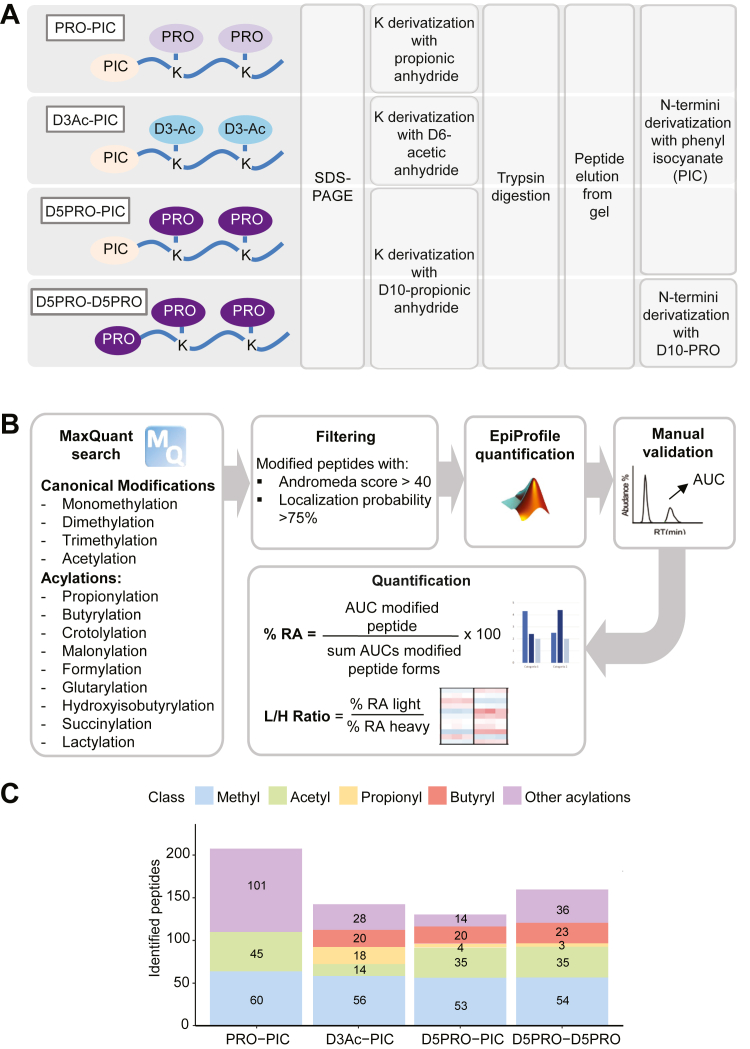
Comparison of in-gel derivatization methods for MS-based analysis of histone acylations. Schematic representation of the in-gel derivatization protocols (A) and the data analysis workflow (B) used in this study. C, bar charts depicting the number of differentially modified peptides identified using the different histone digestion protocols. The methyl-category contains monomethylation/dimethylation/trimethylation. Other acylations are as follow: formylation, crotonylation, succinylation, malonylation, hydroxyisobutyrylation,glutarylation, and lactylation. MS, mass spectrometry.
Fig. 2
Fig. 2
Propionylations and butyrylation profiling of mouse and human tissues.A, catalog of acylated sites identified and/or quantified from mouse and human tissues using the D3Ac-PIC protocol. B, differentially modified peptides identified (left) and quantified (right) in different mouse (brain, heart, kidney, liver, spleen, cecum, and colon) and human (breast and breast cancer) tissues. The methyl category contains monomethylation/dimethylation/trimethylation. Other acylations are as follow: formylation (fo), crotonylation (cr), succinylation (su), malonylation (ma), and lactylation (la). For acetylations and methylations, peptides present in EpiProfile were quantified, even if the corresponding MS/MS spectrum was not identified. C, upset plot showing the intersection of differentially acylated peptides in different mouse and human tissues. D, bar chart showing the modification % relative abundance (%RA) for each peptide. Averages of all the tissue analyzed are displayed. For peptides modified with different modifications, the area was summed to the area of each single modification: for example, the area of a peptide carrying simultaneously a methyl group and an acetyl group was summed to both the area of the methylation and the area of acetylation. To limit the influence of the detection efficiency on %RA estimates, we computed scaling factors to have a total area of 1 × 109 for all the peptide groups and then computed %RAs. D3Ac, deuterated acetyl.
Fig. 3
Fig. 3
A MS-based histone PTM map of mouse tissues.A, heatmap display of the log2 L/H ratios (light: mouse tissues, heavy: spike-in standard) of differentially modified histone peptides. Each row was normalized on the row mean computed across all tissues. Rows clustering was performed with Euclidean distance and complete linkage. The gray color represents missing values. The iso suffix means that different isoforms of the canonical histone share the same peptide sequence. B, bar chart displaying the effect size (LDA score) of the significant modified peptides in determining tissue identity according to LEfSE analysis. C, PCA of histone PTMs data of different mouse tissues. The data were scaled to have zero mean and unitary variance. Un, unmodified; me1, monomethylation; me2, dimethylation; me3, trimethylation; ac, acetylation; pr, propionylation; bu, butyrylation; fo, formylation. “|”= one residue or the other. LEfSe, linear discriminant analysis effect size; MS, mass spectrometry; PCA, principal component analysis; PTM, posttranslational modification.
Fig. 4
Fig. 4
Quantitative profiling of histone acylations levels in mouse cecum and colon tissues upon antibiotic treatment.A, heatmap display of the log2 L/H ratios calculated for the indicated histone PTMs for cecum and colon, normalized on the average of the untreated mice. L: light (cecum or colon), H: heavy (spike-in standard). The gray color indicates peptides that were not quantified. The right panel highlights significant changes (p < 0.05 by Student’s t test) for the comparison between antibiotic-treated and untreated mice. B, volcano plot showing significantly changing histone PTMs upon antibiotic treatment in cecum (top) and colon (bottom). Significant propionylations and acetylations are labeled. “|”= one residue or the other. PTM, posttranslational modification.
Fig. 5
Fig. 5
Epigenetic profiling of normal breast tissue, luminal A, and triple negative breast cancers.A, biplot representing the PCA of quantitative histone PTM data for the analysis of normal breast and breast cancer tissues (six breast tissues, four LuA samples (of which three matched with normal samples), and five TN samples (two matched with normal tissue)). The ten histone PTMs with the highest loadings are shown. B, volcano plots showing significant changes in histone PTMs in LuA breast cancers (top) and TN breast cancer (bottom) compared with normal tissues. C, differences in selected histone PTMs in the analyzed normal breast and breast cancer tissues. ∗p < 0.05. The significance was assed using a moderated t test accounting for interpatient variability in the normal tissue. Significant modified acylated (including acetylated) peptides are labeled, as well as previously reported changes. “|”= one residue or the other. LuA, luminal A; MS, mass spectrometry; PCA, principal component analysis; PTM, posttranslational modification; TN, triple negative.

References

    1. Turner B.M. Cellular memory and the histone code. Cell. 2002;111:285–291. - PubMed
    1. Millán-Zambrano G., Burton A., Bannister A.J., Schneider R. Histone post-translational modifications - cause and consequence of genome function. Nat. Rev. Genet. 2022;23:563–580. - PubMed
    1. Kurdistani S.K. Histone modifications as markers of cancer prognosis: a cellular view. Br. J. Cancer. 2007;97:1–5. - PMC - PubMed
    1. Zhao Y., Garcia B.A. Comprehensive catalog of currently documented histone modifications. Cold Spring Harb. Perspect. Biol. 2015;7 - PMC - PubMed
    1. Nitsch S., Zorro Shahidian L., Schneider R. Histone acylations and chromatin dynamics: concepts, challenges, and links to metabolism. EMBO Rep. 2021;22 - PMC - PubMed