. 2024 Jun 12;14(1):13487.
doi: 10.1038/s41598-024-63044-5.

MPXV DNA kinetics in bloodstream and other body fluids samples

Affiliations

MPXV DNA kinetics in bloodstream and other body fluids samples

Silvia Meschi et al. Sci Rep. .

Abstract

Since spring 2022, the global epidemiology of the monkeypox virus (MPXV) has changed. The unprecedented increase of human clade II MPXV cases worldwide heightened concerns about this emerging zoonotic disease. We analysed the positivity rates, viral loads, infectiousness, and persistence of MPXV DNA for up to 4 months in several biological samples from 89 MPXV-confirmed cases. Our data showed that viral loads and positivity rates were higher during the first two weeks of symptoms for all sample types. Amongst no-skin-samples, respiratory specimens showed higher MPXV DNA levels and median time until viral clearance, suggesting their usefulness in supporting MPXV diagnosis, investigating asymptomatic patients, and monitoring viral shedding. Infectious virus was cultured from respiratory samples, semen, and stools, with high viral loads and collected within the first 10 days. Notably, only one saliva and one semen were found positive for viral DNA after 71 and 31 days from symptoms, respectively. The focus on bloodstream samples showed the best testing sensitivity in plasma, reporting the overall highest MPXV DNA detection rate and viral loads during the 3-week follow-up as compared to serum and whole-blood. The data here presented can be useful for MPXV diagnostics and a better understanding of the potential alternative routes of its onward transmission.


Conflict of interest statement

The authors declare no competing interests.

Figures
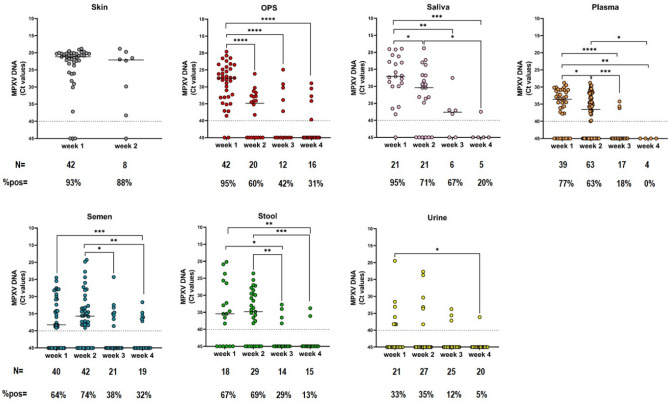
Figure 1
Figure 1
MPXV DNA levels and percentage of positive samples detected at different weeks from the onset of symptoms in each body fluid sample. Median MPXV DNA Ct values are shown for each sample type at different weeks from the onset of symptoms. The horizontal dashed line represents the limit of detection (Ct: 40); values ≥ 40 are considered negative. Statistical analysis by Mann–Whitney test between each time-point pair: *p < 0.05; **p < 0.005; ***p < 0.001; ****p < 0.0001.
Figure 2
Figure 2
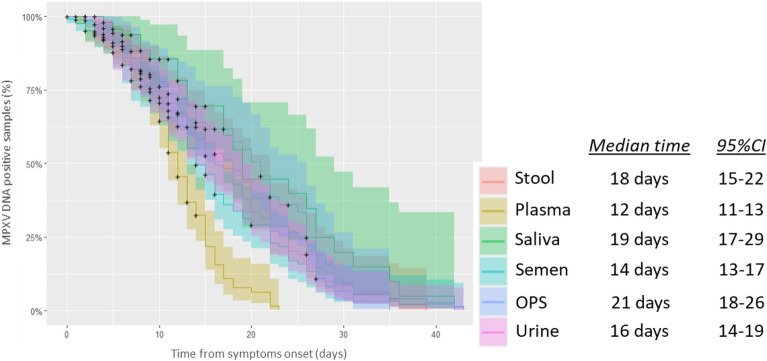
Time from symptom onset to MPXV clearance in different body fluids by the Weibull regression model. The empirical cumulative distribution function with an upper and lower 95% confidence interval and Weibull regression are shown in the graph (left). The median number of days to MPXV DNA undetectability and the 95% CI are reported near the related specimen type (right).
Figure 3
Figure 3
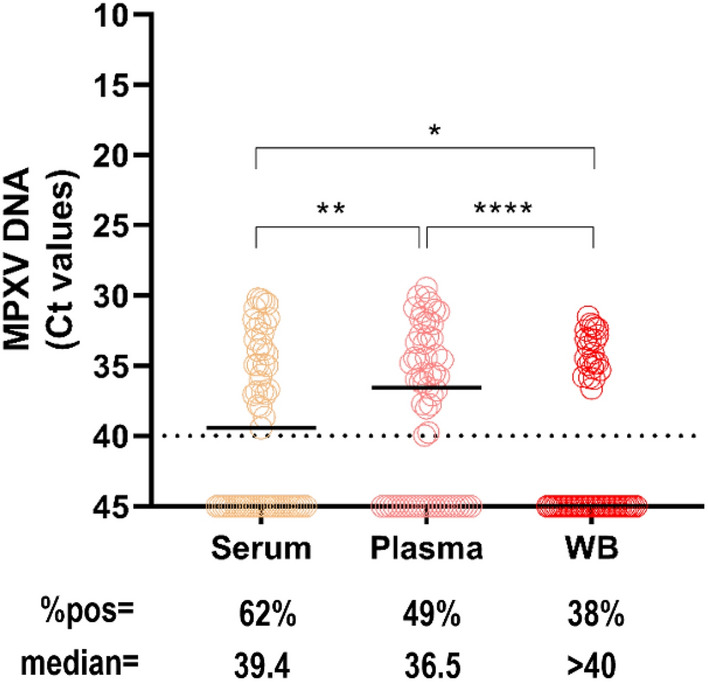
Viral loads and percentages of positivity in paired samples of serum vs. plasma vs. WB from 13 MPXV patients. Median MPXV DNA Ct values are shown for serum (n = 61), plasma (n = 61), and WB (n = 61). The horizontal dashed line represents the limit of detection (Ct = 40); values ≥ 40 are considered negative. Statistical analysis by Wilcoxon matched-pairs signed rank test: *p < 0.05; **p < 0.005; ****p < 0.0001.
Figure 4
Figure 4
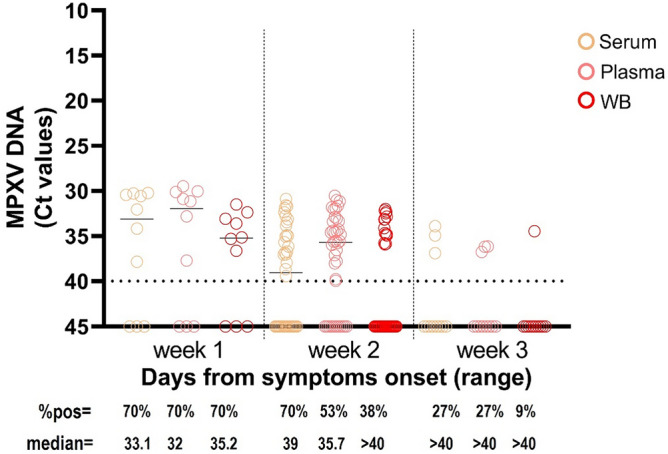
Viral loads and percentages of positivity in paired samples of serum vs. plasma vs. WB collected at different time-ranges from symptoms onset. Median MPXV DNA Ct values are shown for serum, plasma, and WB at week 1 (n = 10), week 2 (n = 40), and week 3 (n = 11). The horizontal dashed line represents the limit of detection (Ct = 40); values ≥ 40 are considered negative. Statistical analysis by Friedman test adjusted with Dunn’s multiple comparisons test: *p < 0.05.

References

    1. World Health Organization (WHO). Multi-country outbreak of mpox, External situation report#31–22 December 2023. https://www.who.int/publications/m/item/multi-country-outbreak-of-mpox--... (2023).
    1. European Centre for Disease Prevention and Control (ECDC). Outbreak of mpox caused by Monkeypox virus clade I in the Democratic Republic of the Congo. https://www.ecdc.europa.eu/en/news-events/outbreak-mpox-caused-monkeypox... (2024).
    1. Altindis M, Puca E, Shapo L. Diagnosis of monkeypox virus—An overview. Travel Med. Infect. Dis. 2022;50:102459. doi: 10.1016/j.tmaid.2022.102459. - DOI - PMC - PubMed
    1. Nörz D, et al. Clinical characteristics and comparison of longitudinal qPCR results from different specimen types in a cohort of ambulatory and hospitalized patients infected with monkeypox virus. J. Clin. Virol. 2022;155:105254. doi: 10.1016/j.jcv.2022.105254. - DOI - PMC - PubMed
    1. Palich R, et al. Viral loads in clinical samples of men with monkeypox virus infection: A French case series. Lancet Infect. Dis. 2023;23:74–80. doi: 10.1016/S1473-3099(22)00586-2. - DOI - PMC - PubMed