


Effect of implementing of the IDEAL discharge model on satisfaction of patient referred to trauma emergency department
- PMID: 38870177
- PMCID: PMC11175502
- DOI: 10.1371/journal.pone.0304969
Effect of implementing of the IDEAL discharge model on satisfaction of patient referred to trauma emergency department
Abstract
Background: Patient education at the time of discharge is one of the most important challenges in the emergency department. This study aimed to evaluate the Effect of implementing the IDEAL, or integrated discharge model, on the satisfaction of patients referred to the trauma emergency department.
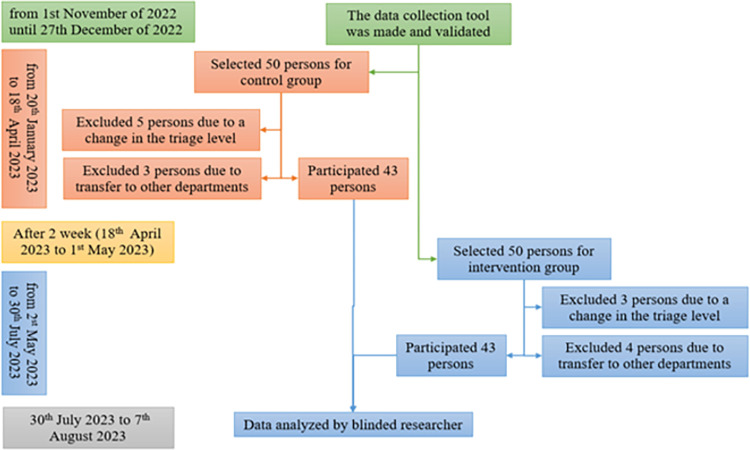
Methods: This quasi-experimental study was conducted on the patients referred to the trauma emergency department of Imam Hossein Hospital in Tehran. Eighty-six patients were recruited from January 20, 2023, until July 30, 2023. In the intervention group, the educational content was taught using the IDEAL (Inclusion, Discussion, Education, Assessment, Listening) or integrated discharge model, and in the control group, it was taught using the emergency department routine method. The satisfaction questionnaire of the emergency department was completed before and after the education in both groups and compared between the two groups. The data were analyzed by using SPSS (version 20) software.
Results: The results showed that out of the 86 participating patients, 52 (60.5%) were male and 34 (39.5%), with a mean (Standard Deviation) of 39.14 (10.89) years old. Demographic characteristics were homogeneous between the two groups (P > 0.05). The mean (standard deviation) of satisfaction of the participants after education, totally was 63.56 (16.21), in the intervention group it was 77.37 (7.95), and in the Control group it was 49.74 (8.84). The mean (SD) participants satisfaction on arrival at the emergency department in the intervention group was 19.16 (2.75) and in the control group was 13.51 (2.51), during hospitalization in the intervention group was 10.72 (1.77) and in the Control group 6.74 (1.81), discharge time in the intervention group 14.51 (2.93) and in the control group 2.93 (2.04), Overall satisfaction with nursing care in intervention group 13.85 (2.46) and in the control group 8.46 (2.41), Overall satisfaction with medical procedures in the intervention group 12.81 (2.73) and in the control group 8.58 (3.20) and Overall patient satisfaction in the intervention group 2.27 (1.81) and 41.4 (1.66) in the control group. An independent T-test was used to compare satisfaction and its dimensions in two groups, and there was a statistically significant difference between the two groups (P<0.01).
Conclusion: The study results showed a statistically significant difference in the satisfaction in the intervention and control groups, so it can be concluded that conducting the integrated discharge model is effective in increasing the satisfaction of trauma patients. Therefore, it is recommended to use this educational method to increase patient satisfaction and decrease readmission rates.
Copyright: © 2024 Moradi Rekabdar Kalaiee et al. This is an open access article distributed under the terms of the Creative Commons Attribution License, which permits unrestricted use, distribution, and reproduction in any medium, provided the original author and source are credited.
Conflict of interest statement
The authors declared no conflicts of interest with respect to the research, authorship, and/or publication of this article.
References
-
- Khattak FA, Saba M, Hakim M, Khan A, Aleem S, Afaq S, et al. Patient Satisfaction and Utilization of Ambulance Services in Prehospital Services at a Tertiary Care Hospital: A Cross-Sectional Study in Peshawar, Khyber Pakhtunkhwa, Pakistan. Air Medical Journal. 2023. - PubMed
-
- Bertolini G, Cattani L, Iaccarino C, Fornaciari A, Picetti E. Head and Brain Trauma. Textbook of Emergency General Surgery: Traumatic and Non-traumatic Surgical Emergencies: Springer; 2023. p. 581–604.
-
- Lax P. Textbook of acute trauma care: Springer Nature; 2022.
MeSH terms
LinkOut - more resources
Full Text Sources
