


How breaking a sweat affects mood: The mediating role of self-efficacy between physical exercise and emotion regulation ability
- PMID: 38870188
- PMCID: PMC11175485
- DOI: 10.1371/journal.pone.0303694
How breaking a sweat affects mood: The mediating role of self-efficacy between physical exercise and emotion regulation ability
Abstract
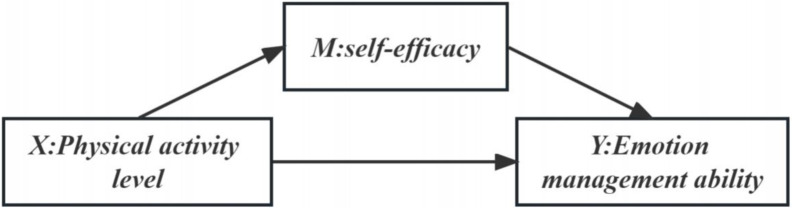
Objective: This study investigates the association between physical exercise and emotion regulation abilities among college students, introducing self-efficacy as a mediating variable to analyze the pathway mechanism through which physical exercise affects emotion regulation abilities.
Methods: A cross-sectional study design was employed, utilizing a stratified random sampling method to survey three colleges in Jiangsu Province, China. Physical Activity Rating Scale, Physical Activity Self-efficacy Scale, and Emotional Intelligence Scale were used to measure the college student population. Regression analysis and mediation tests assessed whether self-efficacy mediates the relationship between physical exercise and college students' emotion regulation abilities. A total of 5,430 valid questionnaires were collected.
Results: The distribution of college students' physical activities was 77.0% for low, 13.1% for medium, and 9.3% for high levels. Physical activities were significantly and positively correlated with self-efficacy and emotional management abilities (r = 0.298,0.105;P<0.01), and self-efficacy was significantly and positively correlated with emotional management abilities (r = 0.322, P<0.01). Situational motivation and subjective support under self-efficacy were 0.08 and 0.255, respectively, and the adjusted R2 was 0.107. Self-efficacy played a fully mediating role between physical activities and emotional management abilities, with a total effect value of 0.032. The values of the direct and indirect effects were 0.003 and 0.029, accounting for 8.95% and 90.74% of the total effect, respectively.
Conclusion: The physical exercise behavior of college students is primarily characterized by low intensity. Physical exercise among college students can positively predict their ability to regulate emotions. Self-efficacy fully mediates the relationship between physical exercise and emotion regulation ability among college students. College students can indirectly influence their ability to regulate emotions through physical exercise and self-efficacy.
Copyright: © 2024 Mu et al. This is an open access article distributed under the terms of the Creative Commons Attribution License, which permits unrestricted use, distribution, and reproduction in any medium, provided the original author and source are credited.
Conflict of interest statement
The authors have declared that no competing interests exist.
Figures
References
-
- Mental Health Blue Book (2022. Edition) Released: Adolescent Population at Higher Risk of Depression than Adult Population. https://m.btime.com/item/46j90dvjm4u8f7808mg4d44j0k6.
-
- Zhang Xuge LB. Mental Health Quality Measurement System-The Production of Core Mental Health Quality Scale Profiles for Chinese Adults. Psychological and Behavioural Research. 2018:16(5): 684–93.
-
- Tull MT, and Aldao AJCoip. Editorial overview: New directions in the science of emotion regulation. 2015;3:iv–x.
-
- Ruiz MC, and Robazza C. Emotion regulation. The Routledge international encyclopedia of sport and exercise psychology: Routledge; 2020. p. 263–80.
