


Developmental associations between cognition and adaptive behavior in intellectual and developmental disability
- PMID: 38872099
- PMCID: PMC11177479
- DOI: 10.1186/s11689-024-09542-z
Developmental associations between cognition and adaptive behavior in intellectual and developmental disability
Abstract
Background: Intellectual and developmental disabilities (IDDs) are associated with both cognitive challenges and difficulties in conceptual, social, and practical areas of living, commonly referred to as adaptive behavior (DSM-5). Although cross-sectional associations between intelligence or cognition and adaptive behavior have been reported in IDD populations, no study to date has examined whether developmental changes in cognition contribute to or track with changes in adaptive behavior. The present study sought to examine associations of longitudinal developmental change in domains of cognition (NIH Toolbox Cognition Battery, NIHTB-CB) and adaptive behavior domains (Vineland Adaptive Behavior Scales-3; VABS-3) including Socialization, Communication, and Daily Living Skills (DLS) over a two year period in a large sample of children, adolescents and young adults with IDD.
Methods: Three groups were recruited, including those with fragile X syndrome, Down syndrome, and other/idiopathic intellectual disability. Eligible participants (n = 263) included those who were between 6 and 26 years (mage = 15.52, sd = 5.17) at Visit 1, and who had a diagnosis of, or suspected intellectual disability (ID), including borderline ID, with a mental age of at least 3.0 years. Participants were given cognitive and adaptive behavior assessments at two time points over a two year period (m = 2.45 years, range = 1.27 to 5.56 years). In order to examine the association of developmental change between cognitive and adaptive behavior domains, bivariate latent change score (BLCS) models were fit to compare change in the three cognitive domains measured by the NIHTB-CB (Fluid Cognition, Crystallized Cognition, Total Cognition) and the three adaptive behavior domains measured by the VABS-3 (Communication, DLS, and Socialization).
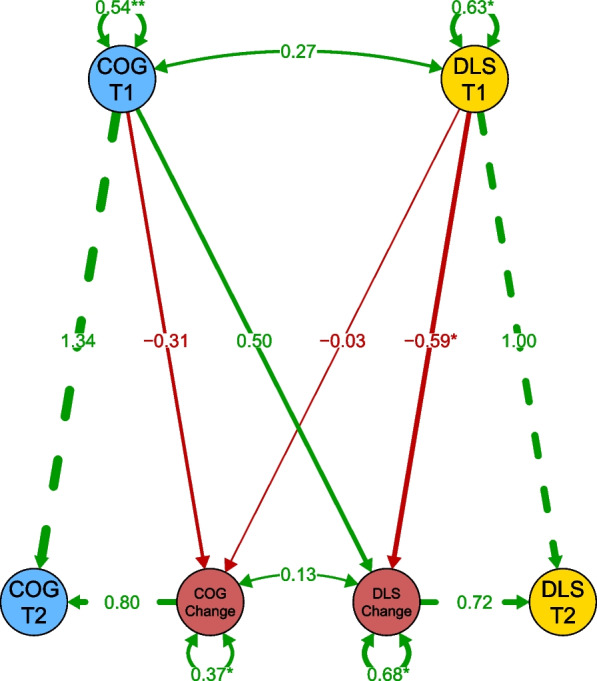
Results: Over a two year period, change in cognition (both Crystallized and Total Composites) was significantly and positively associated with change in daily living skills. Also, baseline cognition level predicted growth in adaptive behavior, however baseline adaptive behavior did not predict growth in cognition in any model.
Conclusions: The present study demonstrated that developmental changes in cognition and adaptive behavior are associated in children and young adults with IDD, indicating the potential for cross-domain effects of intervention. Notably, improvements in DLS emerged as a primary area of adaptive behavior that positively related to improvements in cognition. This work provides evidence for the clinical, "real life" meaningfulness of changes in cognition detected by the NIHTB-CB in IDD, and provides empirical support for the NIHTB-CB as a fit-for-purpose performance-based outcome measure for this population.
Keywords: Adaptive behavior; Cognition; Down syndrome; Fragile X syndrome; Intellectual and developmental disability; Latent change; Longitudinal studies; NIH Toolbox; Structural equation modeling.
© 2024. The Author(s).
Conflict of interest statement
AJK, JK, AD, EC, ES, D. Harvey and KR: no relevant disclosures; EBK has received funding from the following, all of which are directed to Rush University Medical Center in support of rare disease programs, and she receives no personal funds and has no relevant financial interest in any of the commercial entities listed: Acadia, Alcobra, Anavex, Biogen, BioMarin, Cydan, Fulcrum, GeneTx, GW, Ionis, Lumos, Marinus, Neuren, Neurotrope, Novartis, Orphazyme, Ovid, Roche, Seaside Therapeutics, Tetra, Ultragenyx, Yamo, and Zynerba to consult on trial design and development strategies and/or to conduct clinical studies in FXS or other NNDs or neurodegenerative disorders; Vtesse/Sucampo/Mallinckrodt Pharmaceuticals to conduct clinical trials in Nieman Pick; and Asuragen Inc to develop testing standards for
Figures

Update of
-
Developmental Associations between Cognition and Adaptive Behavior in Intellectual and Developmental Disability.Res Sq [Preprint]. 2024 Jan 8:rs.3.rs-3684708. doi: 10.21203/rs.3.rs-3684708/v1. Res Sq. 2024. Update in: J Neurodev Disord. 2024 Jun 13;16(1):31. doi: 10.1186/s11689-024-09542-z. PMID: 38260292 Free PMC article. Updated. Preprint.
References
-
- American Psychiatric Association. Diagnostic and Statistical Manual of Mental Disorders. (American Psychiatric Association, Washington DC. 2013. 10.1176/appi.books.9780890425596.
-
- Sparrow SS, Cicchetti DV, Saulnier CA. Vineland Adaptive Behavior Scales, Third Edition (VinelandTM-3) Comprehensive Interview Form Report. 2016.
MeSH terms
Grants and funding
- U50 DD000596/DD/NCBDD CDC HHS/United States
- R01 HD076189/HD/NICHD NIH HHS/United States
- HD076189/Eunice Kennedy Shriver National Institute of Child Health and Human Development
- P50HD103526/Eunice Kennedy Shriver National Institute of Child Health and Human Development
- 90DD0596/Office of Human Development Services
