


Breeding a new Ganoderma lucidum strain with increased contents of individual ganoderic acids by mono-mono crossing of genetically modified monokaryons
- PMID: 38873146
- PMCID: PMC11169689
- DOI: 10.3389/fmicb.2024.1410368
Breeding a new Ganoderma lucidum strain with increased contents of individual ganoderic acids by mono-mono crossing of genetically modified monokaryons
Abstract
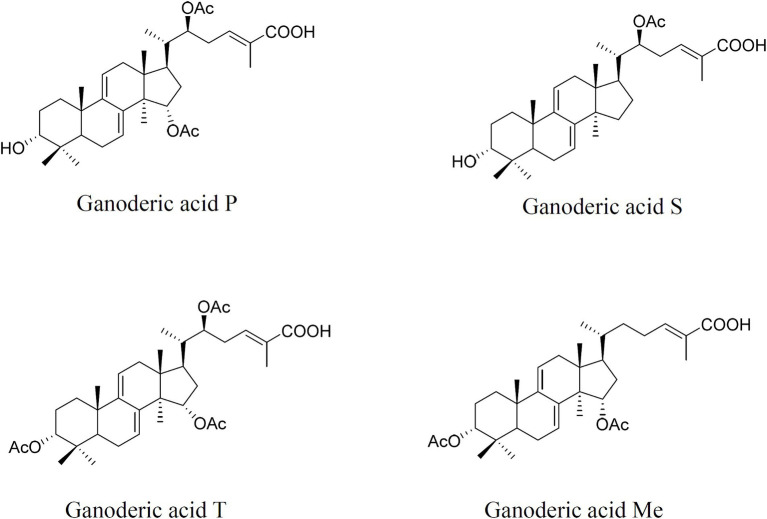
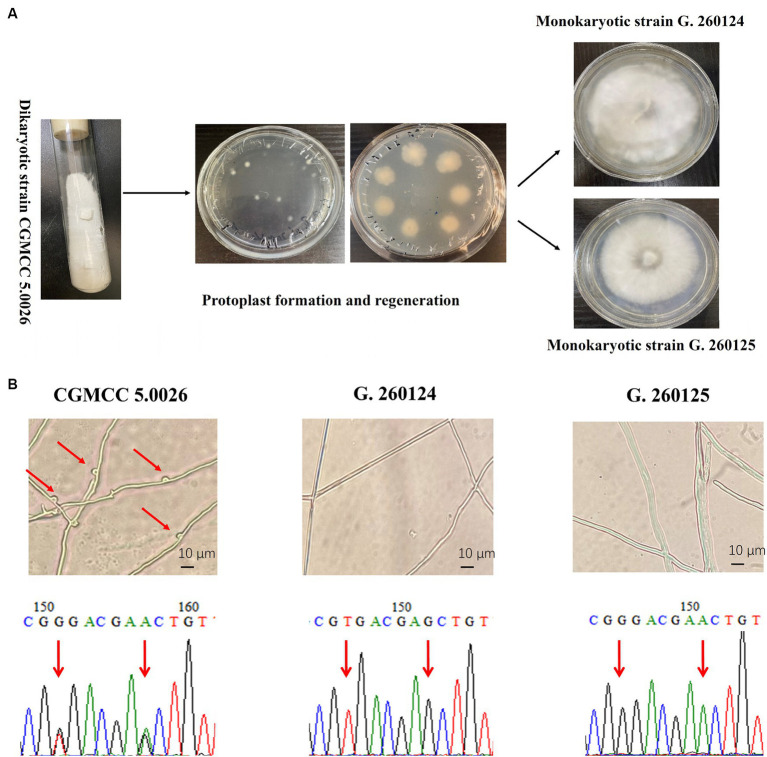
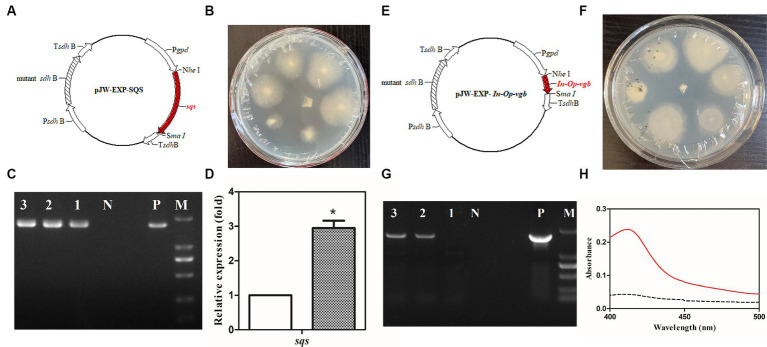
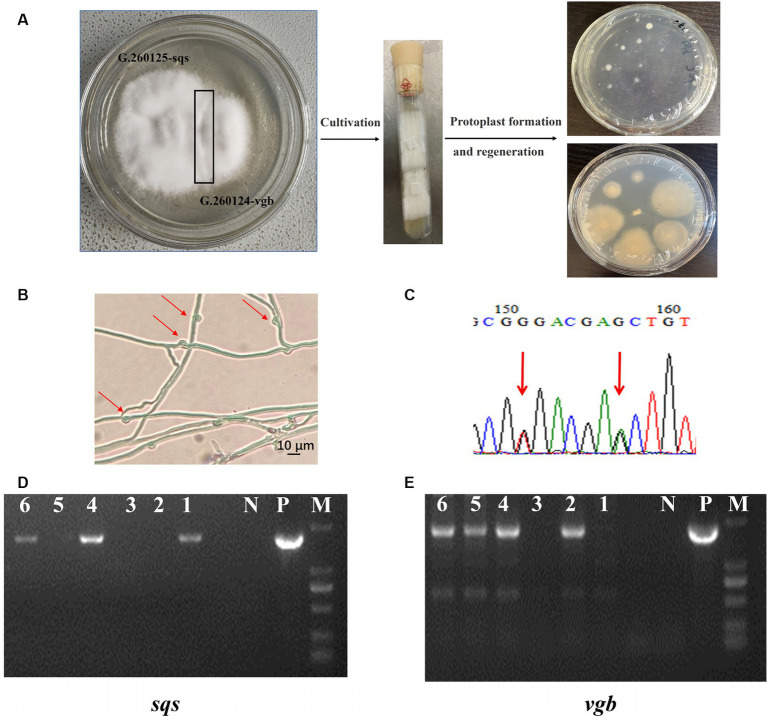
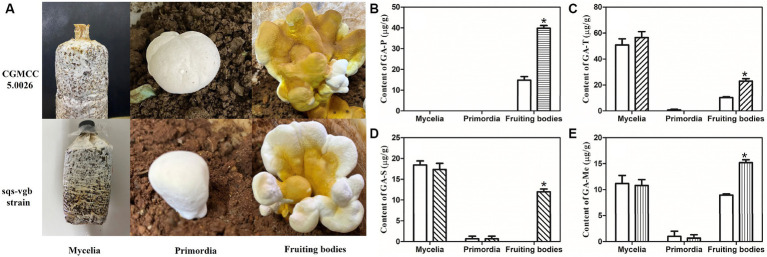
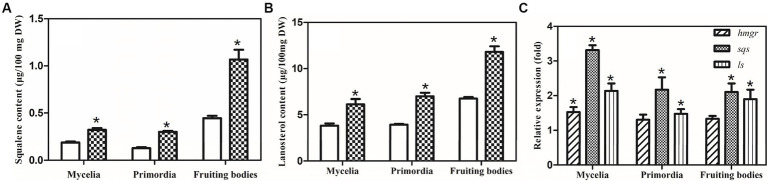
Ganoderic acids (GAs) are major functional components of Ganoderma lucidum. The study aimed to breed a new G. lucidum strain with increased contents of individual GAs. Two mating-compatible monokaryotic strains, G. 260125 and G. 260124, were successfully isolated from the dikaryotic G. lucidum CGMCC 5.0026 via protoplast formation and regeneration. The Vitreoscilla hemoglobin gene (vgb) and squalene synthase gene (sqs) were overexpressed in the monokaryotic G. 260124 and G. 260125 strain, respectively. Mating between the G. 260124 strain overexpressing vgb and the G. 260125 strain overexpressing sqs resulted in the formation of the new hybrid dikaryotic G. lucidum strain sqs-vgb. The maximum contents of ganoderic acid (GA)-T, GA-Me, and GA-P in the fruiting body of the mated sqs-vgb strain were 23.1, 15.3, and 39.8 μg/g dry weight (DW), respectively, 2.23-, 1.75-, and 2.69-fold greater than those in G. lucidum 5.0026. The squalene and lanosterol contents increased 2.35- and 1.75-fold, respectively, in the fruiting body of the mated sqs-vgb strain compared with those in the G. lucidum 5.0026. In addition, the maximum expression levels of the sqs and lanosterol synthase gene (ls) were increased 3.23- and 2.13-fold, respectively, in the mated sqs-vgb strain. In summary, we developed a new G. lucidum strain with higher contents of individual GAs in the fruiting body by integrating genetic engineering and mono-mono crossing.
Keywords: Ganoderma; breeding; ganoderic acids; genetic engineering; mono–mono crossing.
Copyright © 2024 Zhou, Kong, Huang, Li, Feng and Xu.
Conflict of interest statement
The authors declare that the research was conducted in the absence of any commercial or financial relationships that could be construed as a potential conflict of interest.
Figures
References
-
- Adaskaveg J. E., Gilbertson R. L. (1986). Cultural studies and genetics of sexuality of Ganoderma lucidum and G. tsugae in relation to the taxonomy of the G. lucidum complex. Mycologia. 78, 694–705.
-
- Ahmad M. F., Wahab S., Ahmad F. A., Ashraf S. A., Abullais S. S., Saad H. H. (2022). Ganoderma lucidum: a potential pleiotropic approach of ganoderic acids in health reinforcement and factors influencing their production. Fungal Biol. Rev. 39, 100–125. doi: 10.1016/j.fbr.2021.12.003 - DOI
-
- Avin F. A., Bhassu S., Rameeh V., Tan Y. S., Vikineswary S. (2016). Genetics and hybrid breeding of Pleurotus pulmonarius: heterosis, heritability and combining ability. Euphytica 209, 85–102. doi: 10.1007/s10681-016-1638-x - DOI
-
- Feng N., Zhang J., Yue Y., Yang M., Wang C., Zhou S., et al. (2023). “Triterpene compound extracted from Ganoderma lucidum mycelia and application in preparation of anti-inflammatory drug (in Chinese)” in China Patent, CN115894591, 2023.0404. Beijing, China: Intellectual Property Publishing House Co., Ltd.
LinkOut - more resources
Full Text Sources
Molecular Biology Databases
Miscellaneous
