


The Changed Nocturnal Sleep Structure and Higher Anxiety, Depression, and Fatigue in Patients with Narcolepsy Type 1
- PMID: 38873239
- PMCID: PMC11170032
- DOI: 10.2147/NSS.S452665
The Changed Nocturnal Sleep Structure and Higher Anxiety, Depression, and Fatigue in Patients with Narcolepsy Type 1
Abstract
Purpose: This study aimed to evaluate nocturnal sleep structure and anxiety, depression, and fatigue in patients with narcolepsy type 1 (NT1).
Methods: Thirty NT1 patients and thirty-five healthy controls were enrolled and evaluated using the Epworth sleepiness scale (ESS), Generalized Anxiety Disorder-7, Patient Health Questionnaire-9, Fatigue Severity Scale (FSS), polysomnography, multiple sleep latency test, and brain function state monitoring. Statistical analyses were performed using SPSS Statistics for Windows, version 23.0. Benjamini-Hochberg correction was performed to control the false discovery rate.
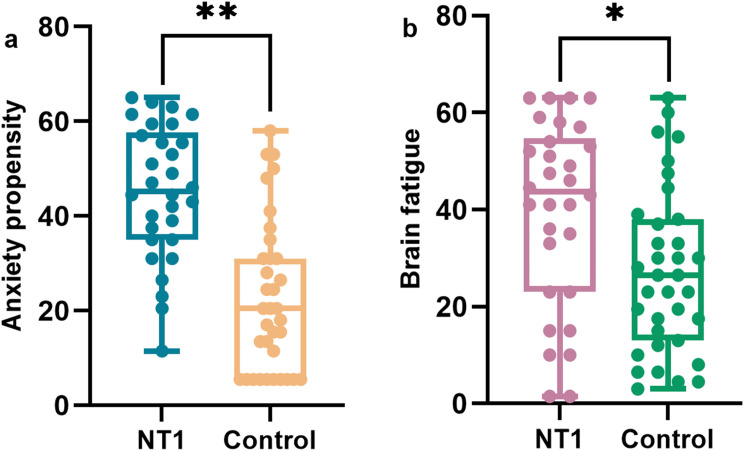
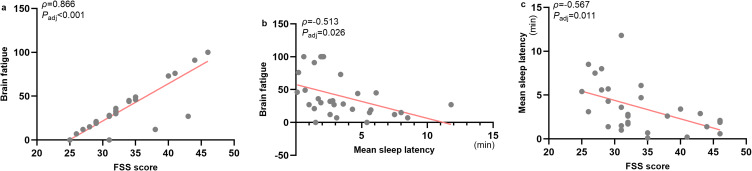
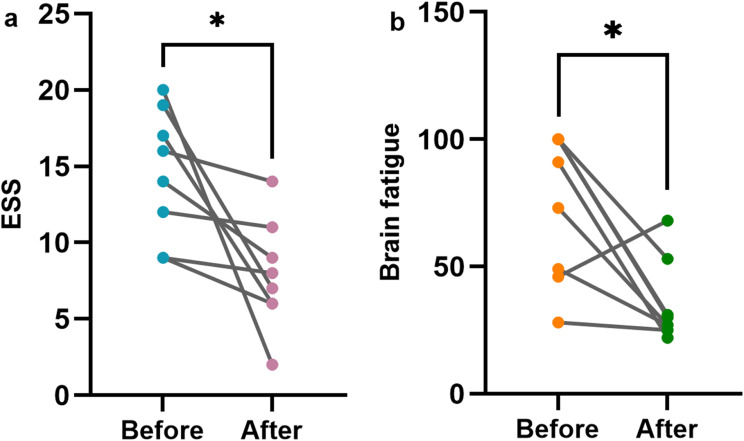
Results: Apart from typical clinical manifestations, patients with NT1 are prone to comorbidities such as nocturnal sleep disorders, anxiety, depression, and fatigue. Compared with the control group, patients with NT1 exhibited abnormal sleep structure, including increased total sleep time (P adj=0.007), decreased sleep efficiency (P adj=0.002), shortening of sleep onset latency (P adj<0.001), elevated wake after sleep onset (P adj=0.002), increased N1% (P adj=0.006), and reduced N2%, N3%, and REM% (P adj=0.007, P adj<0.001, P adj=0.013). Thirty-seven percent of patients had moderate to severe obstructive sleep apnea-hypopnea syndrome. And sixty percent of patients were complicated with REM sleep without atonia. Patients with NT1 displayed increased anxiety propensity (P adj<0.001), and increased brain fatigue (P adj=0.020) in brain function state monitoring. FSS scores were positively correlated with brain fatigue (P adj<0.001) and mean sleep latency was inversely correlated with FSS scores and brain fatigue (P adj=0.013, P adj=0.029). Additionally, ESS scores and brain fatigue decreased after 3 months of therapy (P=0.012, P=0.030).
Conclusion: NT1 patients had abnormal nocturnal sleep structures, who showed increased anxiety, depression, and fatigue. Excessive daytime sleepiness and fatigue improved after 3 months of treatment with methylphenidate hydrochloride prolonged-release tablets in combination with venlafaxine.
Keywords: anxiety; depression; excessive daytime sleepiness; fatigue; narcolepsy; sleep structure.
© 2024 Yu et al.
Conflict of interest statement
The authors report no conflicts of interest in this work.
Figures
References
-
- Disorders CSoS. Chinese guidelines for diagnosis and treatment of narcolepsy (2022). Chin J Neurol. 2022;55(5):406–420.
LinkOut - more resources
Full Text Sources
