


Self-evaluation of ILCORs ten steps to improve around in-hospital cardiac arrests among Swedish hospitals
- PMID: 38873273
- PMCID: PMC11169947
- DOI: 10.1016/j.resplu.2024.100672
Self-evaluation of ILCORs ten steps to improve around in-hospital cardiac arrests among Swedish hospitals
Abstract
Objectives: Recently, ILCOR unveiled the ground-breaking global initiative "Ten Steps Toward Improving In-Hospital Cardiac Arrest" (IHCA).
Aim: To generate a baseline of how well the ten steps currently function in Sweden, in order to better target educational interventions.
Material and methods: A survey was created using an online form application (Google Forms) and sent to CPR coordinators and physicians in charge of CPR at all 74 Swedish hospitals participating in the Swedish Registry for Cardiopulmonary Resuscitation (SRCR). Hospitals were asked to self-evaluate their functionality on each step on a ten-point scale ranging from 1 "Not present or not functioning at all" to 10 "Very well-functioning". Data regarding number of IHCA and their survival during 2018-2022 was gathered from the SRCR.
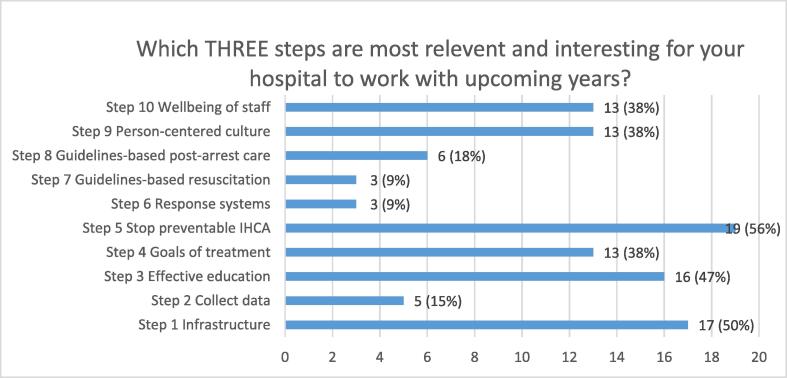
Results: A total of 34 out of 74 (46%) Swedish hospitals participated in the survey, collectively representing 59% (7,113 out of 12,070) of IHCA cases in SRCR. The responding hospitals were satisfied with the functionality of just over half of the steps currently (median 60%, range 30-90%). The steps with the highest proportion of satisfied hospitals were found for step 6-rapid response systems (85%) and 7-guideline-based resuscitation (94%), while the steps with lowest proportion of satisfied hospitals were found for step 4-goals of treatment (32%) and step 9-person centred culture (18%). About half of participating hospitals expressed intent to prioritise upcoming years' work on step 1- infrastructure, step 3- effective education and step 5- stop preventable IHCA.
Conclusion: The conclusion is that most hospitals judge themselves to be well-functioning on many of the ten steps, but steps involving effective education might need attention, as well as the tolerance for presence of preventable IHCA being low.
Keywords: Continuous improvements; IHCA.
© 2024 The Authors.
Conflict of interest statement
The authors declare that they have no known competing financial interests or personal relationships that could have appeared to influence the work reported in this paper.
Figures
References
-
- Grasner J.T., Herlitz J., Tjelmeland I.B.M., et al. European Resuscitation Council Guidelines 2021: Epidemiology of cardiac arrest in Europe. Resuscitation. 2021;161:61–79. - PubMed
-
- Hodgetts T.J., Kenward G., Vlackonikolis I., et al. Incidence, location and reasons for avoidable in-hospital cardiac arrest in a district general hospital. Resuscitation. 2002;54:115–123. - PubMed
LinkOut - more resources
Full Text Sources
