


Assessing knowledge of migrant sexual reproductive health and rights: a national cross-sectional survey among health professionals in Sweden
- PMID: 38873341
- PMCID: PMC11169828
- DOI: 10.3389/fsoc.2024.1356418
Assessing knowledge of migrant sexual reproductive health and rights: a national cross-sectional survey among health professionals in Sweden
Abstract
Introduction: Despite the commitment of the Swedish government to ensuring equal access to Sexual Reproductive Health and Rights services for all citizens, shortcomings persist among the migrant population. In cases where healthcare providers lack sufficient knowledge or hold misconceptions and biases about these contentious issues, it can lead to the delivery of suboptimal care. Therefore, the objective of this study was to assess the level of knowledge of Swedish healthcare providers on global and Swedish migrant Sexual Reproductive Health and Rights.
Methods: A national cross-sectional study was conducted using a questionnaire consisting of seven questions related to global and Swedish migrant Sexual Reproductive Health and Rights. The questionnaire was distributed among midwives, nurses, gynecologists and obstetricians, and hospital social workers (N = 731). The analysis was guided by the Factfulness framework developed by Hans Rosling to identify disparities between healthcare providers' viewpoints and evidence-based knowledge.
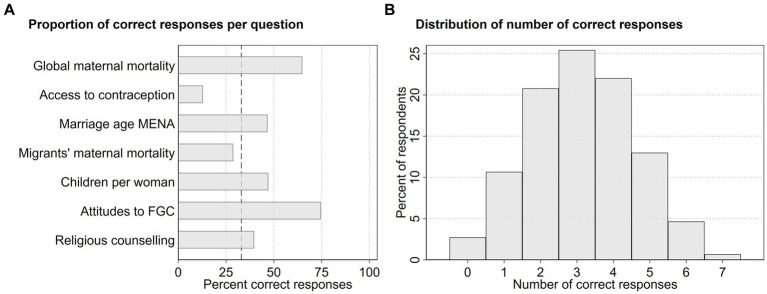
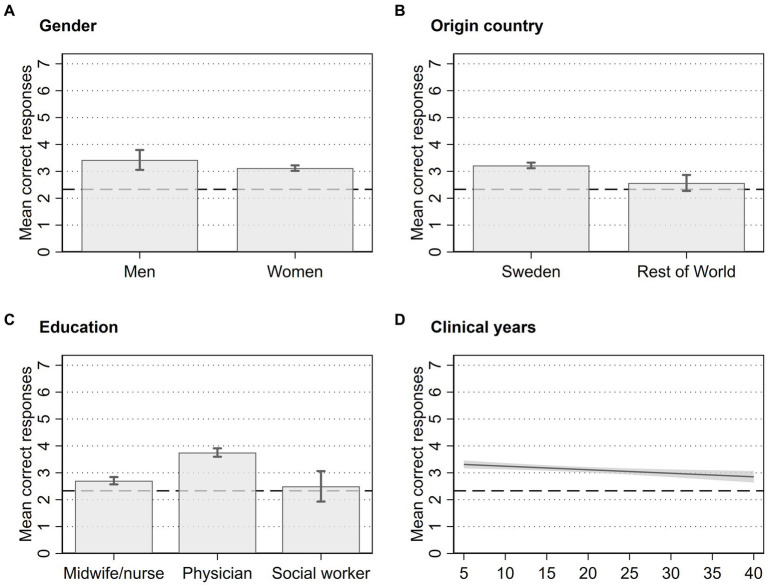
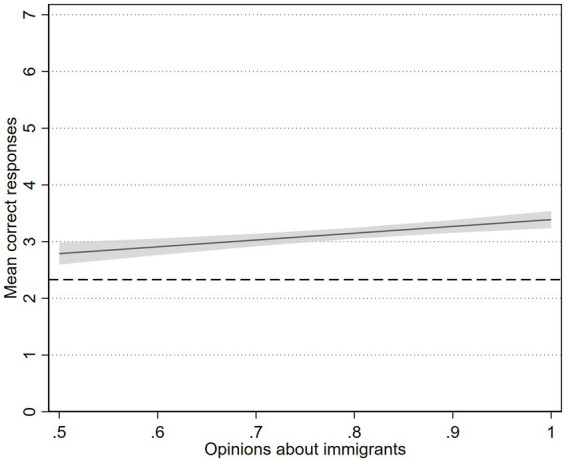
Results: There was an overall lack of knowledge among the health care providers on these issues. The highest correct responses were on the question on abandonment of female genital cutting/mutilation after migration (74%). The findings indicated that healthcare providers originating from Sweden, physicians, those with fewer years of clinical experience, and exhibiting more migrant-friendly attitudes, demonstrated a higher level of knowledge regarding global and Swedish migrant Sexual and Reproductive Health and Rights.
Conclusion: This study demonstrates that healthcare providers lacked knowledge of global and Swedish migrant Sexual Reproductive Health and Rights, which was almost uniformly distributed, except among those with more comprehensive and recent education. Contrary to expectations, healthcare professionals did not primarily rely on their education and experiences but were influenced by their personal values and opinions. The study underscores the importance of upgrading knowledge in Sexual Reproductive Health and Rights and encourages policymakers, professionals, and students to base their opinions on well-founded facts, particularly in the context of a diverse and globalized society.
Keywords: health professionals; healthcare providers; migrants; migrants healthcare; norms and values; sexual and reproductive healthcare; sexual reproductive health and rights.
Copyright © 2024 Essén, Wickramasinghe, Eriksson, Vartanova, Tibajev and Strimling.
Conflict of interest statement
The authors declare that the research was conducted in the absence of any commercial or financial relationships that could be construed as a potential conflict of interest.
Figures
References
-
- Arousell J., Carlbom A., Johnsdotter S., Essén B. (2019). Does religious counselling on abortion comply with Sweden’s “women-friendly” abortion policies? A qualitative exploration among religious counsellors. Sex. Cult. 23, 1230–1249. doi: 10.1007/s12119-019-09614-6 - DOI
-
- Borevi K. (2013). “The political dynamics of multiculturalism in Sweden” in Challenging Multiculturalism: European models of diversity 7. ed. Taras R. (Edinburgh University Press; ), 138–160.
LinkOut - more resources
Full Text Sources
