. 2024 Jun 14;19(6):e0303286.
doi: 10.1371/journal.pone.0303286. eCollection 2024.

The association of systemic immune-inflammation index with lung function, risk of COPD and COPD severity: A population-based study

Affiliations

The association of systemic immune-inflammation index with lung function, risk of COPD and COPD severity: A population-based study

Ying-da Song et al. PLoS One. .

Abstract

Purpose: The relationship between the levels of Systemic Immune-inflammation Index (SII) and chronic obstructive pulmonary disease (COPD), lung function, and COPD severity were not fully understood. We conducted this cross-sectional, population-based study to investigate the complex association between SII and COPD, lung function, and COPD severity among the US adults.

Methods: Overall, 18,349 participants were included in the National Health and Nutrition Examination Survey (NHANES) between 2005 and 2018. The exposure variable was SII, calculated from platelet counts, neutrophil counts, and lymphocyte counts. Weighted univariable and multivariable logistic regression, subgroup analysis, and restricted cubic spline (RCS) regression were performed to assess the relationship between COPD, lung function, COPD severity and SII. Last, we used a propensity score matching (PSM) analysis to reduce selective bias and validate these relationships.

Results: Approximately 1,094 (5.96%) of the participants were diagnosed as COPD. The multivariable-adjusted odds ratio (OR) (95% confidence interval, CI) for the Q2 group (Log-SII > 2.740) was 1.39 (1.16 to 1.68). Before and after matching, multivariable logistic regression models revealed that increased Log-SII levels (SII Logarithmic transformation) associated positively with the risk of COPD. The subgroup analysis showed no interaction between Log-SII and a variety of variables (P for interaction > 0.05). RCS showed a reversed L-shaped relationship between Log-SII with COPD (P for nonlinear = 0.001) in individuals. In addition, we observed negative significant correlations between forced expiratory volume in one second (FEV1) / forced vital capacity (FVC) %, FEV1/FVC% predicted and SII, and reversed U-shaped curve relationships between FEV1, FEV1% predicted and SII. High SII level is associated with severity of COPD, especially at Global Initiative on Obstructive Lung Disease (GOLD) 1 and GOLD 3.

Conclusions: In summary, the Log-SII level is associated with COPD risk, lung function, and COPD severity.


Conflict of interest statement

NO authors have competing interests.

Figures

Fig 1
Fig 1. Flow diagram.
Fig 2
Fig 2. Subgroup analyses of the association between Log-SII and COPD before and after matching, NHANES 2005–2018.
Notes: Data are presented as OR (95% CI). Adjusted for age, PIR, race, education, Wbc count, Mono count, Eos count, waist, waist-height ratio, DM, asthma, stroke, CVD, smoking status, hypertension, and hyperlipidemia. (A) Subgroup analysis of the association between Log-SII and COPD before matching among all the participants; (B) Subgroup analysis of the association between Log-SII and COPD after matching among all the participants. Abbreviations: NHANES, the National Health and Nutrition Examination Survey; PIR, poverty index ratio; BMI, body mass index; Wbc, white blood cells; Mono, monocyte; Eos, eosinophils; Hb, hemoglobin; CKD, chronic kidney disease; CVD, cardiovascular disease; DM, diabetes; IFG, impaired fasting glucose; IGT, impaired glucose tolerance; Log-SII, Logarithm-transformed systemic immune-inflammation index; COPD, chronic obstructive pulmonary disease; OR, odds ratio; CI, confidence interval.
Fig 3
Fig 3. RCS analysis of the association between Log-SII and COPD before and after matching, NHANES 2005–2018.
Notes: The association was adjusted for age, PIR, race, education, Wbc count, Mono count, Eos count, waist, waist-height ratio, DM, asthma, stroke, CVD, smoking status, hypertension, and hyperlipidemia. The median Log-SII was chosen as a reference. (A) RCS curve of the association between Log-SII and COPD before matching; (B) RCS curve of the association between Log-SII and COPD after matching. Abbreviations: RCS, restricted cubic spline; NHANES, the National Health and Nutrition Examination Survey; PIR, poverty index ratio; BMI, body mass index; Wbc, white blood cells; Mono, monocyte; Eos, eosinophils; Hb, hemoglobin; CKD, chronic kidney disease; CVD, cardiovascular disease; DM, diabetes; IFG, impaired fasting glucose; IGT, impaired glucose tolerance; Log-SII, Logarithm-transformed systemic immune-inflammation index; COPD, chronic obstructive pulmonary disease; OR, odds ratio; CI, confidence interval.
Fig 4
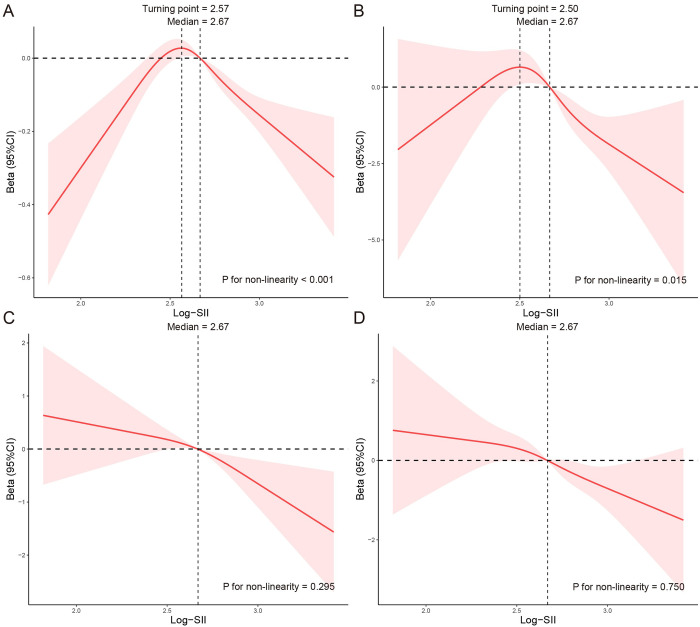
Fig 4. RCS analysis of the association between Log-SII and lung function, NHANES 2007–2012.
Notes: Adjusted model of FEV1 was adjusted for sex, age, PIR, race, smoking status, education, Wbc count, Hb, BMI, waist-height ratio, DM, asthma, stroke, CVD, hypertension, and hyperlipidemia; Adjusted model of FEV1/FVC% was adjusted for sex, age, race, smoking status, education, Wbc count, Mono count, Eos count, Hb, BMI, waist-height ratio, waist, asthma, stroke, CVD, and hypertension. Adjusted model of FEV1% predicted was adjusted for sex, age, PIR, race, smoking status, education, Wbc count, Mono count, Eos count, Hb, BMI, waist-height ratio, waist, DM, asthma, stroke, CVD, and hypertension; Adjusted model of FEV1/FVC % predicted was adjusted for age, race, smoking status, education, Wbc count, Mono count, Eos count, Hb, BMI, waist-height ratio, waist, DM, asthma, and CVD. The median and turning point of Log-SII was chosen as a reference. (A) RCS curve of the association between Log-SII and FEV1; (B) RCS curve of the association between Log-SII and FEV1% predicted; (C) RCS curve of the association between Log-SII and FEV1/FVC%; (D) RCS curve of the association between Log-SII and FEV1/FVC% predicted. Abbreviations: RCS, restricted cubic spline; NHANES: the National Health and Nutrition Examination Survey; PIR, poverty index ratio; BMI, body mass index; Wbc, white blood cells; Mono, monocyte; Eos, eosinophils; Hb, hemoglobin; CKD, chronic kidney disease; CVD, cardiovascular disease; DM, diabetes; FEV1, forced expiratory volume in one second; FVC, forced vital capacity; Log-SII, Logarithm-transformed systemic immune-inflammation index; CI, confidence interval.

References

    1. Venkatesan P. GOLD COPD report: 2024 update. The Lancet Respiratory medicine. 2024;12(1):15–6. Epub 2023/12/08. doi: 10.1016/S2213-2600(23)00461-7 . - DOI - PubMed
    1. Sanders JL, Axelsson G, Putman R, Menon A, Dupuis J, Xu H, et al.. The relationship between interstitial lung abnormalities, mortality, and multimorbidity: a cohort study. Thorax. 2022. Epub 2022/07/02. doi: 10.1136/thoraxjnl-2021-218315 . - DOI - PubMed
    1. Wang C, Xu J, Yang L, Xu Y, Zhang X, Bai C, et al.. Prevalence and risk factors of chronic obstructive pulmonary disease in China (the China Pulmonary Health [CPH] study): a national cross-sectional study. Lancet (London, England). 2018;391(10131):1706–17. Epub 2018/04/14. doi: 10.1016/S0140-6736(18)30841-9 . - DOI - PubMed
    1. Balbirsingh V, Mohammed AS, Turner AM, Newnham M. Cardiovascular disease in chronic obstructive pulmonary disease: a narrative review. Thorax. 2022. Epub 2022/07/01. doi: 10.1136/thoraxjnl-2021-218333 . - DOI - PubMed
    1. Rossaki FM, Hurst JR, van Gemert F, Kirenga BJ, Williams S, Khoo EM, et al.. Strategies for the prevention, diagnosis and treatment of COPD in low- and middle- income countries: the importance of primary care. Expert review of respiratory medicine. 2021;15(12):1563–77. Epub 2021/10/02. doi: 10.1080/17476348.2021.1985762 . - DOI - PubMed