Meta-Analysis
. 2024 Jul;12(7):e1159-e1173.
doi: 10.1016/S2214-109X(24)00181-5.

Cost-effectiveness of interventions for HIV/AIDS, malaria, syphilis, and tuberculosis in 128 countries: a meta-regression analysis

Affiliations
Meta-Analysis

Cost-effectiveness of interventions for HIV/AIDS, malaria, syphilis, and tuberculosis in 128 countries: a meta-regression analysis

Fiona Silke et al. Lancet Glob Health. 2024 Jul.

Abstract

Background: Cost-effectiveness analyses have been conducted for many interventions for HIV/AIDS, malaria, syphilis, and tuberculosis, but they have not been conducted for all interventions that are currently recommended in all countries. To support national decision makers in the effective allocation of resources, we conducted a meta-regression analysis of published incremental cost-effectiveness ratios (ICERs) for interventions for these causes, and predicted ICERs for 14 recommended interventions for Global Fund-eligible countries.

Methods: In the meta-regression analysis, we used data from the Tufts University Center for the Evaluation of Value and Risk in Health (Boston, MA, USA) Cost-Effectiveness Registries (the CEA Registry beginning in 1976 and the Global Health CEA registry beginning in 1995) up to Jan 1, 2018. To create analysis files, we standardised and mapped the data, extracted additional data from published articles, and added variables from the Global Burden of Diseases, Injuries, and Risk Factors Study (GBD). Then we selected ratios for interventions with a minimum of two published articles and three published ICERs that mapped to one of five GBD causes (HIV/AIDS, malaria, syphilis, drug-susceptible tuberculosis, or multi-drug resistant tuberculosis), and to a GBD country; reported a currency year during or after 1990; and for which the comparator intervention was defined as no intervention, standard of care, or placebo. Our meta-regression analysis used all available data on 25 eligible interventions, and quantified the association between ICERs and factors at country level and intervention level. We used a five-stage statistical model that was developed to synthesise evidence on cost-effectiveness analyses, and we adapted it for smaller sample sizes by grouping interventions by cause and type (ie, prevention, diagnostics, and treatment). Using the meta-regression parameters we predicted country-specific median ICERs, IQRs, and 95% uncertainty intervals in 2019 US$ per disability-adjusted life-year (DALY) for 14 currently recommended interventions. We report ICERs in league tables with gross domestic product (GDP) per capita and country-specific thresholds.

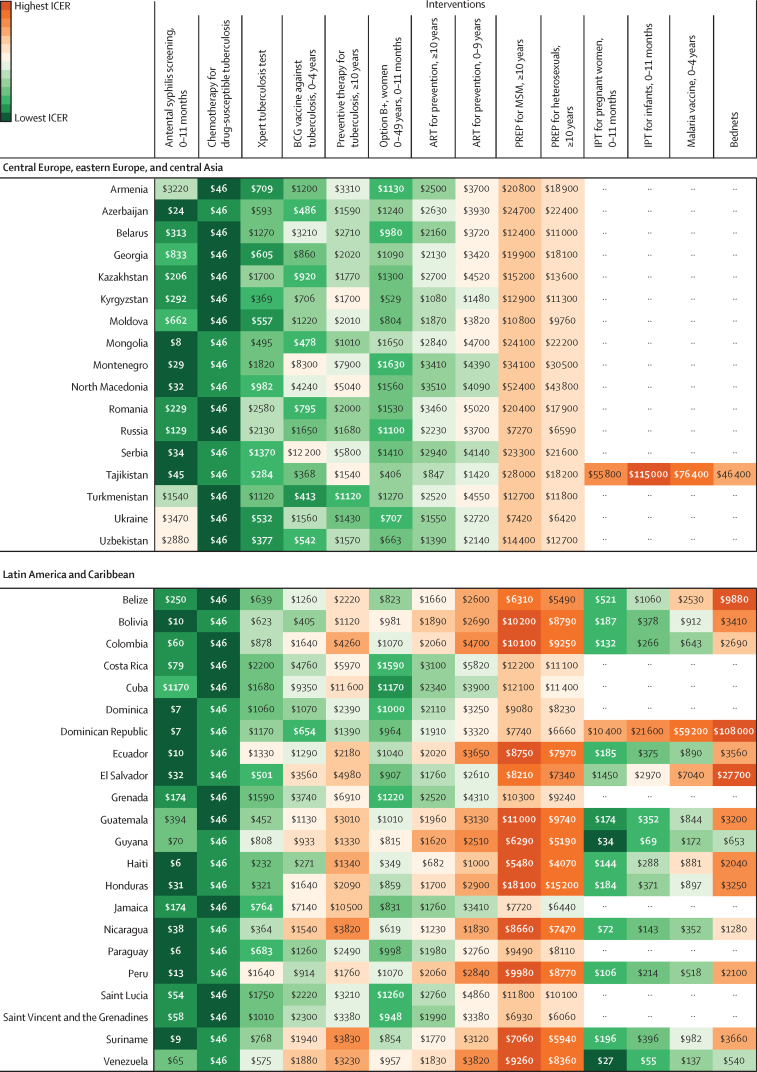
Findings: The sample for the analysis was 1273 ratios from 144 articles, of which we included 612 ICERs from 106 articles in our meta-regression analysis. We predicted ICERs for antiretroviral therapy for prevention for two age groups and pregnant women, pre-exposure prophylaxis against HIV for two risk groups, four malaria prevention interventions, antenatal syphilis screening, two tuberculosis prevention interventions, the Xpert tuberculosis test, and chemotherapy for drug-sensitive tuberculosis. At the country level, ranking of interventions and number of interventions with a predicted median ICER below the country-specific threshold varied greatly. For instance, median ICERs for six of 14 interventions were below the country-specific threshold in Sudan, whereas 12 of 14 were below the country-specific threshold in Peru. Antenatal syphilis screening had the lowest median ICER among all 14 interventions in 81 (63%) of 128 countries, ranging from $3 (IQR 2-4) per DALY averted in Equatorial Guinea to $3473 (2244-5222) in Ukraine. Pre-exposure prophylaxis for HIV/AIDS for men who have sex with men had the highest median ICER among all interventions in 116 (91%) countries, ranging from $2326 (1077-4567) per DALY averted in Lesotho to $53 559 (23 841-108 534) in Maldives.

Interpretation: Country-specific league tables highlight the interventions that offer better value per DALY averted, and can support decision making at a country level that is more tailored to available resources than GDP per capita and country-specific thresholds. Meta-regression is a promising method to synthesise cost-effectiveness analysis results and transfer them across settings.

Funding: Bill & Melinda Gates Foundation.


Conflict of interest statement

Declaration of interests We declare no competing interests.

Figures

Figure 1
Figure 1
Overview of processes in the meta-regression analysis The red parallelogram is input data, the blue parallelograms are output data, grey rectangles indicate processes, green rectangles indicate a sub-component or component process, and the dark grey diamond indicates a decision. CEA=cost-effectiveness analysis. GBD=Global Burden of Disease. GDP=gross domestic product. ICER=incremental cost-effectiveness ratio. *The two registries are the CEA registry and the Global Health CEA registry.
Figure 2
Figure 2
Flow diagram for meta-regression analysis based on data from cost-effectiveness analyses registries CEA=cost-effectiveness analysis. DALY=disability-adjusted life-year. ICER=incremental cost-effectiveness ratio. QALY=quality-adjusted life-year. *Dominated means that the intervention was costlier and led to worse outcomes than the chosen reference ratio. †Descriptive statistics for each cause-type group are in table 1. ‡Exclusions for each cause-type group are in the appendix (p 68). §In the summary of articles presented in the appendix (pp 6–40), the number of articles is 136 rather than 144; this is because we tracked articles by cause-type group, and ratios from two cause-type groups were extracted from six articles, and ratios from three cause-type groups were extracted from one article. ¶Descriptive statistics for each cause-type group are in the appendix (pp 69–70).
Figure 3
Figure 3
League tables of interventions to avert the burden of HIV/AIDS, malaria, syphilis, and tuberculosis ranked by median incremental cost-effectiveness ratio in India (A), Indonesia (B), Nigeria (C), Peru (D), Sudan (E), and Ukraine (F), in 2019 US$ Box plots show median estimates and IQRs, with whiskers indicating 95% uncertainty intervals. This figure presents the league tables for the country in each GBD super-region (excluding the high-income super-region) that has the highest sum of DALYs from HIV/AIDS, malaria, and tuberculosis. Note that x-axis scales vary between plots. In panel F, no malaria-based interventions are presented because Ukraine is certified malaria-free. For IPT for pregnant women, 0–11 months, the infants aged 0–11 months are the beneficiaries of the intervention. Interventions without an age range are applicable for all age groups. All interventions are eligible for Global Fund support, unless otherwise indicated. The ICERs might be lower-bound estimates when a country is not eligible for support for that cause. ART=antiretroviral therapy. DALY=disability-adjusted life-year. GBD=Global Burden of Diseases, Injuries, and Risk Factor Study. GDP=gross domestic product. ICER=incremental cost-effectiveness ratio. IPT=intermittent preventive treatment for malaria. MSM=men who have sex with men. Option B+=HIV/AIDS screening for pregnant women and lifelong ART. PREP=pre-exposure prophylaxis. *Interventions not eligible for Global Fund support.
Figure 3
Figure 3
League tables of interventions to avert the burden of HIV/AIDS, malaria, syphilis, and tuberculosis ranked by median incremental cost-effectiveness ratio in India (A), Indonesia (B), Nigeria (C), Peru (D), Sudan (E), and Ukraine (F), in 2019 US$ Box plots show median estimates and IQRs, with whiskers indicating 95% uncertainty intervals. This figure presents the league tables for the country in each GBD super-region (excluding the high-income super-region) that has the highest sum of DALYs from HIV/AIDS, malaria, and tuberculosis. Note that x-axis scales vary between plots. In panel F, no malaria-based interventions are presented because Ukraine is certified malaria-free. For IPT for pregnant women, 0–11 months, the infants aged 0–11 months are the beneficiaries of the intervention. Interventions without an age range are applicable for all age groups. All interventions are eligible for Global Fund support, unless otherwise indicated. The ICERs might be lower-bound estimates when a country is not eligible for support for that cause. ART=antiretroviral therapy. DALY=disability-adjusted life-year. GBD=Global Burden of Diseases, Injuries, and Risk Factor Study. GDP=gross domestic product. ICER=incremental cost-effectiveness ratio. IPT=intermittent preventive treatment for malaria. MSM=men who have sex with men. Option B+=HIV/AIDS screening for pregnant women and lifelong ART. PREP=pre-exposure prophylaxis. *Interventions not eligible for Global Fund support.
Figure 4
Figure 4
Heat map of 14 interventions by median predicted ICER, in 2019 US$ per DALY averted, for 128 countries, by GBD super-region Data are provided as integers to a maximum of three significant figures; results with all integers are available through the GHDx website. Data for malaria interventions are not provided for 45 countries that are certified as being malaria-free. Interventions without an age range are applicable for all age groups. The median ICERs are reported with IQRs and 95% uncertainty intervals for 128 countries in the appendix (pp 105–233). ART=antiretroviral therapy. DALY=disability-adjusted life-year. GBD=Global Burden of Diseases, Injuries, and Risk Factor Study. ICER=incremental cost-effectiveness ratio. IPT=intermittent preventive treatment for malaria. MSM=men who have sex with men. Option B+=HIV/AIDS screening for pregnant women and lifelong ART. PREP=pre-exposure prophylaxis.
Figure 4
Figure 4
Heat map of 14 interventions by median predicted ICER, in 2019 US$ per DALY averted, for 128 countries, by GBD super-region Data are provided as integers to a maximum of three significant figures; results with all integers are available through the GHDx website. Data for malaria interventions are not provided for 45 countries that are certified as being malaria-free. Interventions without an age range are applicable for all age groups. The median ICERs are reported with IQRs and 95% uncertainty intervals for 128 countries in the appendix (pp 105–233). ART=antiretroviral therapy. DALY=disability-adjusted life-year. GBD=Global Burden of Diseases, Injuries, and Risk Factor Study. ICER=incremental cost-effectiveness ratio. IPT=intermittent preventive treatment for malaria. MSM=men who have sex with men. Option B+=HIV/AIDS screening for pregnant women and lifelong ART. PREP=pre-exposure prophylaxis.
Figure 4
Figure 4
Heat map of 14 interventions by median predicted ICER, in 2019 US$ per DALY averted, for 128 countries, by GBD super-region Data are provided as integers to a maximum of three significant figures; results with all integers are available through the GHDx website. Data for malaria interventions are not provided for 45 countries that are certified as being malaria-free. Interventions without an age range are applicable for all age groups. The median ICERs are reported with IQRs and 95% uncertainty intervals for 128 countries in the appendix (pp 105–233). ART=antiretroviral therapy. DALY=disability-adjusted life-year. GBD=Global Burden of Diseases, Injuries, and Risk Factor Study. ICER=incremental cost-effectiveness ratio. IPT=intermittent preventive treatment for malaria. MSM=men who have sex with men. Option B+=HIV/AIDS screening for pregnant women and lifelong ART. PREP=pre-exposure prophylaxis.

References

    1. GBD 2019 HIV Collaborators Global, regional, and national sex-specific burden and control of the HIV epidemic, 1990–2019, for 204 countries and territories: the Global Burden of Diseases Study 2019. Lancet HIV. 2021;8:e633–e651. - PMC - PubMed
    1. GBD Tuberculosis Collaborators Global, regional, and national sex differences in the global burden of tuberculosis by HIV status, 1990–2019: results from the Global Burden of Disease Study 2019. Lancet Infect Dis. 2022;22:222–241. - PMC - PubMed
    1. Weiss DJ, Lucas TCD, Nguyen M, et al. Mapping the global prevalence, incidence, and mortality of Plasmodium falciparum, 2000–17: a spatial and temporal modelling study. Lancet. 2019;394:322–331. - PMC - PubMed
    1. Battle KE, Lucas TCD, Nguyen M, et al. Mapping the global endemicity and clinical burden of Plasmodium vivax, 2000–17: a spatial and temporal modelling study. Lancet. 2019;394:332–343. - PMC - PubMed
    1. Micah AE, Su Y, Bachmeier SD, et al. Health sector spending and spending on HIV/AIDS, tuberculosis, and malaria, and development assistance for health: progress towards Sustainable Development Goal 3. Lancet. 2020;396:693–724. - PMC - PubMed

Publication types

MeSH terms