


Eggsurance? A randomized controlled trial of a decision aid for elective egg freezing
- PMID: 38876980
- PMCID: PMC11291942
- DOI: 10.1093/humrep/deae121
Eggsurance? A randomized controlled trial of a decision aid for elective egg freezing
Abstract
Study question: Does a purpose-designed Decision Aid for women considering elective egg freezing (EEF) impact decisional conflict and other decision-related outcomes?
Summary answer: The Decision Aid reduces decisional conflict, prepares women for decision-making, and does not cause distress.
What is already known: Elective egg-freezing decisions are complex, with 78% of women reporting high decisional conflict. Decision Aids are used to support complex health decisions. We developed an online Decision Aid for women considering EEF and demonstrated that it was acceptable and useful in Phase 1 testing.
Study design, size, duration: A single-blind, two-arm parallel group randomized controlled trial was carried out. Target sample size was 286 participants. Randomization was 1:1 to the control (existing website information) or intervention (Decision Aid plus existing website information) group and stratified by Australian state/territory and prior IVF specialist consultation. Participants were recruited between September 2020 and March 2021 with outcomes recorded over 12 months. Data were collected using online surveys and data collection was completed in March 2022.
Participants/materials, setting, methods: Females aged ≥18 years, living in Australia, considering EEF, proficient in English, and with internet access were recruited using multiple methods including social media posts, Google advertising, newsletter/noticeboard posts, and fertility clinic promotion. After completing the baseline survey, participants were emailed their allocated website link(s). Follow-up surveys were sent at 6 and 12 months. Primary outcome was decisional conflict (Decisional Conflict Scale). Other outcomes included distress (Depression Anxiety and Stress Scale), knowledge about egg freezing and female age-related infertility (study-specific measure), whether a decision was made, preparedness to decide about egg freezing (Preparation for Decision-Making Scale), informed choice (Multi-Dimensional Measure of Informed Choice), and decision regret (Decision Regret Scale).
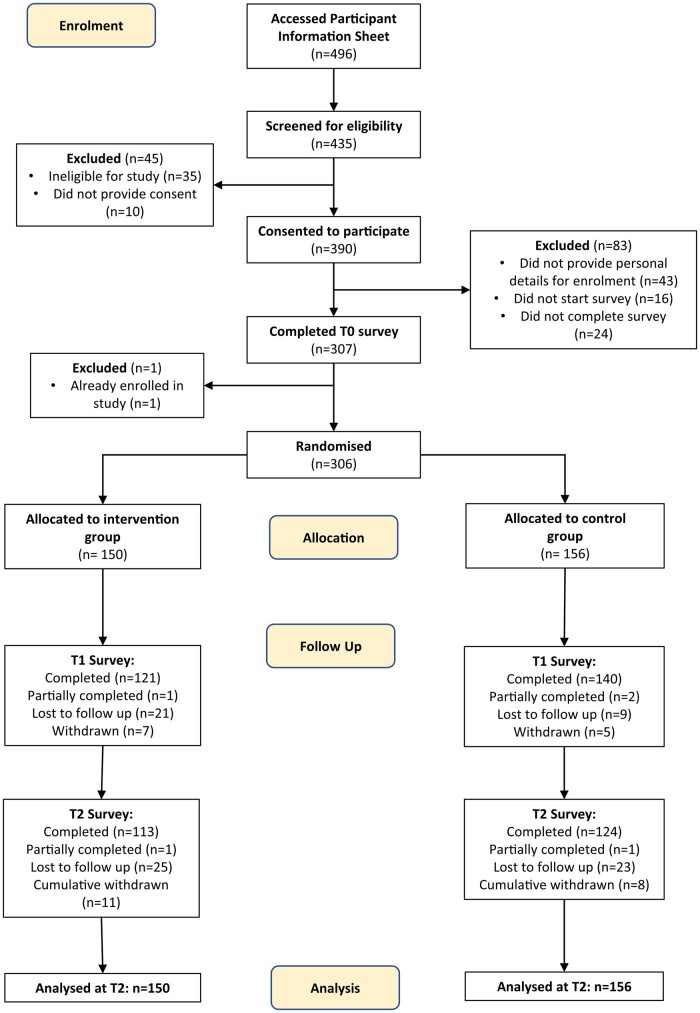
Main results and the role of chance: Overall, 306 participants (mean age 30 years; SD: 5.2) were randomized (intervention n = 150, control n = 156). Decisional Conflict Scale scores were significantly lower at 12 months (mean score difference: -6.99 [95% CI: -12.96, -1.02], P = 0.022) for the intervention versus control group after adjusting for baseline decisional conflict. At 6 months, the intervention group felt significantly more prepared to decide about EEF than the control (mean score difference: 9.22 [95% CI: 2.35, 16.08], P = 0.009). At 12 months, no group differences were observed in distress (mean score difference: 0.61 [95% CI: -3.72, 4.93], P = 0.783), knowledge (mean score difference: 0.23 [95% CI: -0.21, 0.66], P = 0.309), or whether a decision was made (relative risk: 1.21 [95% CI: 0.90, 1.64], P = 0.212). No group differences were found in informed choice (relative risk: 1.00 [95% CI: 0.81, 1.25], P = 0.983) or decision regret (median score difference: -5.00 [95% CI: -15.30, 5.30], P = 0.337) amongst participants who had decided about EEF by 12 months (intervention n = 48, control n = 45).
Limitations, reasons for caution: Unknown participant uptake and potential sampling bias due to the recruitment methods used and restrictions caused by the coronavirus disease 2019 pandemic. Some outcomes had small sample sizes limiting the inferences made. The use of study-specific or adapted validated measures may impact the reliability of some results.
Wider implications of the findings: This is the first randomized controlled trial to evaluate a Decision Aid for EEF. The Decision Aid reduced decisional conflict and improved women's preparation for decision making. The tool will be made publicly available and can be tailored for international use.
Study funding/competing interest(s): The Decision Aid was developed with funding from the Royal Women's Hospital Foundation and McBain Family Trust. The study was funded by a National Health and Medical Research Council (NHMRC) Project Grant APP1163202, awarded to M. Hickey, M. Peate, R.J. Norman, and R. Hart (2019-2021). S.S., M.P., D.K., and S.B. were supported by the NHMRC Project Grant APP1163202 to perform this work. R.H. is Medical Director of Fertility Specialists of Western Australia and National Medical Director of City Fertility. He has received grants from MSD, Merck-Serono, and Ferring Pharmaceuticals unrelated to this study and is a shareholder of CHA-SMG. R.L. is Director of Women's Health Melbourne (Medical Practice), ANZSREI Executive Secretary (Honorary), RANZCOG CREI Subspecialty Committee Member (Honorary), and a Fertility Specialist at Life Fertility Clinic Melbourne and Royal Women's Hospital Public Fertility Service. R.A.A. has received grants from Ferring Pharmaceuticals unrelated to this study. M.H., K.H., and R.J.N. have no conflicts to declare.
Trial registration number: ACTRN12620001032943.
Trial registration date: 11 August 2020.
Date of first patient’s enrolment: 29 September 2020.
Keywords: RCT; decision aid; decision making; decision support; decisional conflict; egg freezing; fertility preservation; information; oocyte cryopreservation; randomized.
© The Author(s) 2024. Published by Oxford University Press on behalf of European Society of Human Reproduction and Embryology.
Conflict of interest statement
S.S., M.P., D.K., and S.B. were supported by the NHMRC Project Grant APP1163202 to perform this work. R.H. is Medical Director of Fertility Specialists of Western Australia and National Medical Director of City Fertility. He has received grants from MSD, Merck-Serono, and Ferring Pharmaceuticals unrelated to this study and is a shareholder of CHA-SMG. R.L. is Director of Women’s Health Melbourne (Medical Practice), ANZSREI Executive Secretary (Honorary), RANZCOG CREI Subspecialty Committee Member (Honorary), and a Fertility Specialist at Life Fertility Clinic Melbourne and Royal Women’s Hospital Public Fertility Service. R.A.A. has received grants from Ferring Pharmaceuticals unrelated to this study. M.H., K.H., and R.J.N. have no conflicts to declare.
Figures
References
-
- Anderson RA, Davies MC, Lavery SA; Royal College of Obstetricians Gynaecologists. Elective egg freezing for non-medical reasons: scientific impact paper no. 63. BJOG 2020b;127:e113–e121. - PubMed
-
- Argyle CE, Harper JC, Davies MC. Oocyte cryopreservation: where are we now? Hum Reprod Update 2016;22:440–449. - PubMed
-
- Australian Commission on Safety and Quality in Healthcare. Decision Support Tools for Consumers. https://www.safetyandquality.gov.au/our-work/partnering-consumers/shared... (1 August 2022, date last accessed).
-
- Baldwin K, Culley L. Women’s experience of social egg freezing: perceptions of success, risks, and ‘going it alone’. Hum Fertil (Camb) 2020;23:186–192. - PubMed
Publication types
MeSH terms
Grants and funding
LinkOut - more resources
Full Text Sources
Research Materials
