


Physiology of the volume-sensitive/regulatory anion channel VSOR/VRAC: part 2: its activation mechanisms and essential roles in organic signal release
- PMID: 38877402
- PMCID: PMC11177392
- DOI: 10.1186/s12576-024-00926-3
Physiology of the volume-sensitive/regulatory anion channel VSOR/VRAC: part 2: its activation mechanisms and essential roles in organic signal release
Abstract
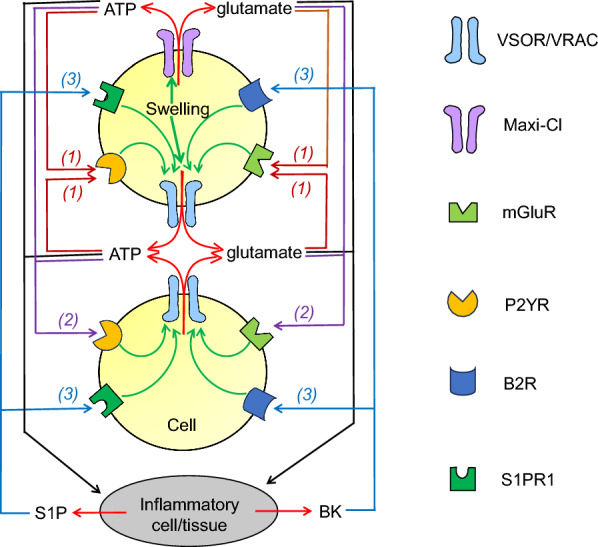
The volume-sensitive outwardly rectifying or volume-regulated anion channel, VSOR/VRAC, which was discovered in 1988, is expressed in most vertebrate cell types, and is essentially involved in cell volume regulation after swelling and in the induction of cell death. This series of review articles describes what is already known and what remains to be uncovered about the functional and molecular properties as well as the physiological and pathophysiological roles of VSOR/VRAC. This Part 2 review article describes, from the physiological and pathophysiological standpoints, first the pivotal roles of VSOR/VRAC in the release of autocrine/paracrine organic signal molecules, such as glutamate, ATP, glutathione, cGAMP, and itaconate, as well as second the swelling-independent and -dependent activation mechanisms of VSOR/VRAC. Since the pore size of VSOR/VRAC has now well been evaluated by electrophysiological and 3D-structural methods, the signal-releasing activity of VSOR/VRAC is here discussed by comparing the molecular sizes of these organic signals to the channel pore size. Swelling-independent activation mechanisms include a physicochemical one caused by the reduction of intracellular ionic strength and a biochemical one caused by oxidation due to stimulation by receptor agonists or apoptosis inducers. Because some organic substances released via VSOR/VRAC upon cell swelling can trigger or augment VSOR/VRAC activation in an autocrine fashion, swelling-dependent activation mechanisms are to be divided into two phases: the first phase induced by cell swelling per se and the second phase caused by receptor stimulation by released organic signals.
Keywords: ATP; LRRC8; Organic signal; Pore size; ROS; Volume-sensitive anion channel.
© 2024. The Author(s).
Conflict of interest statement
The author declares no competing interests.
Figures

References
-
- Okada Y, Okada T, Sato-Numata K, Islam MR, Ando-Akatsuka Y, Numata T, Kubo M, Shimizu T, Kurbannazarova RS, Marunaka M, Sabirov RZ. Cell volume-activated and -correlated anion channels in mammalian cells: their biophysical, molecular and pharmacological properties. Pharmacol Rev. 2019;71:49–88. doi: 10.1124/pr.118.015917. - DOI - PubMed
-
- Cahalan MD, Lewis RS. Role of potassium and chloride channels in volume regulation by T lymphocytes. Soc Gen Physiol Ser. 1988;43:281–301. - PubMed
Publication types
MeSH terms
LinkOut - more resources
Full Text Sources
