. 2024 Jun;14(6):e1733.
doi: 10.1002/ctm2.1733.

Heavy metals in cigarette smoke strongly inhibit pancreatic ductal function and promote development of chronic pancreatitis

Affiliations

Heavy metals in cigarette smoke strongly inhibit pancreatic ductal function and promote development of chronic pancreatitis

Petra Pallagi et al. Clin Transl Med. 2024 Jun.

Abstract

Background and aims: Smoking is recognised as an independent risk factor in the development of chronic pancreatitis (CP). Cystic fibrosis transmembrane conductance regulator (CFTR) function and ductal fluid and bicarbonate secretion are also known to be impaired in CP, so it is crucial to understand the relationships between smoking, pancreatic ductal function and the development of CP.

Methods: We measured sweat chloride (Cl-) concentrations in patients with and without CP, both smokers and non-smokers, to assess CFTR activity. Serum heavy metal levels and tissue cadmium concentrations were determined by mass spectrometry in smoking and non-smoking patients. Guinea pigs were exposed to cigarette smoke, and cigarette smoke extract (CSE) was prepared to characterise its effects on pancreatic HCO3 - and fluid secretion and CFTR function. We administered cerulein to both the smoking and non-smoking groups of mice to induce pancreatitis.

Results: Sweat samples from smokers, both with and without CP, exhibited elevated Cl- concentrations compared to those from non-smokers, indicating a decrease in CFTR activity due to smoking. Pancreatic tissues from smokers, regardless of CP status, displayed lower CFTR expression than those from non-smokers. Serum levels of cadmium and mercury, as well as pancreatic tissue cadmium, were increased in smokers. Smoking, CSE, cadmium, mercury and nicotine all hindered fluid and HCO3 - secretion and CFTR activity in pancreatic ductal cells. These effects were mediated by sustained increases in intracellular calcium ([Ca2+]i), depletion of intracellular ATP (ATPi) and mitochondrial membrane depolarisation.

Conclusion: Smoking impairs pancreatic ductal function and contributes to the development of CP. Heavy metals, notably cadmium, play a significant role in the harmful effects of smoking.

Key points: Smoking and cigarette smoke extract diminish pancreatic ductal fluid and HCO3 - secretion as well as the expression and function of CFTR Cd and Hg concentrations are significantly higher in the serum samples of smokers Cd accumulates in the pancreatic tissue of smokers.

Keywords: CFTR; cadmium; chronic pancreatitis; epithelial ion secretion; smoking.


Conflict of interest statement

The authors have no relevant financial or non‐financial interests to disclose.

Figures
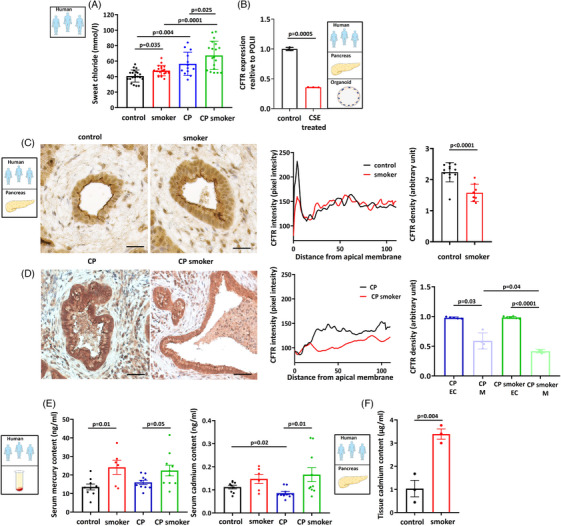
FIGURE 1
FIGURE 1
Cystic fibrosis transmembrane conductance regulator (CFTR) expression and activity are decreased in smokers and in chronic pancreatitis (CP) patients. (A) Clsw was significantly higher in smoking patients (n = 16) compared to non‐smoking controls (n = 20). There is a significant difference in CP (n = 12) versus the control patients. Further elevation in sweat Cl concentration (Clsw ) was observed in the smoking CP (n = 19) patients compared to the CP group. (B) Expression analysis showed that incubation of human pancreatic organoid cultures with 80 µg/mL cigarette smoke extract (CSE) significantly reduced the mRNA expression of CFTR. Expression levels were calculated relative to the POLII gene. (C) Representative confocal images showed that smoking significantly reduced CFTR expression on the apical membrane of pancreatic ductal epithelial cells in tissues from the human non‐smoker and smoker cadaver donors (n = 3). Scale bar = 50 µm. (D) The intensity profile confirmed that apical CFTR distribution was impaired in response to smoking. CFTR staining density at the luminal membrane was decreased in the smoking CP patients (H), whereas there was no significant difference in cytoplasmic density of CFTR between the non‐smoker CP (G) and smoker CP groups (n = 3). EC: cytoplasm; M: membrane. Scale bar = 50 µm. Exact p‐values are indicated above each column. (E) Analysis of the human serum samples showed that their mercury (Hg) content was significantly higher in smoker groups, both in the control and CP patients (n = 7−10). No significant difference in serum cadmium (Cd) concentration was observed between the non‐smoker (n = 9) and smoker (n = 7) controls. However, there was a significantly higher Cd concentration in the smoking CP (n = 10) versus non‐smoking CP (n = 10) patients. (F) Cd level was significantly higher in human pancreatic tissue samples derived from the smoker compared to the non‐smoker cadaver donors (n = 3).
FIGURE 2
FIGURE 2
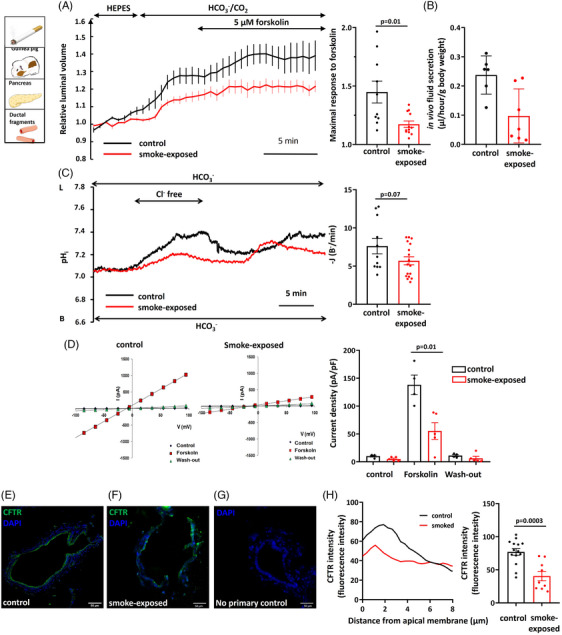
Smoke inhalation reduces pancreatic fluid and bicarbonate secretion and inhibits cystic fibrosis transmembrane conductance regulator (CFTR) Cl channel expression and function. (A and B) A six‐week period of smoke inhalation caused significantly reduced forskolin‐stimulated in vitro (A) and secretin‐stimulated in vivo (B) fluid secretion of isolated guinea pig pancreatic ducts. (C) Alkalisation of intracellular pH (pHi) caused by luminal Cl removal from the extracellular solution was significantly lower in isolated ducts from the smoke‐exposed animals (n = 17) compared to the control (n = 11), suggesting that HCO3 secretion is reduced by smoking. L: luminal side; B: basal side. (D) The whole‐cell configuration of the patch clamp technique demonstrated that whole‐body smoke exposure significantly reduced the forskolin‐stimulated Cl current of CFTR in smoking guinea pig pancreas ductal epithelial cells (n = 4−5). (E–G) Confocal images indicated that the apical plasma membrane expression of CFTR was significantly decreased in guinea pig pancreatic ducts exposed to whole‐body smoke (F) compared to the control (E). (G) No‐primary antibody control. Green: CFTR; blue: DAPI. Scale bar = 50 µm. (H) Intensity profile of CFTR localisation confirmed that apical distribution was impaired because of the effect of smoking (n = 9−14). Exact p‐values are indicated above each column.
FIGURE 3
FIGURE 3
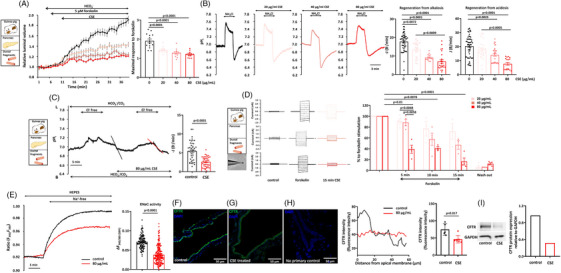
Cigarette smoke extract (CSE) reduces pancreatic fluid and bicarbonate secretion, inhibits cystic fibrosis transmembrane conductance regulator (CFTR) Cl channel expression and function and ENaC activity. (A) CSE treatment in 20, 40 and 80 µg/mL concentrations significantly inhibited the forskolin‐stimulated fluid secretion of pancreatic ducts isolated from the control guinea pigs. (B) Representative pHi traces show that regeneration from alkalosis evoked by 20 mM NH4Cl was significantly and dose‐dependently reduced after 30 min CSE pretreatment. Recovery from acid load was also diminished by preincubation of the isolated pancreatic ducts with 20, 40 and 80 µg/mL CSE, suggesting that the activity of luminal and basolateral transporters may also be impaired. (C) The initial rate of pHi recovery after luminal Cl re‐addition was significantly lower after preincubation of pancreatic ducts with 80 µg/mL CSE for 30 min (n = 5). (D) Patch clamp measurements showed that CSE significantly and irreversibly decreased the CFTR‐mediated forskolin‐stimulated, Cl current‐, time‐ and dose‐dependent manner in guinea pig pancreatic ductal epithelial cells (PDECs) (n = 4). (E) Representative traces and summary data of the ΔF 344/380 show the effect of 80 µg/mL CSE on [Na+]i. ENaC activity was significantly decreased after CSE treatment. (F–H) Confocal images indicate that localisation of CFTR on apical plasma membrane is significantly decreased in guinea pig pancreatic ducts after pretreatment with 80 µg/mL CSE (G) compared to the control (F). (H) No‐primary antibody control. Scale bar = 50 µm. Green: CFTR; blue: DAPI. Intensity profile of CFTR localisation confirmed that apical distribution was impaired because of the effect of CSE preincubation (n = 5−7). Exact p‐values are indicated above each column. (I) Western blot analysis of CFTR protein level: protein samples were isolated from guinea pig pancreas organoid cultures after 12 h 80 µg/mL CSE incubation. CFTR protein level is markedly decreased in the pancreas after incubation for 12 h with 80 µg/ml CSE.
FIGURE 4
FIGURE 4
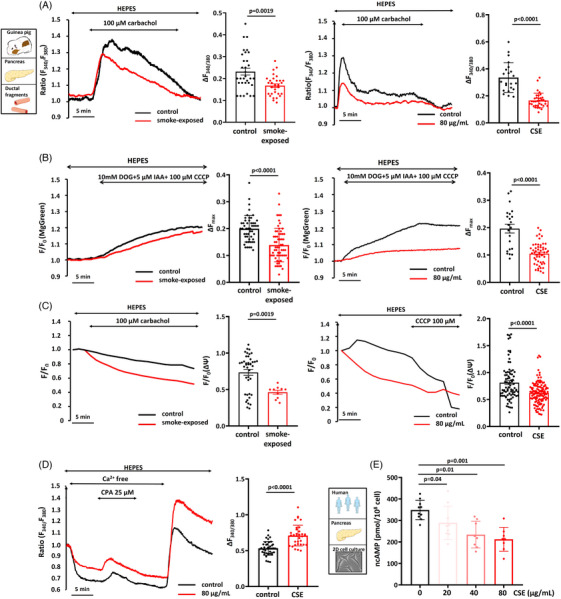
Smoke inhalation and cigarette smoke extract (CSE) reduce the maximum elevation of [Ca2+]i, ATP level and decrease mitochondrial membrane potential in isolated guinea pig pancreatic ductal cells. (A) Representative traces and summary data of the δRatiomax showing the effect of smoking and CSE on [Ca2+]i. The maximum response to 100 µM carbachol was significantly smaller in pancreatic ductal fragments isolated from the smoking animals and also after pretreatment with 80 µg/mL CSE (n = 5−7). (B) Total ATP depletion induced by a combination of deoxyglucose/iodoacetate/carbonyl cyanide 3‐chlorophenylhydrazone showed a significantly lower level of intracellular ATP in pancreatic ductal fragments isolated from the smoking animals or treated with CSE (n = 5−7). (C) Mitochondrial membrane potential was significantly diminished by smoking or CSE incubation (n = 5−7). (D) Representative traces of [Ca2+]i demonstrating that CSE incubation significantly reduced extracellular Ca2+ influx in guinea pig pancreatic ductal fragments. (E) Summary data for cAMP measurements showing that total intracellular cAMP level was significantly reduced after preincubation of 20, 40 and 80 µg/mL CSE in CAPAN‐1 cells (n = 3).
FIGURE 5
FIGURE 5
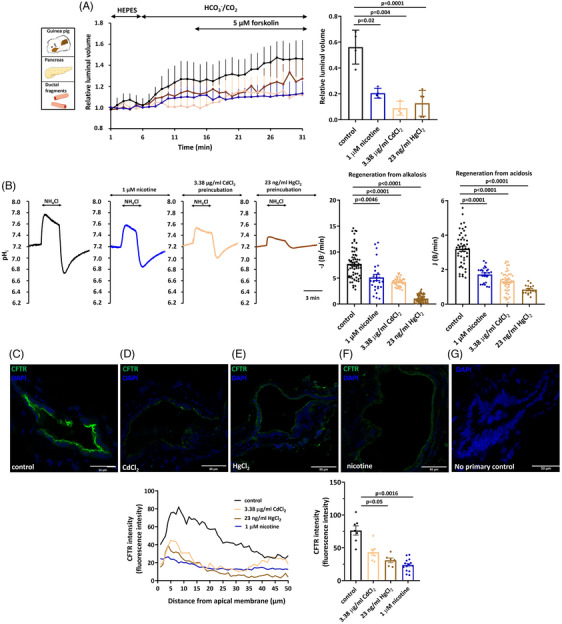
Nicotine, mercury and cadmium inhibit the functions of isolated guinea pig pancreatic epithelial cells. (A) Average traces and summary bar charts showing that forskolin‐stimulated fluid secretion into the closed luminal space was inhibited by administration of 1 µM nicotine (n = 4), 3.38 µg/mL Cd (n = 3) or 23 ng/mL Hg (n = 5) compared to the control. (B) Representative pHi traces and summary bar charts demonstrating that regeneration from alkalosis and acidosis was significantly reduced by 30 min pretreatment with all three components of cigarette smoke. (C–F) Confocal images showing preincubation of isolated pancreatic ductal fragments with Cd (D), Hg (E) or nicotine (F) significantly reduced the apical localisation of cystic fibrosis transmembrane conductance regulator (CFTR). (G) No‐primary antibody control. Scale bar = 50 µm. Green: CFTR; blue: DAPI. An intensity profile of CFTR localisation confirmed that apical distribution was reduced after nicotine, Hg or Cd preincubation.
FIGURE 6
FIGURE 6
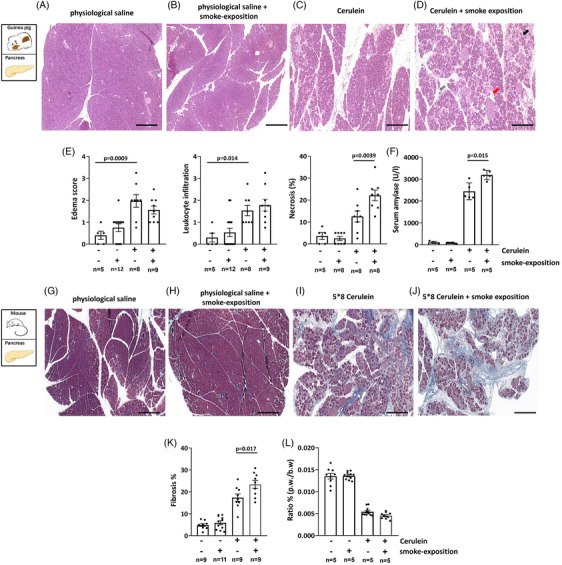
Smoking increases the severity of cerulein‐induced pancreatitis. Acute pancreatitis (AP) was induced by 10 h i.p. injections of either physiological saline (PS and control group) or 50 µg/kg cerulein after a 6‐week smoking period. (A–D) Representative haematoxylin and eosin (H&E) images of guinea pig pancreas. (A and B) PS and smoking alone caused no significant changes in pancreas histology. However, cerulein administration (C and D) induced a significant increase in pancreatic oedema (grey arrow on H&E image) (E), leukocyte infiltration scores (red arrow on H&E image) (E), necrosis (black arrow on H&E image) (E) or serum amylase activity (F). No significant differences were observed in the extent of interstitial oedema or leukocyte infiltration between the cerulein‐treated non‐smoker and smoker groups (E). However, the level of necrosis was significantly higher in the cerulein‐treated smoker group in comparison with the cerulein‐treated non‐smoking animals (E). Serum amylase activity was also significantly elevated in the cerulein‐treated smoking animals versus the cerulein‐treated non‐smoker group (F). Scale bar = 50 µm. Chronic pancreatitis (CP) was induced by repetitive i.p. injection of cerulein during the smoke‐exposed period in mice. In the last 2 weeks of the 6‐week smoking period used in previous experiments, the mice received five series of 8 hourly PS (control group) or 50 µg/bw kg cerulein injections every third day. (G–J) Representative Crossmon's trichrome staining images of mouse pancreas. Both the smoking and non‐smoking animals had normal pancreatic histology (G and H), whereas repetitive cerulein administration caused severe acinar cell atrophy, extensive fibrosis and the presence of acinar‐to‐ductal metaplasia (I and J), which was significantly worsened in the mice exposed to whole‐body smoke for 6 weeks (K). There was no significant difference was detected in pancreas weight/body weight ratio between the non‐smoker and smoker CP animals (L).

References

    1. Braganza JM, Lee SH, McCloy RF, McMahon MJ. Chronic pancreatitis. Lancet. 2011;377:1184‐1197. - PubMed
    1. Tattersall SJN, Apte MV, Wilson JS. A fire inside: current concepts in chronic pancreatitis. Intern Med J. 2008;38:592‐598. - PubMed
    1. Kleeff J, Whitcomb DC, Shimosegawa T, et al. Chronic pancreatitis. Nat Rev Dis Primers. 2017;3:17060. - PubMed
    1. Olesen SS, Phillips AE, Faghih M, et al. Overlap and cumulative effects of pancreatic duct obstruction, abnormal pain processing and psychological distress on patient‐reported outcomes in chronic pancreatitis. Gut. 2022;71:2518‐2525. - PubMed
    1. Jagannath S, Garg PK. Novel and experimental therapies in chronic pancreatitis. Dig Dis Sci. 2017;62:1751‐1761. - PubMed

Substances

LinkOut - more resources