


Glucoselysine, a unique advanced glycation end-product of the polyol pathway and its association with vascular complications in type 2 diabetes
- PMID: 38879006
- PMCID: PMC11283207
- DOI: 10.1016/j.jbc.2024.107479
Glucoselysine, a unique advanced glycation end-product of the polyol pathway and its association with vascular complications in type 2 diabetes
Abstract
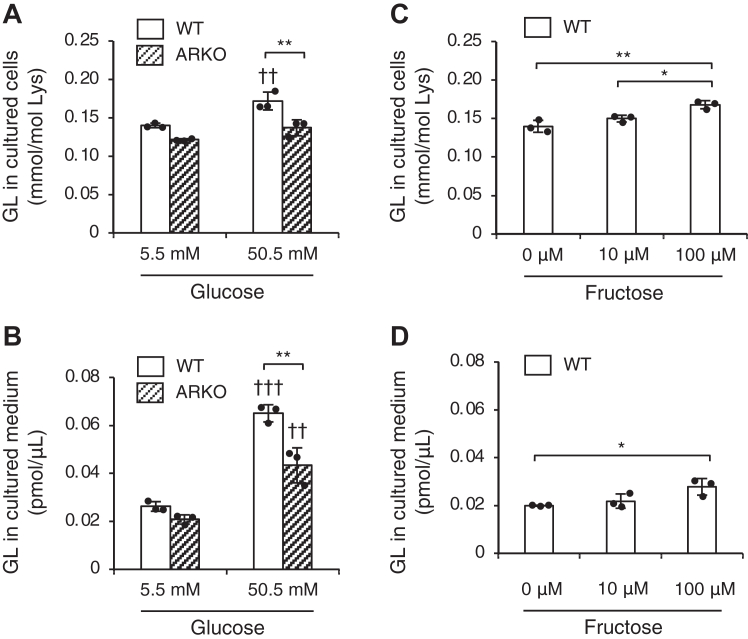
Glucoselysine (GL) is an unique advanced glycation end-product derived from fructose. The main source of fructose in vivo is the polyol pathway, and an increase in its activity leads to diabetic complications. Here, we aimed to demonstrate that GL can serve as an indicator of the polyol pathway activity. Additionally, we propose a novel approach for detecting GL in peripheral blood samples using liquid chromatography-tandem mass spectrometry and evaluate its clinical usefulness. We successfully circumvent interference from fructoselysine, which shares the same molecular weight as GL, by performing ultrafiltration and hydrolysis without reduction, successfully generating adequate peaks for quantification in serum. Furthermore, using immortalized aldose reductase KO mouse Schwann cells, we demonstrate that GL reflects the downstream activity of the polyol pathway and that GL produced intracellularly is released into the extracellular space. Clinical studies reveal that GL levels in patients with type 2 diabetes are significantly higher than those in healthy participants, while Nδ-(5-hydro-5-methyl-4-imidazolon-2-yl)ornithine (MG-H1) levels are significantly lower. Both GL and MG-H1 show higher values among patients with vascular complications; however, GL varies more markedly than MG-H1 as well as hemoglobin A1c, fasting plasma glucose, and estimated glomerular filtration rate. Furthermore, GL remains consistently stable under various existing drug treatments for type 2 diabetes, whereas MG-H1 is impacted. To the best of our knowledge, we provide important insights in predicting diabetic complications caused by enhanced polyol pathway activity via assessment of GL levels in peripheral blood samples from patients.
Keywords: advanced glycation end-products (AGEs); aldose reductase; biomarker; blood; diabetes; fructose; glucose metabolism; glucoselysine; hyperglycemia; mass spectrometry (MS); polyol pathway.
Copyright © 2024 The Authors. Published by Elsevier Inc. All rights reserved.
Conflict of interest statement
Conflict of interest The authors declare that they have no conflicts of interest with the contents of this article.
Figures




References
-
- Brownlee M. Biochemistry and molecular cell biology of diabetic complications. Nature. 2001;414:813–820. - PubMed
-
- Nathan D.M., Genuth S., Lachin J., Cleary P., Crofford O., Davis M., et al. The effect of intensive treatment of diabetes on the development and progression of long-term complications in insulin-dependent diabetes mellitus. N. Engl. J. Med. 1993;329:977–986. - PubMed
-
- UK Prospective Diabetes Study (UKPDS) Group Intensive blood-glucose control with sulphonylureas or insulin compared with conventional treatment and risk of complications in patients with type 2 diabetes (UKPDS 33) Lancet. 1998;352:837–853. - PubMed
-
- Ohkubo Y., Kishikawa H., Araki E., Miyata T., Isami S., Kojima Y., et al. Intensive insulin therapy prevents the progression of diabetic microvascular complications in Japanese patients with non-insulin-dependent diabetes mellitus: a randomized prospective 6-year study. Diabetes Res. Clin. Pract. 1995;28:103–117. - PubMed
-
- Wei M., Gaskill S.P., Haffner S.M., Stern M.P. Effects of diabetes and level of glycemia on all-cause and cardiovascular mortality. The San Antonio Heart Study. Diabetes Care. 1998;21:1167–1172. - PubMed
Publication types
MeSH terms
Substances
LinkOut - more resources
Full Text Sources
Medical
Research Materials
