. 2024 Jun 15;15(1):5124.
doi: 10.1038/s41467-024-49032-3.

Oceanic Anoxic Event 2 triggered by Kerguelen volcanism

Affiliations

Oceanic Anoxic Event 2 triggered by Kerguelen volcanism

C A Walker-Trivett et al. Nat Commun. .

Abstract

Large Igneous Provinces (LIPs) are associated with global warming and carbon cycle perturbations during Oceanic Anoxic Event 2 (OAE2, ~94 Ma) and the Mid-Cenomanian Event (MCE, ~96.5 Ma). However, there is still no consensus on the role volcanism played as a trigger, or its source - previously ascribed to the Caribbean LIP or High Arctic LIP. Here, we use Mentelle Basin sedimentary mercury (Hg) concentrations to determine the timing of volcanism, and neodymium (Nd) and strontium (Sr) isotopes for sedimentary provenance. High Hg concentrations compared to Northern Hemisphere records, and a shift to radiogenic Nd isotopes, indicates Kerguelen LIP volcanic activity and plateau uplift occurred in the lead up to and within OAE2. Whilst we find limited evidence that a volcanic event caused the MCE, pulsed Hg spikes before and during OAE2 imply volcanic emissions were key in driving climate and carbon cycle changes and triggering OAE2.


Conflict of interest statement

The authors declare no competing interests.

Figures

Fig. 1
Fig. 1. Mid-Cretaceous palaeogeography and large igneous provinces.
Paleogeographic reconstructions of the mid-Cretaceous, created on GPlates using time dependent raster files. a Mollweide Projection. Pink shaded areas with a white outline represent modelled extent of active Large Igneous Provinces (LIPs). HALIP = High Arctic Large Igneous Province; OJP = Ontong Java Plateau; KP = Kerguelen Plateau; CLIP = Caribbean Large Igneous Province; MB = Mentelle Basin; WIS = Western Interior Seaway; EES = Eurasian Epicontinental Sea; GZ = Gongzha Section, Tibet; 1138 = Ocean Drilling Program Site 1138; MBT = Maverick Basin, Texas; VB = Vocontian Basin, France; EB = Eastbourne, UK; YG =Yezo Group, Hokkaido, Japan; 1260 = Site 1260 B, Demerara Rise, Atlantic Ocean; TB = Tarfaya Basin, Morocco. b The proto-Indian Ocean region focused on the Kerguelen Plateau and the Mentelle Basin. Dashed purple arrow = mean direction of intermediate water mass (500–1500 m) flow during the Cenomanian. Absolute ages of volcanic activity on the Kerguelen Plateau and named sub-sections of the LIP. NKP = North Kerguelen Plateau, BR = Broken Ridge; SKP = South Kerguelen Plateau; CKP/EB = Central Kerguelen Plateau/Elan Bank.
Fig. 2
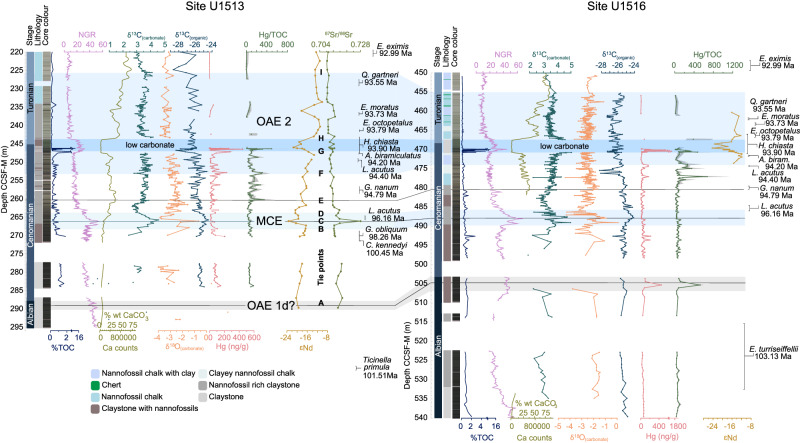
Fig. 2. Sites U1513 and U1516 correlation.
Planktonic foraminifera and calcareous nannofossil bio-events, constrain the timing of Oceanic Anoxic Event 2 (OAE2) and the Mid-Cenomanian Event (MCE). Core lithology, colour and Natural Gamma Radiation (NGR) from International Ocean Discovery Program Expedition 369 Proceedings. Calcium (Ca) counts (X-Ray Fluorescence (XRF) data) correlate with measured % calcium carbonate (CaCO3), and the relationship between them is used to create a scale for %CaCO3. CCSF (m) = core composite depth below sea floor in meters. % total organic carbon (TOC), δ13C(organic), mercury (Hg) and Hg/TOC, 87Sr/86Sr and εNd presented in this study. δ13C(carbonate) is a compilation of data from this and other recent studies,. Light blue shading represents the MCE and OAE2, with darker blue shading indicating the low carbonate  zone in OAE2. A light grey shaded area indicates the possible location of OAE 1d (see Supplementary Materials for identification of OAEs). Grey shading in Hg/TOC data represents uncertainty – see details in methods for calculations.
Fig. 3
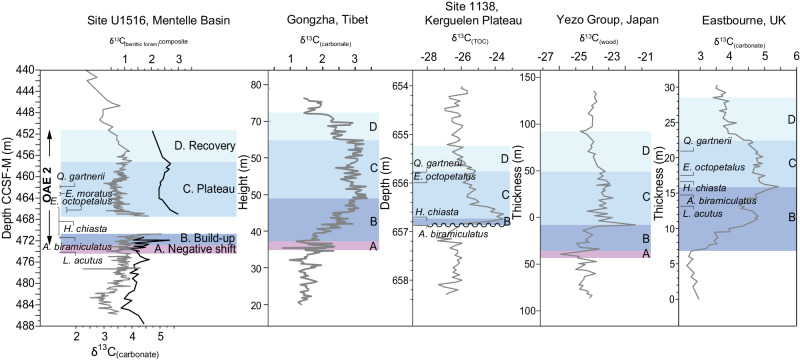
Fig. 3. Refined Oceanic Anoxic Event 2 (OAE2) carbon isotope stages in the Mentelle Basin.
Refined carbon isotope stages from site U1516 in the Mentelle Basin, Australia, supported by biostratigraphy,. Bulk carbonate (grey) and benthic foraminifera δ13C data (black) are shown for the Mentelle Basin – the latter showing a prolonged positive excursion compared to bulk isotope data. Colour bands indicate different carbon isotope stages of OAE2 that are used to establish correlations of the OAE2 records. Data from the Mentelle Basin (this study), Gongzha, Tingri, southern Tibet, Ocean Drilling Program (ODP) Site 1138 (Kerguelen Plateau), Yezo Group, Japan and Eastbourne, UK.
Fig. 4
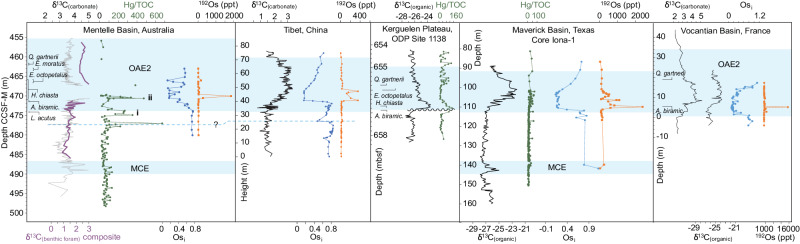
Fig. 4. Volcanic signals across Oceanic Anoxic Event 2 (OAE2) and the Mid-Cenomanian Event (MCE).
Hg relative to total organic carbon (Hg/TOC), δ13C and osmium (Os) isotope records of OAE2 and the MCE from the Mentelle Basin (proto-Indian Ocean), Maverick Basin (Western Interior Seaway),, Tibet, the Kerguelen Plateau, and Vocontian Trough, south-east France,. Hg/TOC values in the Mentelle Basin are an order of magnitude higher than at Northern Hemisphere sites across OAE2, indicating a proximal source of volcanism to southwest Australia. Data from the Kerguelen Plateau are incomplete due to a hiatus during OAE2 onset – precluding direct comparison with the Mentelle Basin, and making a Kerguelen Plateau source of Hg possible, despite generally low Hg/TOC values in the upper portion of the OAE2 record from Ocean Drilling Program (ODP) Site 1138 (Kerguelen Plateau).
Fig. 5
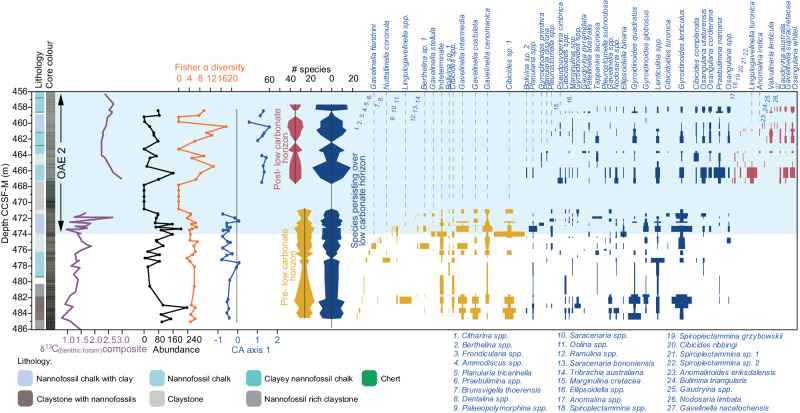
Fig. 5. Site U1516 benthic foraminifera assemblage shift over Oceanic Anoxic Event 2 (OAE2).
Range chart, abundance, Fisher α diversity, Correspondence Analysis (CA) Axis 1, and carbon isotopes from benthic foraminifera. A significant shift in assemblage is seen either side of the low carbonate horizon. Axis 1 of the CA correlates with the proportion of infaunal / high productivity species (Supplementary data 2). Thus, high values above the low carbonate horizon suggest high organic carbon flux in the later stages of OAE2.
Fig. 6
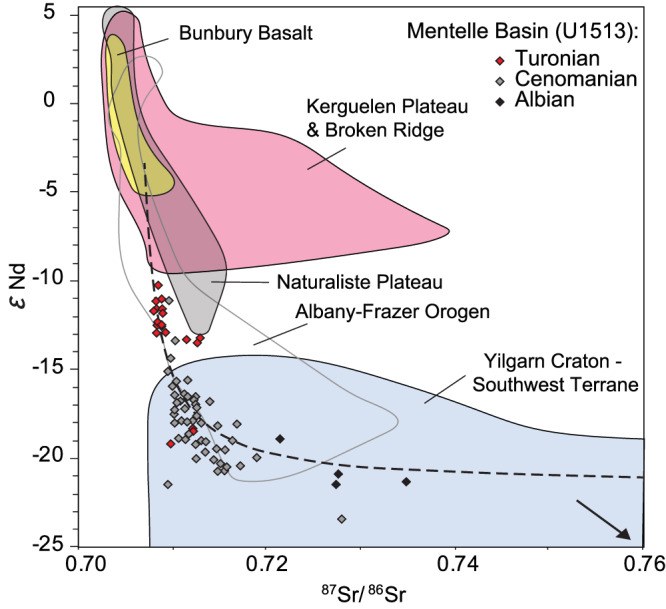
Fig. 6. Change in sediment provenance from Albian - Turonian in the Mentelle Basin.
Neodymium (Nd) and strontium (Sr) isotope data from detrital sediments of Site U1513 (this study), Mentelle Basin, and proximal geological terranes. Fields represent the approximate ranges of terrane values based on published literature (Supplementary Data 3). The dashed line represents a mixing calculation between the average values for the Kerguelen Plateau and Yilgarn Craton (Southwest Terrane). Site U1513 Turonian values (red) are approximately concurrent with Oceanic Anoxic Event 2.
Fig. 7
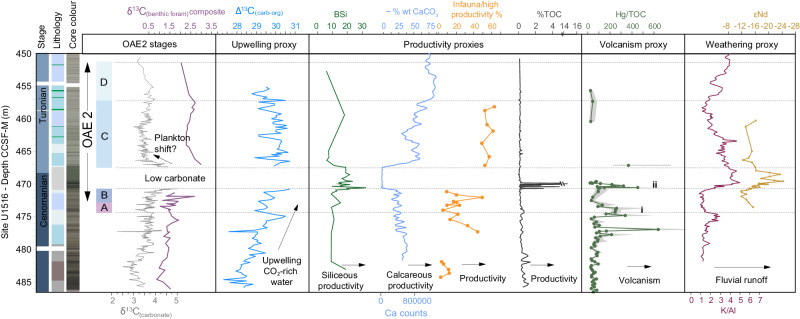
Fig. 7. Environmental interpretations across Ocean Anoxic Event 2 (OAE2).
Summary figure showing environmental interpretations for the Mentelle Basin, Site U1516, during OAE2. Δ13C interpreted as local increased CO2 in the surface waters – either as a result of higher atmospheric CO2 levels or increased upwelling. δ13C(carbonate) and δ13C(benthic foram) composite show similar trends prior to OAE2, and during phases A and B. After the low carbonate horizon, there is an offset between the two, possibly caused by a change in the dominance or abundance of different planktic groups. Hg relative to total organic carbon (Hg/TOC) data show sporadic enhanced volcanism prior to OAE2, with the first large Hg/TOC signal occurring at OAE2 onset, corresponding with a negative shift in δ13C for both bulk and composite benthic foraminiferal records. Another large spike in Hg/TOC corresponds with the start of enhanced fluvial runoff, demonstrated by K/Al and εNd data. Productivity is enhanced over OAE2, and remains high during phase C, despite the apparent recovery in δ13C(carbonate). A particularly intense period of productivity over the low carbonate horizon is suggested by high levels of biogenic silica (BSi).

References

    1. Huber BT, MacLeod KG, Watkins DK, Coffin MF. The rise and fall of the Cretaceous Hot Greenhouse climate. Glob. Planet. Change. 2018;167:1–23. doi: 10.1016/j.gloplacha.2018.04.004. - DOI
    1. Jenkyns, H. C. Geochemistry of oceanic anoxic events. Geochem., Geophys., Geosyst.11, 1–30 (2010).
    1. Leckie RM, Bralower TJ, Cashman R. Oceanic anoxic events and plankton evolution: Biotic response to tectonic forcing during the mid-Cretaceous. Paleoceanography. 2002;17:13-1–13–29. doi: 10.1029/2001PA000623. - DOI
    1. Heimhofer, U. et al. Vegetation response to exceptional global warmth during Oceanic Anoxic Event 2. Nat. Commun.9, 3832 (2018). - PMC - PubMed
    1. Takashima, R. et al. Prevailing oxic environments in the Pacific Ocean during the mid-Cretaceous Oceanic Anoxic Event 2. Nat. Commun.2, 234 (2011). - PubMed