


Profiling Proteins and Phosphorylation Sites During T Cell Activation Using an Integrated Thermal Shift Assay
- PMID: 38880243
- PMCID: PMC11298636
- DOI: 10.1016/j.mcpro.2024.100801
Profiling Proteins and Phosphorylation Sites During T Cell Activation Using an Integrated Thermal Shift Assay
Abstract
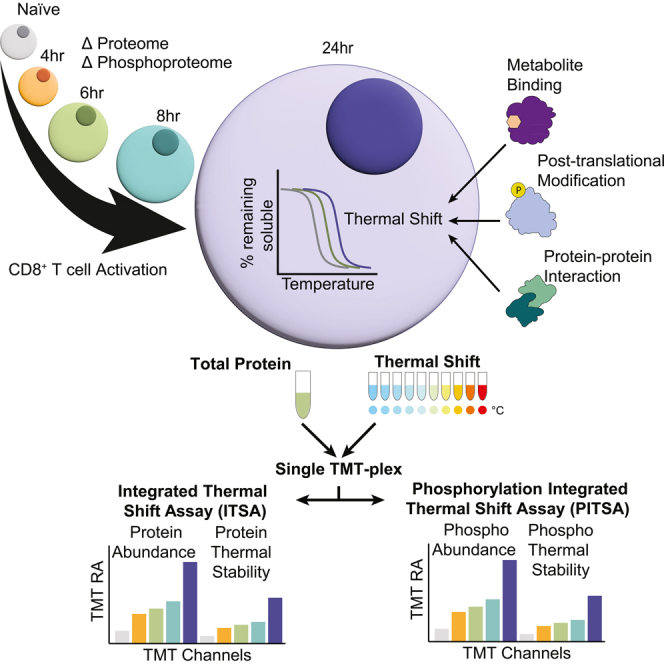
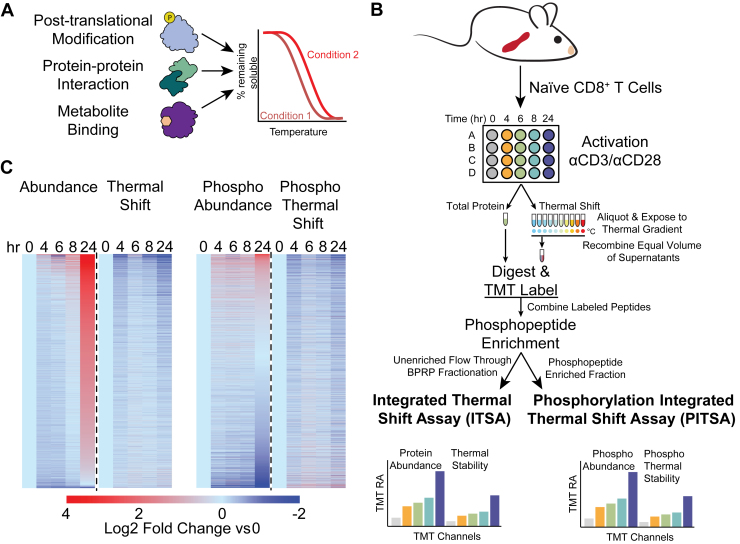
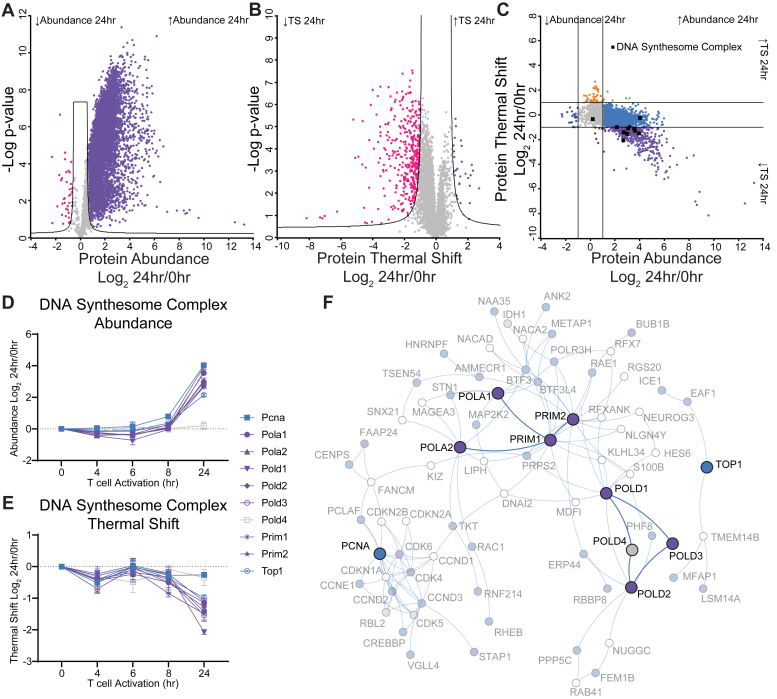
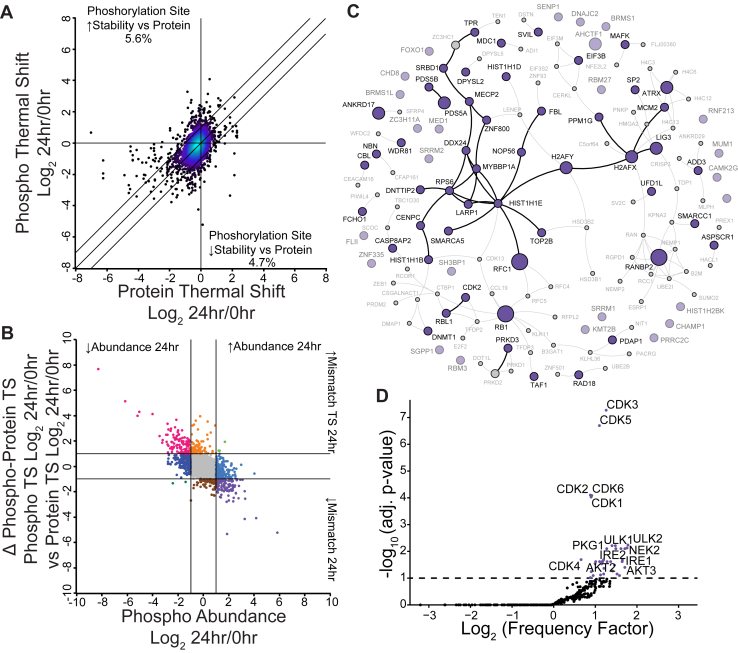
T cell activation is a complex biological process of naive cells maturing into effector cells. Proteomic and phospho-proteomic approaches have provided critical insights into this process, yet it is not always clear how changes in individual proteins or phosphorylation sites have functional significance. Here, we developed the Phosphorylation Integrated Thermal Shift Assay (PITSA) that combines the measurement of protein or phosphorylation site abundance and thermal stability into a single tandem mass tags experiment and apply this method to study T cell activation. We quantified the abundance and thermal stability of over 7500 proteins and 5000 phosphorylation sites and identified significant differences in chromatin-related, TCR signaling, DNA repair, and proliferative phosphoproteins. PITSA may be applied to a wide range of biological contexts to generate hypotheses as to which proteins or phosphorylation sites are functionally regulated in a given system as well as the mechanisms by which this regulation may occur.
Keywords: CD8((+)) T cell activation; DNA repair; cyclin-dependent kinase signaling; phosphoproteomics; proteome thermal stability; proteomics.
Copyright © 2024 The Authors. Published by Elsevier Inc. All rights reserved.
Conflict of interest statement
Conflict of interests The authors declare the following financial interests/personal relationships which may be considered as potential competing interests: S. P. G. is a member of the scientific advisory boards of Cell Signaling Technologies and ThermoFisher Scientific. L. C. C. is a founder and member of the board of directors of Agios Pharmaceuticals and is a founder and receives research support from Petra Pharmaceuticals; is listed as an inventor on a patent (WO2019232403A1, Weill Cornell Medicine) for combination therapy for PI3K-associated disease or disorder, and the identification of therapeutic interventions to improve response to PI3K inhibitors for cancer treatment; is a co-founder and shareholder in Faeth Therapeutics; has equity in and consults for Cell Signaling Technologies, Volastra, Larkspur and 1 Base Pharmaceuticals; and consults for Loxo-Lilly. J. L. J has received consulting fees from Scorpion Therapeutics and Volastra Therapeutics. T. M. Y.-B. is a co-founder of DeStroke.
Figures
References
-
- Ron-Harel N., Sharpe A.H., Haigis M.C. Mitochondrial metabolism in T cell activation and senescence: a mini-review. Gerontology. 2015;61:131–138. - PubMed
MeSH terms
Substances
Grants and funding
LinkOut - more resources
Full Text Sources
Research Materials
