


Explicitly encoding the cyclic nature of breathing signal allows for accurate breathing motion prediction in radiotherapy with minimal training data
- PMID: 38883146
- PMCID: PMC11176922
- DOI: 10.1016/j.phro.2024.100594
Explicitly encoding the cyclic nature of breathing signal allows for accurate breathing motion prediction in radiotherapy with minimal training data
Erratum in
-
Corrigendum to "Explicitly encoding the cyclic nature of breathing signal allows for accurate breathing motion prediction in radiotherapy with minimal training data" [Phys. Imaging Radiat. Oncol. 30 (2024) 100594].Phys Imaging Radiat Oncol. 2025 Feb 1;33:100718. doi: 10.1016/j.phro.2025.100718. eCollection 2025 Jan. Phys Imaging Radiat Oncol. 2025. PMID: 39981523 Free PMC article.
Abstract
Background and purpose: Active breathing motion management in radiotherapy consists of motion monitoring, quantification and mitigation. It is impacted by associated latencies of a few 100 ms. Artificial neural networks can successfully predict breathing motion and eliminate latencies. However, they require usually a large dataset for training. The objective of this work was to demonstrate that explicitly encoding the cyclic nature of the breathing signal into the training data enables significant reduction of training datasets which can be obtained from healthy volunteers.
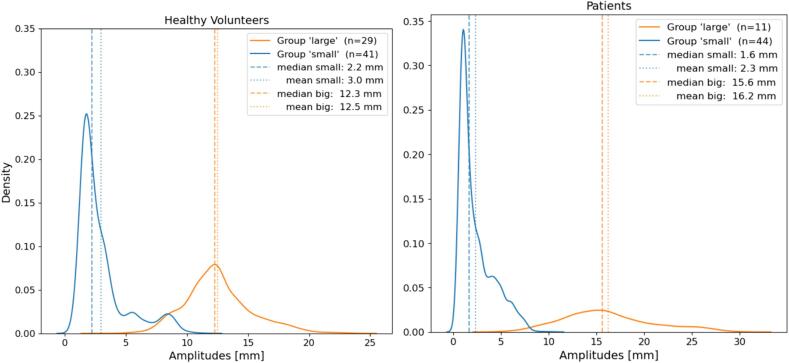
Material and methods: Seventy surface scanner breathing signals from 25 healthy volunteers in anterior-posterior direction were used for training and validation (ratio 4:1) of long short-term memory models. The model performance was compared to a model using decomposition into phase, amplitude and a time-dependent baseline. Testing of the models was performed on 55 independent breathing signals in anterior-posterior direction from surface scanner (35 lung, 20 liver) of 30 patients with a mean breathing amplitude of (5.9 ± 6.7) mm.
Results: Using the decomposed breathing signal allowed for a reduction of the absolute root-mean square error (RMSE) from 0.34 mm to 0.12 mm during validation. Testing using patient data yielded an average absolute RMSE of the breathing signal of (0.16 ± 0.11) mm with a prediction horizon of 500 ms.
Conclusion: It was demonstrated that a motion prediction model can be trained with less than 100 datasets of healthy volunteers if breathing cycle parameters are considered. Applied to 55 patients, the model predicted breathing motion with a high accuracy.
Keywords: 4D image guidance; Intrafractional motion; Long short-term memory network; Motion prediction; Real-time tumour motion monitoring.
© 2024 The Author(s).
Conflict of interest statement
The authors declare the following financial interests/personal relationships which may be considered as potential competing interests: Barbara Knäusl is associated editor in the journal “Physics and Imaging in Radiation Oncology” and Petra Trnkova member of the editorial board.
Figures


References
-
- Seppenwoolde Y., Shirato H., Kitamura K., Shimizu S., van Herk M., Lebesque J.V., et al. Precise and real-time measurement of 3D tumor motion in lung due to breathing and heartbeat, measured during radiotherapy. Int J Radiat Oncol Biol Phys. 2002;53:822–834. doi: 10.1016/s0360-3016(02)02803-1. - DOI - PubMed
-
- Anastasi G., Bertholet J., Poulsen P., Roggen T., Garibaldi C., Tilly N., et al. Patterns of practice for adaptive and real-time radiation therapy (POP-ART RT) part I: Intra-fraction breathing motion management. Radiother Oncol. 2020;153:79–87. doi: 10.1016/j.radonc.2020.06.018. - DOI - PMC - PubMed
LinkOut - more resources
Full Text Sources
