


Short-term effects of temperature-related indices on emergency ambulance dispatches due to mental and behavioral disorders in Shenzhen, China
- PMID: 38883192
- PMCID: PMC11177611
- DOI: 10.3389/fpubh.2024.1343550
Short-term effects of temperature-related indices on emergency ambulance dispatches due to mental and behavioral disorders in Shenzhen, China
Abstract
Introduction: The precise associations between temperature-related indices and mental and behavioral disorders (MBDs) have yet to be fully elucidated. Our study aims to ascertain the most effective temperature-related index and assess its immediate impact on emergency ambulance dispatches (EADs) due to MBDs in Shenzhen, China.
Methods: EADs data and meteorological data from January 1, 2013, to December 31, 2020, in Shenzhen were collected. Distributed lag non-linear models (DLNMs) were utilized to examine the non-linear and lagged effects of temperature-related indices on EADs due to MBDs. The Quasi Akaike Information criterion (QAIC) was used to determine the optimal index after standardizing temperature-related indices. After adjusting for confounding factors in the model, we estimated the immediate and cumulative effects of temperature on EADs due to MBDs.
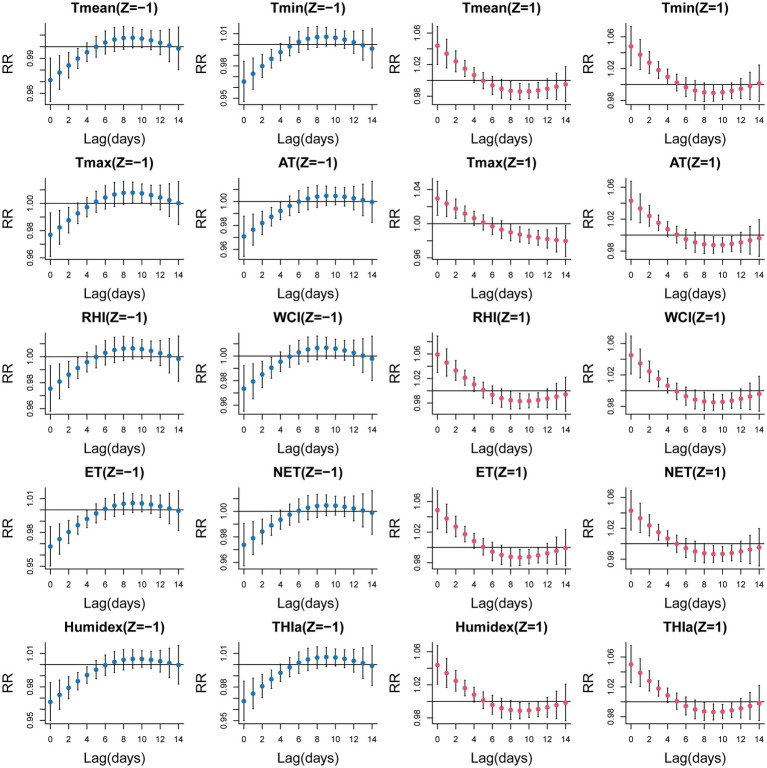
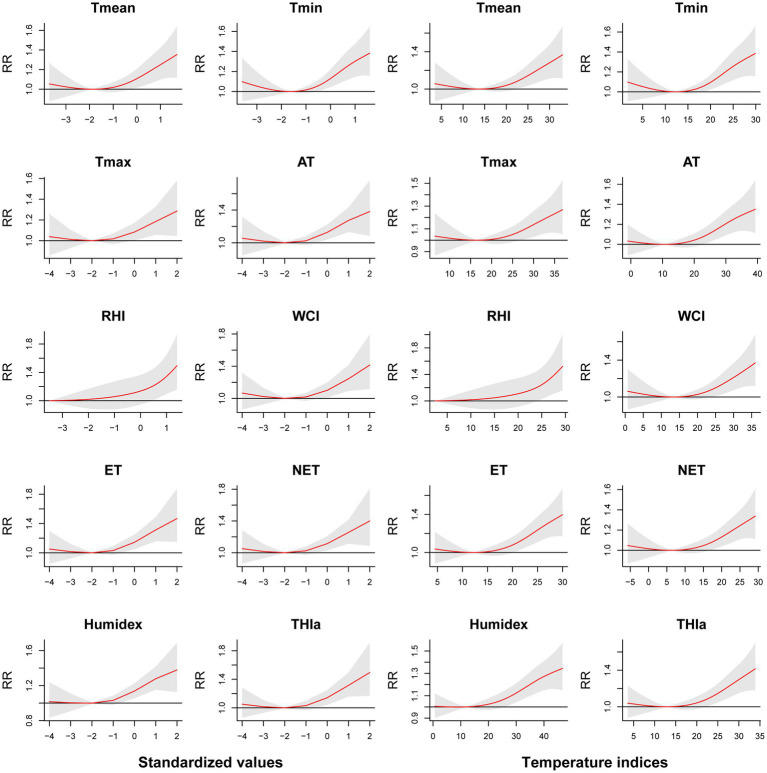
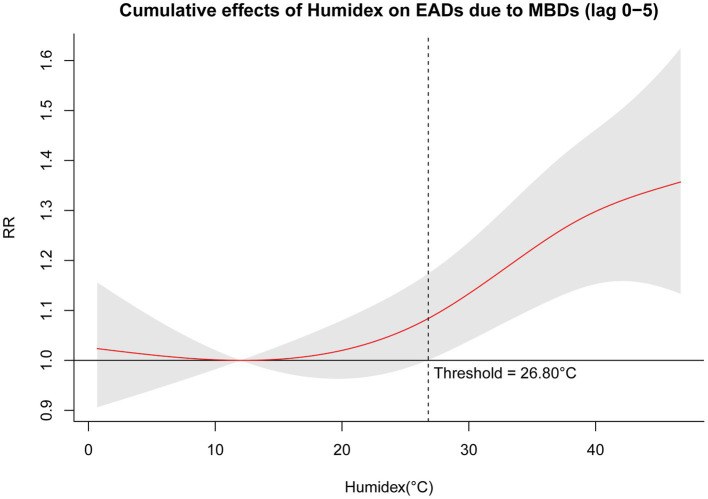
Results: The analysis of short-term temperature effects on EADs due to MBDs revealed Humidex as the most suitable index. Referring to the optimal Humidex (3.2th percentile, 12.00°C), we observed a significant effect of Humidex over the threshold (34.6th percentile, 26.80°C) on EADs due to MBDs at lag 0-5. The cumulative relative risks for high temperature (90th percentile, 41.90°C) and extreme high temperature (99th percentile, 44.20°C) at lag 0-5 were 1.318 (95% CI: 1.159-1.499) and 1.338 (95% CI: 1.153-1.553), respectively. No significant cold effect was observed on EADs due to MBDs.
Conclusion: High Humidex was associated with more EADs due to MBDs in subtropical regions. Health authorities should implement effective measures to raise public awareness of risks related to high temperature and protect vulnerable populations.
Keywords: distributed lag non-linear models; emergency ambulance dispatches; humidity index; mental and behavioral disorders; temperature related indices.
Copyright © 2024 Yin, Jingesi, Yin, Chen, Huang, Cheng, Li, Liu, Wang, Yin and Jiang.
Conflict of interest statement
The authors declare that the research was conducted in the absence of any commercial or financial relationships that could be construed as a potential conflict of interest.
Figures
References
-
- World Health Organization . Who Fact Sheet on Mental Disorders. (2022). https://www.who.int/en/news-room/fact-sheets/detail/mental-disorders (Accessed June 8, 2022).
-
- GBD . Mental disorders collaborators. Global, regional, and National Burden of 12 mental disorders in 204 countries and territories, 1990–2019: a systematic analysis for the global burden of disease study 2019. Lancet Psychiatry. (2019) 9:137–50. doi: 10.1016/S2215-0366(21)00395-3, PMID: - DOI - PMC - PubMed
MeSH terms
LinkOut - more resources
Full Text Sources
Medical
