


Lifestyle Changes and Industrialization in the Development of Allergic Diseases
- PMID: 38884832
- PMCID: PMC11233349
- DOI: 10.1007/s11882-024-01149-7
Lifestyle Changes and Industrialization in the Development of Allergic Diseases
Abstract
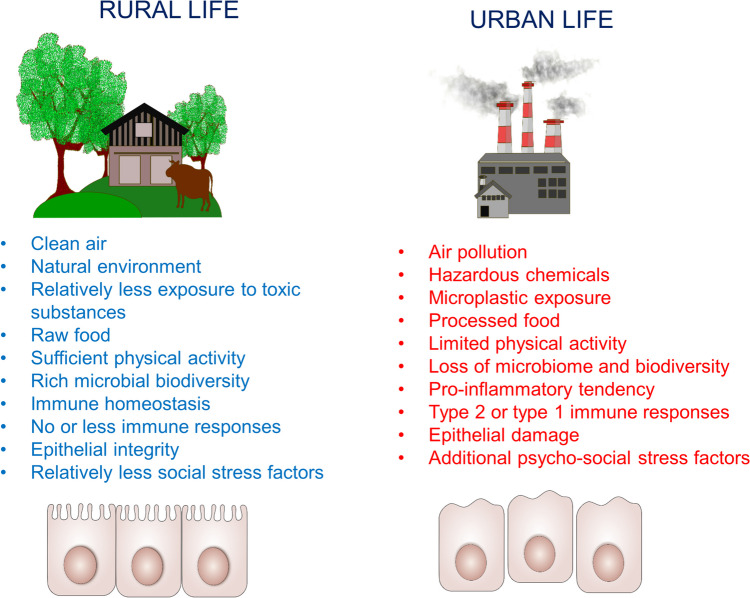
Purpose of review: Modernization and Westernization in industrialized and developing nations is associated with a substantial increase in chronic noncommunicable diseases. This transformation has far-reaching effects on lifestyles, impacting areas such as economics, politics, social life, and culture, all of which, in turn, have diverse influences on public health. Loss of contact with nature, alternations in the microbiota, processed food consumption, exposure to environmental pollutants including chemicals, increased stress and decreased physical activity jointly result in increases in the frequency of inflammatory disorders including allergies and many autoimmune and neuropsychiatric diseases. This review aims to investigate the relationship between Western lifestyle and inflammatory disorders.
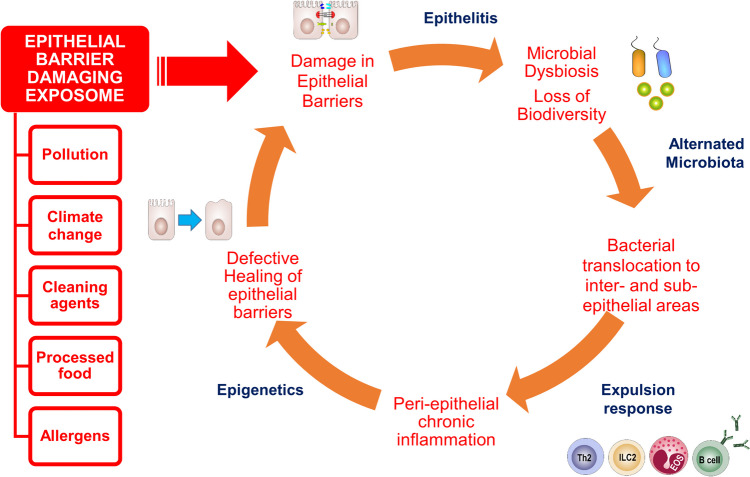
Recent findings: Several hypotheses have been put forth trying to explain the observed increases in these diseases, such as 'Hygiene Hypothesis', 'Old Friends', and 'Biodiversity and Dysbiosis'. The recently introduced 'Epithelial Barrier Theory' incorporates these former hypotheses and suggests that toxic substances in cleaning agents, laundry and dishwasher detergents, shampoos, toothpastes, as well as microplastic, packaged food and air pollution damage the epithelium of our skin, lungs and gastrointestinal system. Epithelial barrier disruption leads to decreased biodiversity of the microbiome and the development of opportunistic pathogen colonization, which upon interaction with the immune system, initiates local and systemic inflammation. Gaining a deeper comprehension of the interplay between the environment, microbiome and the immune system provides the data to assist with legally regulating the usage of toxic substances, to enable nontoxic alternatives and to mitigate these environmental challenges essential for fostering a harmonious and healthy global environment.
Keywords: Allergy; Environment; Epithelial barriers; Microbiome; Toxicity.
© 2024. The Author(s).
Conflict of interest statement
Dr. Kari Nadeau reports grants from National Institute of Allergy and Infectious Diseases (NIAID), National Heart, Lung, and Blood Institute (NHLBI, and from National Institute of Environmental Health Sciences (NIEHS); other from Immune Tolerance Network (ITN), other from National Institutes of Health (NIH) clinical research centers, during the conduct of the study; other from IgGenix, other from Seed Health, other from ClostraBio, other from Cour, other from Alladapt, other from Excellergy, other from Red tree ventures, other from Regeneron, other from Latitude, outside the submitted work; In addition, Dr. Nadeau has the following patents, "Mixed allergen composition and methods for using the same", "Granulocyte-based methods for detecting and monitoring immune system disorders", and"Methods and Assays for Detecting and Quantifying Pure Subpopulations of White Blood Cells in Immune System Disorders".
Dr. Mubeccel Akdis reports grants from Swiss National science Foundation, Bern, grants from The Stanford University, grants from Leading House for the Latin American Region, other from Stanford University-Sean Parker Asthma Allergy Center, CA, other from LEO Foundation Skin Immunology Research Center, Kopenhagen, other from World allergy Congress (WAC) Istanbul, 2022, other from EAACI, during the conduct of the study.
Dr. Cezmi Akdis reports grants from Swiss National Science Foundation, European Union (EU CURE, EU Syn-Air-G), grants from Novartis Research Institutes (Basel, Switzerland), grants from Stanford University (Redwood City, Calif), grants from Seed Health (Boston, USA), grants from SciBase (Stockholm, Sweden), other from EAACI Guidelines on Environmental Science in Allergic diseases and Asthma, other from The EAACI Epithelial Cell Biology Working Group is on the Advisory Boards of Sanofi/Regeneron (Bern, Switzerland, New York, USA), Stanford University Sean Parker Asthma Allergy Center (CA, USA), Novartis (Basel, Switzerland), Glaxo Smith Kline (Zurich, Switzerland), Bristol-Myers Squibb (New York, USA), Seed Health (Boston, USA) and SciBase (Stockholm, Sweden), other from The Editor-in-Chief Allergy, during the conduct of the study.
The remaining authors have nothing to declare in relation with this study.
Figures

References
Publication types
MeSH terms
LinkOut - more resources
Full Text Sources
Medical
