


Human Gonads Do Not Contribute to the Circulating Pool of 11-Oxygenated Androgens
- PMID: 38885296
- PMCID: PMC12012767
- DOI: 10.1210/clinem/dgae420
Human Gonads Do Not Contribute to the Circulating Pool of 11-Oxygenated Androgens
Abstract
Context: Androstenedione (A4) and testosterone (T) are produced by both the adrenal glands and the gonads. The adrenal enzyme 11β-hydroxylase (CYP11B1) executes the final step in cortisol synthesis; CYP11B1 also uses A4 and T as substrates, generating 11-hydroxyandrostenedione and 11-hydroxytestosterone, respectively. It has been suggested that CYP11B1 is expressed in the gonads, yet the circulating levels of all 11-oxygenated androgens (11-oxyandrogens) are similar in males and females of reproductive ages, despite enormous differences in T.
Objective: To assess the gonadal contribution to the circulating pool of 11-oxyandrogens.
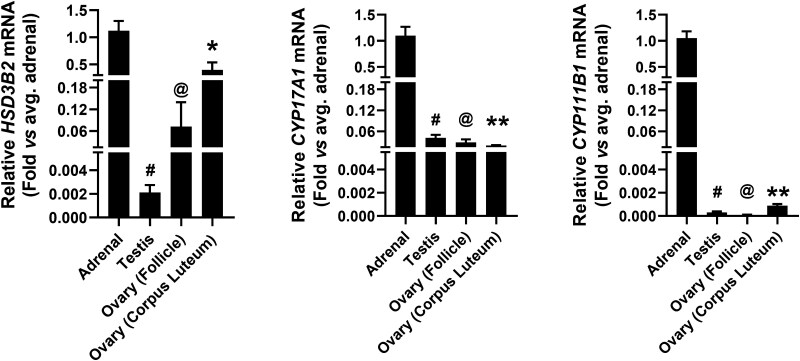
Methods: We used liquid chromatography-tandem mass spectrometry to measure 13 steroids, including traditional and 11-oxyandrogens in: (i) paired gonadal and peripheral vein blood samples obtained during gonadal venograms from 11 patients (7 women), median age 37 (range, 31-51 years); and (ii) 17 women, median age 57 (range, 41-81 years) before and after bilateral salpingo-oophorectomy (BSO). We also compared CYP11B1, 17α-hydroxylase/17,20-lyase (CYP17A1), and 3β-hydroxysteroid dehydrogenase type 2 (HSD3B2) mRNA expression in adrenal, ovarian, and testicular tissue.
Results: A4, T, estradiol, estrone, progesterone, 17α- and 16α-hydroxyprogesterone were all higher in gonadal veins vs periphery (P < .05 for all), while four 11-oxyandrogens were similar between matched gonadal and peripheral vein samples. Equally, in women who underwent BSO, A4 (median [interquartile range]: 59.7 [47.7-67.6] ng/dL vs 32.7 [27.4-47.8] ng/dL, P < .001) and T (24.1 [16.4-32.3] vs 15.5 [13.7-19.0] ng/dL, P < .001) declined, while 11-oxyandrogens remained stable. Gonadal tissue displayed negligible CYP11B1 mRNA.
Conclusion: Despite producing substantial amounts of A4 and T, human gonads are not relevant sources of 11-oxyandrogens.
Keywords: 11-ketotestosterone; 11-oxygenated androgen; adrenal; androgen; gonad; steroidogenesis.
© The Author(s) 2024. Published by Oxford University Press on behalf of the Endocrine Society. All rights reserved. For commercial re-use, please contact reprints@oup.com for reprints and translation rights for reprints. All other permissions can be obtained through our RightsLink service via the Permissions link on the article page on our site—for further information please contact journals.permissions@oup.com. See the journal About page for additional terms.
Figures


Comment in
-
11-Oxygenated Androgens Originate From the Adrenals. Period! And Now?J Clin Endocrinol Metab. 2025 May 19;110(6):e2094-e2095. doi: 10.1210/clinem/dgae638. J Clin Endocrinol Metab. 2025. PMID: 39270728 No abstract available.
References
-
- Knochenhauer ES, Key TJ, Kahsar-Miller M, Waggoner W, Boots LR, Azziz R. Prevalence of the polycystic ovary syndrome in unselected black and white women of the southeastern United States: a prospective study. J Clin Endocrinol Metab. 1998;83(9):3078‐3082. - PubMed
-
- Sanchón R, Gambineri A, Alpañés M, Martínez-García MÁ, Pasquali R, Escobar-Morreale HF. Prevalence of functional disorders of androgen excess in unselected premenopausal women: a study in blood donors. Hum Reprod. 2012;27(4):1209‐1216. - PubMed
-
- Dubey P, Reddy SY, Alvarado L, Manuel SL, Dwivedi AK. Prevalence of at-risk hyperandrogenism by age and race/ethnicity among females in the United States using NHANES III. Eur J Obstet Gynecol Reprod Biol. 2021;260:189‐197. - PubMed
-
- Burger HG. Androgen production in women. Fertil Steril. 2002;77(Suppl 4):S3‐S5. - PubMed
MeSH terms
Substances
Grants and funding
LinkOut - more resources
Full Text Sources
