. 2024 Aug 1;39(8):1628-1644.
doi: 10.1093/humrep/deae109.

Variation of sperm quality and circular RNA content in men exposed to environmental contamination with heavy metals in 'Land of Fires', Italy

Affiliations

Variation of sperm quality and circular RNA content in men exposed to environmental contamination with heavy metals in 'Land of Fires', Italy

Vincenza Grazia Mele et al. Hum Reprod. .

Abstract

Study question: Can illegal discharge of toxic waste into the environment induce a new condition of morpho-epigenetic pathozoospermia in normozoospermic young men?

Summary answer: Toxic environmental contaminants promote the onset of a new pathozoospermic condition in young normozoospermic men, consisting of morpho-functional defects and a sperm increase of low-quality circular RNA (circRNA) cargo, tightly linked to contaminant bioaccumulation in seminal plasma.

What is known already: Epidemiological findings have reported several reproductive anomalies depending on exposure to contaminants discharged into the environment, such as germ cell apoptosis, steroidogenesis defects, oxidative stress induction, blood-testis barrier dysfunctions, and poor sperm quality onset. In this scenario, a vast geographical area located in Campania, Italy, called the 'Land of Fires', has been associated with an excessive illegal discharge of toxic waste into the environment, negatively impacting human health, including male reproductive functions.

Study design, size, duration: Semen samples were obtained from healthy normozoospermic men divided into two experimental groups, consisting of men living in the 'Land of Fires' (LF; n = 80) or not (CTRL; n = 80), with age ranging from 25 to 40 years. The study was carried out following World Health Organization guidelines.

Participants/materials, setting, methods: Quality parameters of semen from CTRL- and LF-normozoospermic men were evaluated by computer-assisted semen analysis; high-quality spermatozoa from CTRL and LF groups (n = 80 for each experimental group) were obtained using a 80-40% discontinuous centrifugation gradient. Seminal plasma was collected following centrifugation and used for the dosage of chemical elements, dioxins and steroid hormones by liquid chromatography with tandem mass spectrometry. Sperm morpho-functional investigations (cellular morphology, acrosome maturation, IZUMO1 fertility marker analysis, plasma membrane lipid state, oxidative stress) were assessed on the purified high-quality spermatozoa fraction by immunochemistry/immunofluorescence and western blot analyses. Sperm circRNA cargo was evaluated by quantitative RT-PCR, and the physical interaction among circRNAs and fused in sarcoma (FUS) protein was detected using an RNA-binding protein immunoprecipitation assay. Protein immunoprecipitation experiments were carried out to demonstrate FUS/p-300 protein interaction in sperm cells. Lastly, in vitro lead (Pb) treatment of high-quality spermatozoa collected from normozoospermic controls was used to investigate a correlation between Pb accumulation and onset of the morpho-epigenetic pathozoospermic phenotype.

Main results and the role of chance: Several morphological defects were identified in LF-spermatozoa, including: a significant increase (P < 0.05 versus CTRL) in the percentage of spermatozoa characterized by structural defects in sperm head and tail; and a high percentage (P < 0.01) of peanut agglutinin and IZUMO1 null signal cells. In agreement with these data, abnormal steroid hormone levels in LF seminal plasma suggest a premature acrosome reaction onset in LF-spermatozoa. The abnormal immunofluorescence signals of plasma membrane cholesterol complexes/lipid rafts organization (Filipin III and Flotillin-1) and of oxidative stress markers [3-nitrotyrosine and 3-nitrotyrosine and 4-hydroxy-2-nonenal] observed in LF-spermatozoa and associated with a sperm motility reduction (P < 0.01), demonstrated an affected membrane fluidity, potentially impacting sperm motility. Bioaccumulation of heavy metals and dioxins occurring in LF seminal plasma and a direct correlation between Pb and deregulated circRNAs related to high- and low-sperm quality was also revealed. In molecular terms, we demonstrated that Pb bioaccumulation promoted FUS hyperacetylation via physical interaction with p-300 and, in turn, its shuttling from sperm head to tail, significantly enhancing (P < 0.01 versus CTRL) the endogenous backsplicing of sperm low-quality circRNAs in LF-spermatozoa.

Limitations, reasons for caution: Participants were interviewed to better understand their area of origin, their eating habits as well as their lifestyles, however any information incorrectly communicated or voluntarily omitted that could potentially compromise experimental group determination cannot be excluded. A possible association between seminal Pb content and other heavy metals in modulating sperm quality should be explored further. Future investigations will be performed in order to identify potential synergistic or anti-synergistic effects of heavy metals on male reproduction.

Wider implications of the findings: Our study provides new findings regarding the effects of environmental contaminants on male reproduction, highlighting how a sperm phenotype classified as normozoospermic may potentially not match with a healthy morpho-functional and epigenetic one. Overall, our results improve the knowledge to allow a proper assessment of sperm quality through circRNAs as biomarkers to select spermatozoa with high morpho-epigenetic quality to use for ART.

Study funding/competing interest(s): This study was supported by 'Convenzione Azienda Sanitaria Locale (ASL) Caserta, Regione Campania' (ASL CE Prot. N. 1217885/DIR. GE). The authors have no conflict of interest to declare.

Trial registration number: N/A.

Keywords: Land of Fires; circular RNA; environmental contaminants; fused in sarcoma protein; heavy metals; lead; male infertility; spermatozoa.


Conflict of interest statement

The authors declare no competing interests.

Figures
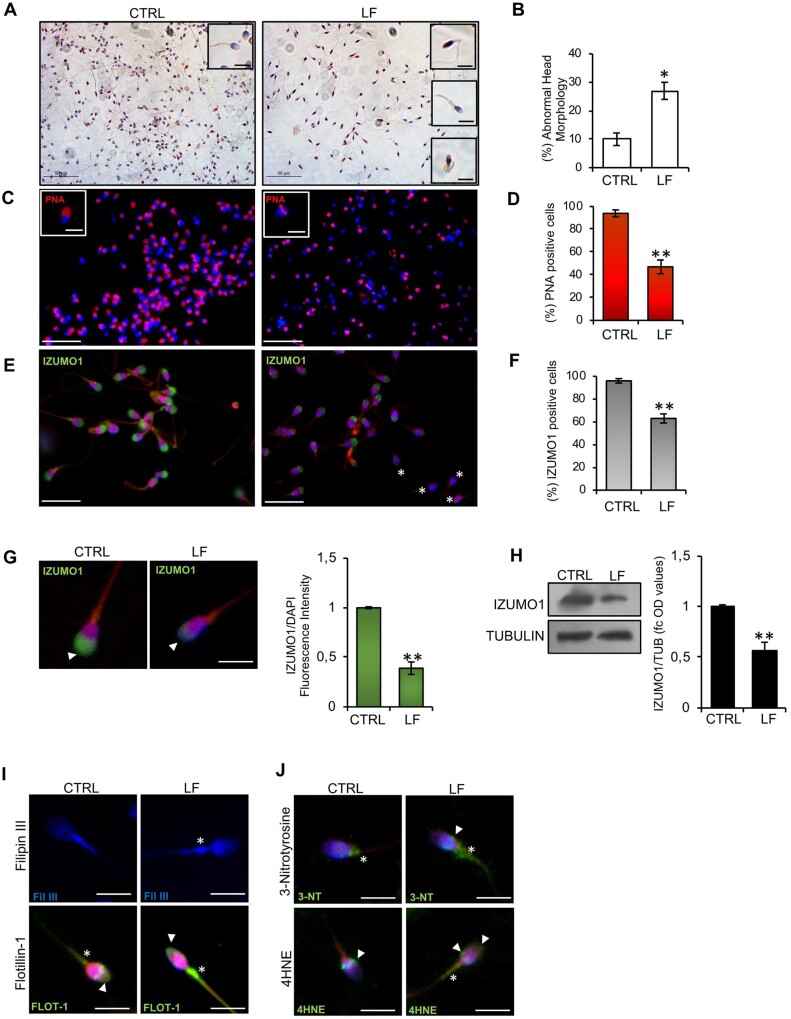
Figure 1.
Figure 1.
Morpho-functional characterization of high-quality spermatozoa in normozoospermic young men. (A) H&E staining of high-quality CTRL- and LF-spermatozoa (n = 10 for each experimental group); scale bar: 50 μm. Physiological and anomalous sperm head morphology is indicated in the insets; scale bar inset: 10 μm. (B) Cell count of sperm cells having anomalous head morphology in high-quality CTRL- and LF-spermatozoa (n = 10 different samples in triplicate for each experimental group). Data are expressed as the percentage of anomalous sperm heads/total spermatozoa and reported as mean ± SEM; *P < 0.05. (C) Immunofluorescence analysis of PNA (red) in high-quality CTRL- and LF-spermatozoa (n = 6 different samples in triplicate for each experimental group). Nuclei were labelled with DAPI (blue). Scale bar: 50 μm; scale bar inset: 5 μm. (D) Cell count of PNA positive sperm cells in high-quality CTRL- and LF-spermatozoa (n = 6 different samples in triplicate for each experimental group). Data are expressed as percentage of positive cells on total and reported as mean ± SEM; **P < 0.01. (E) Immunofluorescence analysis of IZUMO1 (FITC-green) in high-quality CTRL- and LF-spermatozoa (n = 6 different samples in triplicate for each experimental group). Nuclei were labelled with DAPI (blue); white asterisks represent negative IZUMO1 sperm cells. Scale bar: 20 μm. (F) Cell count of IZUMO1-positive sperm cells in high-quality CTRL- and LF-spermatozoa (n = 6 different samples in triplicate for each experimental group). Data are expressed as percentage of positive cells on the total and reported as mean ± SEM; **P < 0.01. (G) Immunofluorescence analysis and histogram showing the quantification of IZUMO1 signal intensity in high-quality CTRL- and LF-spermatozoa (n = 6 different samples in triplicate for each experimental group). Values are expressed as mean ± SEM; **P < 0.01; scale bar: 4 μm. (H) Western blot analysis of IZUMO1 in high-quality CTRL- and LF-spermatozoa (n = 10 different samples in triplicate for each experimental group). Signals were quantified by densitometry analysis and normalized to tubulin. Data are expressed in OD values as fold change and reported as mean ± SEM; **P < 0.01. (I) Filipin III staining and Flotillin-1 (FITC-green) immunofluorescence analyses in high-quality CTRL- and LF-spermatozoa (n = 6 different samples for each experimental group). White arrowheads represent sperm head localizations; white asterisks represent sperm midpiece localizations. Nuclei were labelled with DAPI (blue); scale bar: 4 μm. (J) 3-NT (FITC-green) and 4HNE immunofluorescence analyses in high-quality CTRL- and LF-spermatozoa (n = 6 different samples for each experimental group). White arrowheads represent sperm head and neck localizations; white asterisks represent sperm midpiece localizations. Nuclei were labelled with DAPI (blue); scale bar: 4 μm. CTRL: control group, men not living in the Land of Fires; H&E: haematoxylin and eosin; 4HNE: 4-hydroxy-2-nonenal; LF: the group of men living in the ‘Land of Fires’, which is a large geographical area located in Campania, Italy, where excessive illegal discharge of toxic waste into the environment occurs; OD: optical density; PNA: peanut agglutinin. Applied statistical test: Student's t-test.
Figure 2.
Figure 2.
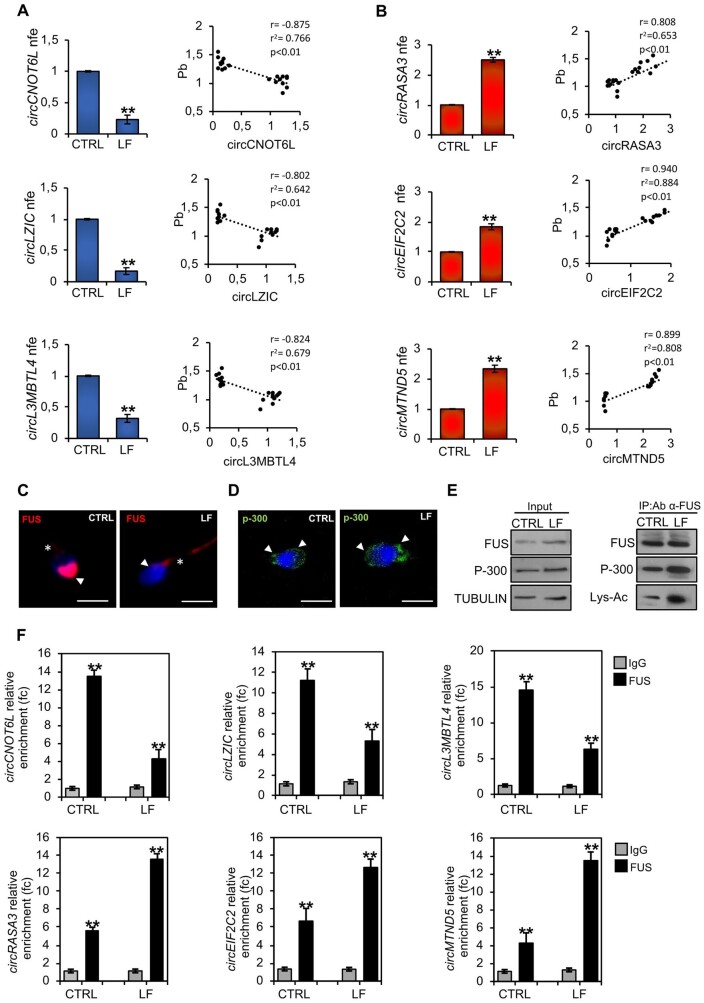
Environmental contaminants affect FUS-dependent sperm circular RNA backsplicing in sperm from normozoospermic men. (A and B) Expression analysis of circRNAs (cirCNOT6L; circLZIC; circL3MBTL4; circRASA3; circEIF2C2; circMTND5) in high-quality CTRL- and LF-spermatozoa (n = 10 different samples in triplicate for each experimental group). qRT-PCR data were normalized using GPDH, expressed as fold expression (nfe) and reported as mean value ± SEM. **P < 0.01. (A and B) Correlation analysis between circRNA expression values and Pb seminal plasma levels relative to high-quality LF-spermatozoa (n = 20). (C) Immunofluorescence analysis of FUS (red) in high-quality CTRL- and LF-spermatozoa (n = 6 different samples for each experimental group). Nuclei were labeled with DAPI (blue); white arrowheads represent FUS localization in sperm head; white asterisks represent FUS localization in sperm tail. Scale bar: 4 μm. (D) Immunofluorescence analysis of p-300 (FITC-green) in high-quality CTRL- and LF-spermatozoa (n = 6 different samples for each experimental group). Nuclei were labelled with DAPI (blue); white arrowheads represent p-300 localization in sperm head and neck. Scale bar: 4 μm. (E) Western blot analysis of protein immunoprecipitation (IP) in high-quality CTRL- and LF-spermatozoa (n = 10 different samples for each experimental group) using FUS antibody. FUS-IP was analysed in comparison with Input protein extracts. (F) The enrichment levels of circRNAs (cirCNOT6L; circLZIC; circL3MBTL4; circRASA3; circEIF2C2; circMTND5) in the products of the RIP assay (FUS-IP compared with IgG-IP) in high-quality CTRL- and LF-spermatozoa detected by qRT-PCR. Data are reported as mean ± SEM (n = 6 different samples for each experimental group in triplicate); **P < 0.01. circRNA: circular RNA; CTRL: control group, men not living in the Land of Fires; FUS: fused in sarcoma; LF: the group of men living in the ‘Land of Fires’, which is a large geographical area located in Campania, Italy, where excessive illegal discharge of toxic waste into the environment occurs.; qRT-PCR: quantitative RT-PCR; RIP: RNA-binding protein immunoprecipitation. Applied statistical test: Student's t-test.
Figure 3.
Figure 3.
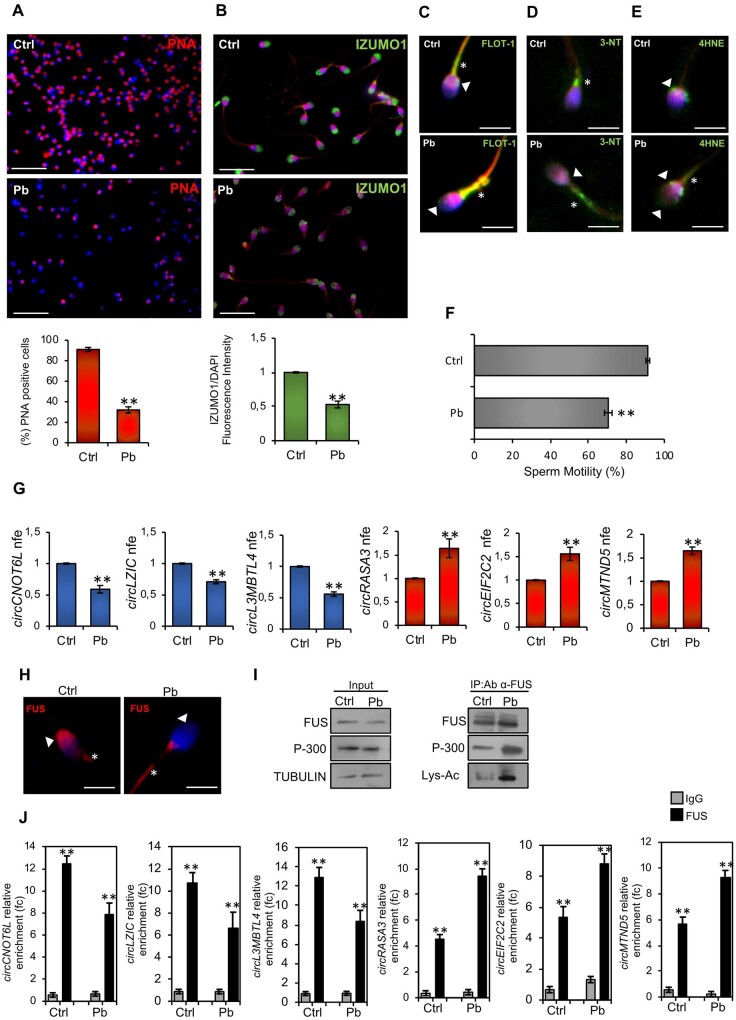
A heavy metal drives the pathozoospermic phenotype in high-quality spermatozoa from normozoospermic men (men not living in the Land of Fires). (A) Immunofluorescence analysis of PNA (red) (n = 6 different samples for each experimental group) and cellular counting of PNA-positive sperm cells in Ctrl- and Pb-spermatozoa (n = 10 different samples in triplicate for each experimental group). Nuclei were labelled with DAPI (blue). Scale bar: 50 μm. Data are expressed as percentage of positive cells on total and reported as mean ± SEM; **P < 0.01. (B) Immunofluorescence analysis of IZUMO1 (FITC-green) (n = 6 different samples for each experimental group) and immunofluorescence signal intensity analysis (n = 6 different samples for each experimental group) in Ctrl- and Pb-spermatozoa. Values are expressed as mean ± SEM; **P < 0.01. Immunofluorescence analyses of Flotillin-1 (FITC-green) (C), 3-NT (FITC-green) (D), and 4HNE (E) in Ctrl- and Pb-spermatozoa (n = 6 different samples for each experimental group). White arrowheads represent sperm head and neck localizations; white asterisks represent localizations in sperm midpiece. Nuclei were labelled with DAPI (blue); scale bar: 4 μm. (F) Motility assay in Ctrl- and Pb-spermatozoa (n = 10 different samples in triplicate for each experimental group). Data are expressed as the percentage of motile/live spermatozoa and reported as mean ± SEM; **P < 0.01. (G) Expression analysis of circRNAs (cirCNOT6L; circLZIC; circL3MBTL4; circRASA3; circEIF2C2; circMTND5) in Ctrl- and Pb-spermatozoa (n = 6 different samples in triplicate for each experimental group). qRT-PCR data were normalized using GAPDH, expressed as fold expression (nfe) and reported as mean value ± S.E.M. **P < 0.01. (H) Immunofluorescence analysis of FUS (red) in Ctrl- and Pb-spermatozoa (n = 6 different samples for each experimental group). Nuclei were labelled with DAPI (blue); white arrowheads represent FUS localization in sperm head; white asterisks represent FUS localization in sperm tail. Scale bar: 4 μm. (I) Western blot analysis of IP in Ctrl- and Pb-spermatozoa (n = 6 different samples for each experimental group) using FUS antibody. FUS-IP was analysed in comparison with Input protein extracts. (J) The enrichment levels of circRNAs (cirCNOT6L; circLZIC; circL3MBTL4; circRASA3; circEIF2C2; circMTND5) in the products of RIP (FUS-IP compared with IgG-IP) in Ctrl- and Pb-spermatozoa detected by qRT-PCR. Data are reported as mean ± SEM (n = 6 different samples for each experimental group in triplicate); **P < 0.01. Ctrl: control experimental group, spermatozoa incubated in vitro with vehicle; FUS: fused in sarcoma; 4HNE: 4-hydroxy-2-nonenal; IP: immunoprecipitation; 3-NT: 3-nitrotyrosine; PNA: peanut agglutinin; qRT-PCR: quantitative RT-PCR; RIP: RNA-binding protein immunoprecipitation. Applied statistical test: Student's t-test.

References

    1. Alberti P. The ‘land of fires’: epidemiological research and public health policy during the waste crisis in Campania, Italy. Heliyon 2022;8:e12331. - PMC - PubMed
    1. Almeida Lopes ACB, Peixe TS, Mesas AE, Paoliello MMB. Lead exposure and oxidative stress: a systematic review. Rev Environ Contam Toxicol 2016;236:193–238. - PubMed
    1. Arenas A, Chen J, Kuang L, Barnett KR, Kasarskis EJ, Gal J, Zhu H. Lysine acetylation regulates the RNA binding, subcellular localization and inclusion formation of FUS. Hum Mol Genet 2020;29:2684–2697. - PMC - PubMed
    1. Auger J, Jouannet P, Eustache F. Another look at human sperm morphology. Hum Reprod 2016;31:10–23. - PubMed
    1. Aydin Y, Erkan M. The toxic effects of polychlorinated biphenyl (Aroclor 1242) on Tm3 Leydig cells. Toxicol Ind Health 2017;33:636–645. - PubMed

Publication types