Meta-Analysis
. 2024 Jun 18;11(1):e002669.
doi: 10.1136/openhrt-2024-002669.

Therapeutic options for neurocardiogenic syncope: a meta-analysis of randomised trials with and without blinding

Affiliations
Meta-Analysis

Therapeutic options for neurocardiogenic syncope: a meta-analysis of randomised trials with and without blinding

Nandita Kaza et al. Open Heart. .

Abstract

Background: Neurocardiogenic syncope is a common condition with significant associated psychological and physical morbidity. The effectiveness of therapeutic options for neurocardiogenic syncope beyond placebo remains uncertain.

Methods: The primary endpoint was the risk ratio (RR) of spontaneously recurring syncope following any therapeutic intervention. We also examined the effect of blinding on treatment efficacy. We identified all randomised trials which evaluated the effect of any pharmacological, device-based or supportive intervention on patients with a history of syncope. A systematic search was conducted on Medline, Embase, PubMed databases and Cochrane Central Register for Controlled Trials from 1950 to 25 April 2023. Event rates, their RRs and 95% CIs were calculated, and a random-effects meta-analysis was conducted for each intervention. Data analysis was performed in R using RStudio.

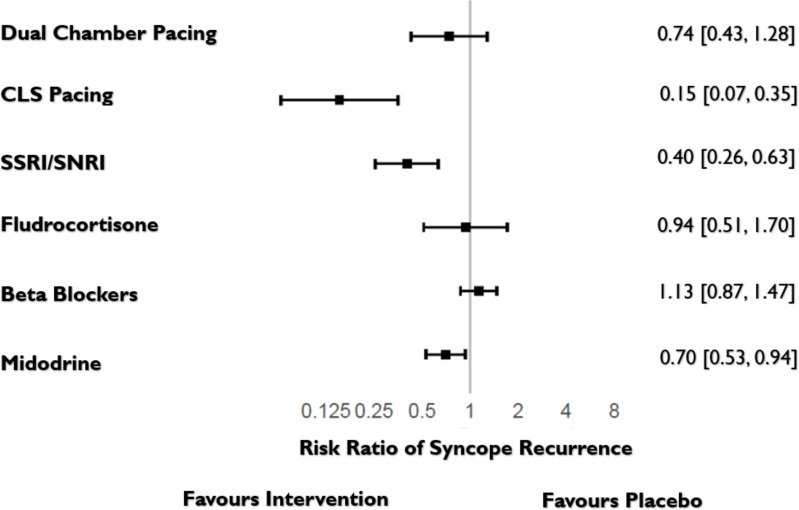
Results: We identified 47 eligible trials randomising 3518 patients. Blinded trials assessing syncope recurrence were neutral for beta blockers, fludrocortisone and conventional dual-chamber pacing but were favourable for selective serotonin reuptake inhibitors (SSRIs) (RR 0.40, 95% CI 0.26 to 0.63, p<0.001), midodrine (RR 0.70, 95% CI 0.53 to 0.94, p=0.016) and closed-loop stimulation (CLS) pacing (RR 0.15, 95% CI 0.07 to 0.35, p<0.001). Unblinded trials reported significant benefits for all therapy categories other than beta blockers and consistently showed larger benefits than blinded trials.

Conclusions: Under blinded conditions, SSRIs, midodrine and CLS pacing significantly reduced syncope recurrence. Future trials for syncope should be blinded to avoid overestimating treatment effects.

Prospero registration number: CRD42022330148.

Keywords: Meta-Analysis; Pacemaker, Artificial; Quality of Health Care; SYNCOPE.


Conflict of interest statement

Competing interests: None declared.

Figures
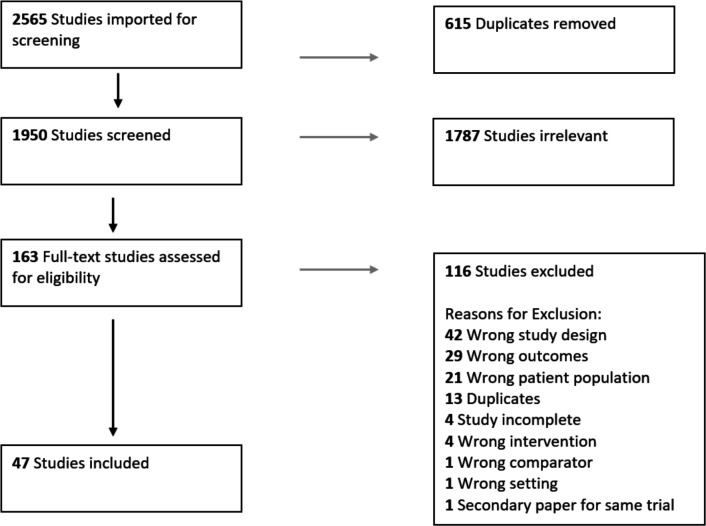
Figure 1
Figure 1
Preferred Reporting Items for Systematic Reviews and Meta-Analyses (PRISMA) diagram summarising the search outcomes. A total of 2565 papers were identified through the systematic search. Duplicates were removed leaving a total of 1950 papers to be screened of which 163 were relevant to the purpose of this paper and 47 met the inclusion criteria.
Figure 2
Figure 2
Summary effect of therapies on syncope recurrence in blinded trials with placebo control. Blinded trials were neutral for conventional pacing, beta blockers and fludrocortisone but favourable for closed-loop stimulation (CLS) pacing, selective serotonin reuptake inhibitors/serotonin norepinephrine reuptake inhibitors (SSRIs/SNRIs) and midodrine.
Figure 3
Figure 3
Summary effect of therapies on syncope recurrence in unblinded trials without placebo control. Unblinded trials without placebo control were significant for every category of therapy with the exception of beta blockers.
Figure 4
Figure 4
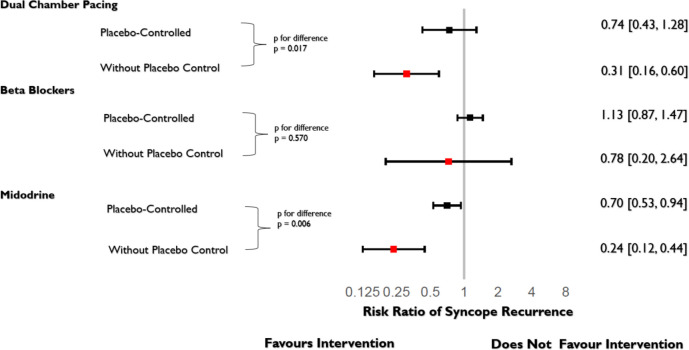
Comparison of trials with and without placebo control across therapies. Midodrine, beta blockers and dual-chamber pacing have been assessed in studies using placebo control and in others without placebo control. All three interventions have been reportedly more effective in studies without placebo control. Dual-chamber pacing showed significant reduction in syncope recurrence in studies without placebo control but failed to demonstrate this under placebo control. Midodrine has been found to reduce syncope recurrence even in placebo-controlled studies; however, the magnitude of risk ratio reduction was less than in studies without placebo.
Figure 5
Figure 5
Placebo effect on syncope recurrence. The overall ‘placebo effect’ in the treatment of cardiogenic syncope is estimated in this figure. For instance, about 15% of pacing effect in reducing syncope recurrence can be attributed to a placebo effect, and this is even higher in some pharmacological interventions, as shown with midodrine where 23.1% of treatment effect can be attributed to a placebo effect.

References

    1. Saklani P, Krahn A, Klein G. Syncope. Circulation 2013;127:1330–9. 10.1161/CIRCULATIONAHA.112.138396 - DOI - PubMed
    1. Brignole M, Moya A, de Lange FJ, et al. . 2018 ESC guidelines for the diagnosis and management of syncope. Eur Heart J 2018;39:1883–948. 10.1093/eurheartj/ehy037 - DOI - PubMed
    1. Miller FG, Wendler D, Swartzman LC. Deception in research on the placebo effect. PLoS Med 2005;2:e262. 10.1371/journal.pmed.0020262 - DOI - PMC - PubMed
    1. Ahmad Y, Francis DP, Bhatt DL, et al. . Renal denervation for hypertension: a systematic review and meta-analysis of randomized, blinded, placebo-controlled trials. JACC Cardiovasc Interv 2021;14:2614–24. 10.1016/j.jcin.2021.09.020 - DOI - PubMed
    1. Sheldon R, Connolly S, Rose S, et al. . Prevention of syncope trial (POST): a randomized, placebo-controlled study of metoprolol in the prevention of vasovagal syncope. Circulation 2006;113:1164–70. 10.1161/CIRCULATIONAHA.105.535161 - DOI - PubMed

LinkOut - more resources