


The Evolving Role of Genomic Testing in Early Breast Cancer: Implications for Diagnosis, Prognosis, and Therapy
- PMID: 38891906
- PMCID: PMC11172282
- DOI: 10.3390/ijms25115717
The Evolving Role of Genomic Testing in Early Breast Cancer: Implications for Diagnosis, Prognosis, and Therapy
Abstract
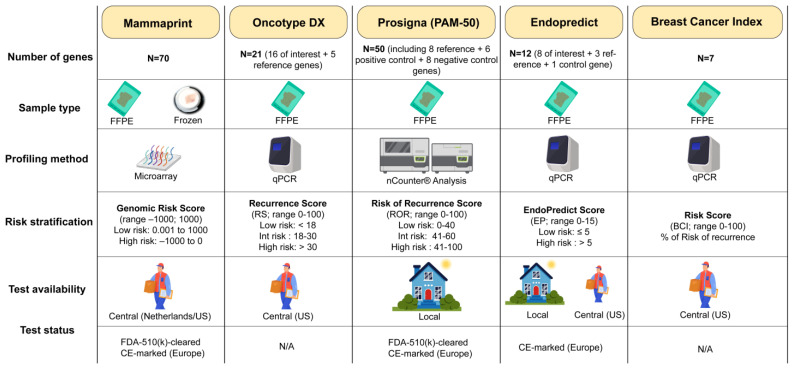
Multigene prognostic genomic assays have become indispensable in managing early breast cancer (EBC), offering crucial information for risk stratification and guiding adjuvant treatment strategies in conjunction with traditional clinicopathological parameters. The American Society of Clinical Oncology (ASCO) guidelines endorse these assays, though some clinical contexts still lack definitive recommendations. The dynamic landscape of EBC management demands further refinement and optimization of genomic assays to streamline their incorporation into clinical practice. The breast cancer community is poised at the brink of transformative advances in enhancing the clinical utility of genomic assays, aiming to significantly improve the precision and effectiveness of both diagnosis and treatment for women with EBC. This article methodically examines the testing methodologies, clinical validity and utility, costs, diagnostic frameworks, and methodologies of the established genomic tests, including the Oncotype Dx Breast Recurrence Score®, MammaPrint, Prosigna®, EndoPredict®, and Breast Cancer Index (BCI). Among these tests, Prosigna and EndoPredict® have at present been validated only on a prognostic level, while Oncotype Dx, MammaPrint, and BCI hold both a prognostic and predictive role. Oncologists and pathologists engaged in the management of EBC will find in this review a thorough comparison of available genomic assays, as well as strategies to optimize the utilization of the information derived from them.
Keywords: adjuvant chemotherapy; early breast cancer; endocrine therapy; genomic testing; prognostication; risk assessment.
Conflict of interest statement
E.M. has acted as a consultant and/or has received funding for travel expenses and/or accommodation to Pierre Fabre, Genomic Health, Celgene, Roche, Eisai, Mylan, Exact Sciences, Merck Sharp & Dohme (MSD) Oncology, AstraZeneca, Daiichi Sankyo, Lilly, Novartis, Seagen, and Pfizer. S.D. has acted as a consultant for and/or has received funding for travel expenses and/or accommodation from AstraZeneca, Daiichi Sankyo, Lilly, Novartis, and Pfizer. C.C. reported grants from Gilead, Seagen, and personal fees from Pfizer, Lilly, Novartis, MSD, Daiichi Sankyo, and AstraZeneca outside the submitted work. G.C. reports funding from Astra Zeneca, Daichii Sankyo, and Merck; consulting fees from BMS, Roche, Pfizer, Novartis, Lilly, Astra Zeneca, Daichii Sankyo, Merck, Seagen, and Ellipsis; honoraria from Pfizer and Lilly; and support for attending meetings from Roche, Pfizer. E.G-R. has relevant relationships (advisory fees, honoraria, travel accommodation and expenses, grants, and non-financial support) with AstraZeneca, Exact Sciences, GlaxoSmithKline (GSK), Novartis, Roche, and Thermo Fisher Scientific unrelated to the current work. N.F. has received honoraria for consulting, advisory role, speaker bureau, travel, and/or research grants from Merck Sharp & Dohme (MSD), Merck, Novartis, AstraZeneca, Roche, Menarini, Daiichi Sankyo, GlaxoSmithKline (GSK), Gilead, Adicet Bio, Sysmex, Reply, Veracyte Inc., Sakura, Leica Biosystems, and Lilly. These companies had no role in the design of the study; in the collection, analyses, or interpretation of data; in the writing of the manuscript; and/or in the decision to publish the results. All other authors declare no potential conflicts of interest.
Figures
References
-
- Licata L., De Sanctis R., Vingiani A., Cosentini D., Iorfida M., Caremoli E.R., Sassi I., Fernandes B., Gianatti A., Guerini-Rocco E., et al. Real-world use of multigene signatures in early breast cancer: Differences to clinical trials. Breast Cancer Res. Treat. 2024;205:39–48. doi: 10.1007/s10549-023-07227-0. - DOI - PMC - PubMed
