. 2024 May 30;25(11):6042.
doi: 10.3390/ijms25116042.

Machine Learning Identifies Key Proteins in Primary Sclerosing Cholangitis Progression and Links High CCL24 to Cirrhosis

Affiliations

Machine Learning Identifies Key Proteins in Primary Sclerosing Cholangitis Progression and Links High CCL24 to Cirrhosis

Tom Snir et al. Int J Mol Sci. .

Abstract

Primary sclerosing cholangitis (PSC) is a rare, progressive disease, characterized by inflammation and fibrosis of the bile ducts, lacking reliable prognostic biomarkers for disease activity. Machine learning applied to broad proteomic profiling of sera allowed for the discovery of markers of disease presence, severity, and cirrhosis and the exploration of the involvement of CCL24, a chemokine with fibro-inflammatory activity. Sera from 30 healthy controls and 45 PSC patients were profiled with proximity extension assay, quantifying the expression of 2870 proteins, and used to train an elastic net model. Proteins that contributed most to the model were tested for correlation to enhanced liver fibrosis (ELF) score and used to perform pathway analysis. Statistical modeling for the presence of cirrhosis was performed with principal component analysis (PCA), and receiver operating characteristics (ROC) curves were used to assess the useability of potential biomarkers. The model successfully predicted the presence of PSC, where the top-ranked proteins were associated with cell adhesion, immune response, and inflammation, and each had an area under receiver operator characteristic (AUROC) curve greater than 0.9 for disease presence and greater than 0.8 for ELF score. Pathway analysis showed enrichment for functions associated with PSC, overlapping with pathways enriched in patients with high levels of CCL24. Patients with cirrhosis showed higher levels of CCL24. This data-driven approach to characterize PSC and its severity highlights potential serum protein biomarkers and the importance of CCL24 in the disease, implying its therapeutic potential in PSC.

Keywords: CCL24; clinical data; machine learning; primary sclerosing cholangitis; proteomics.


Conflict of interest statement

Raanan Greenman, Ilan Vaknin, Revital Aricha, Tom Snir, Matthew Frankel, John Lawler, and Adi Mor are employees of Chemomab Therapeutics (Israel). Massimo Pinzani is a co-founder and shareholder of Engitix Therapeutics Ltd. (UK), a consultant of Chemomab, a chief medical advisor and shareholder of Aculive Therapeutics Ltd. (UK), and an advisory board/consultant (active March 2022) of Chemomab Therapeutics (Israel); Resolution Therapeutics (UK); Dicerna (USA); Astra Zeneca (UK); and Galecto (Sweden). Francesca Saffioti and Douglas Thorburn have nothing to disclose.

Figures
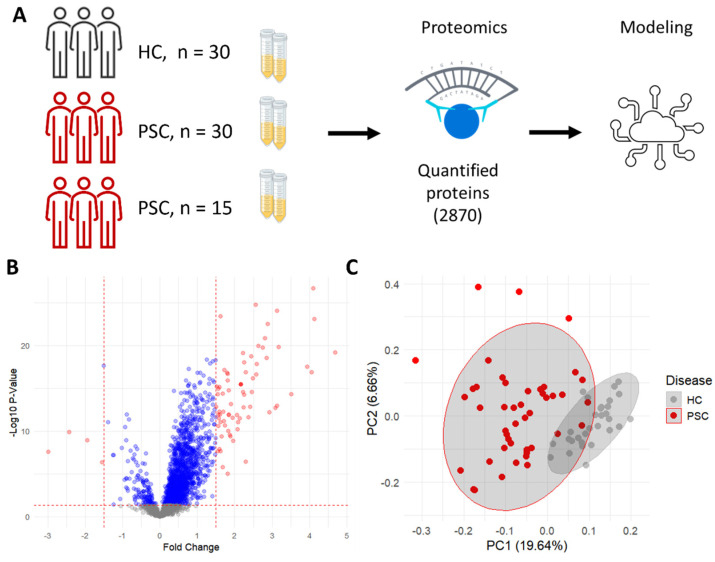
Figure 1
Figure 1
Proteomic profiling demonstrates unique protein expression in PSC patients. (A) In the data acquisition process, serum was taken from three cohorts of individuals, quantified by the real-time PCR-based proximity extension assay (PEA) and used to model disease presence. (B) Volcano plot showing the fold change (red points represent FC > 1.5, blue points represent FC < 1.5) and −Log10 of the p-value from a Welch two-sample t-test between HC and PSC patients. (C) Principal component analysis showing the separation of HC and PSC patients.
Figure 2
Figure 2
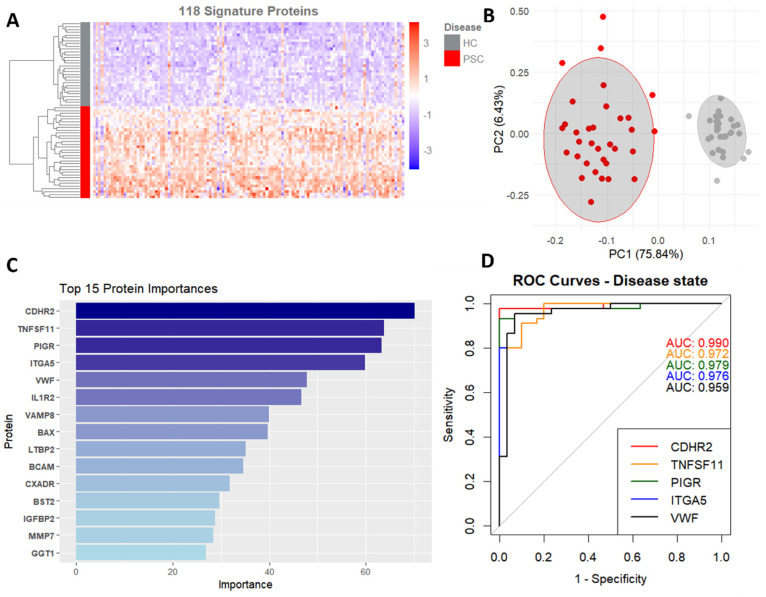
Elastic net logistic regression identifies disease biomarkers with high predictive values. (A) Heatmap based on 118 proteins contributing to disease presence prediction. (B) PCA using the same 118 proteins. (C) Protein importance for the top 15 proteins, averaged across 500 runs. (D) ROC curves and area under the curve for the top five proteins predicting disease state.
Figure 3
Figure 3
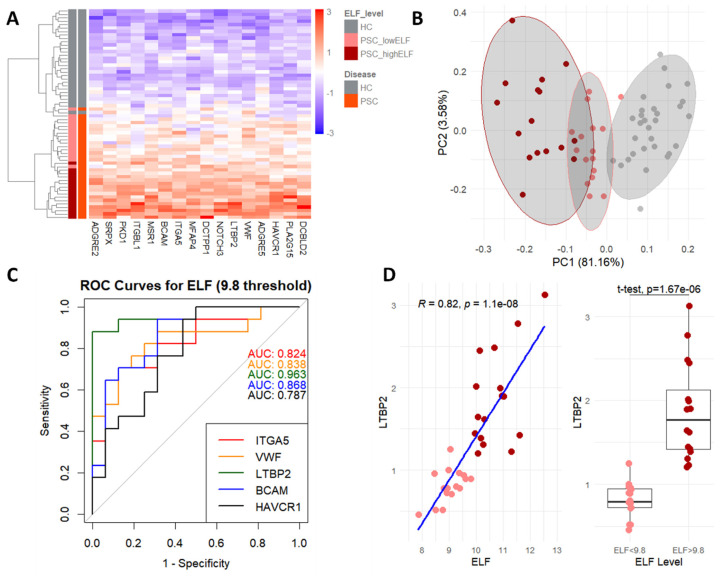
Association of model to disease severity. (A) Heatmap of protein signature for PSC and ELF score, showing hierarchical clustering of HC and patients with PSC with low (<9.8) and high (>9.8) ELF scores. (B) PCA using only the proteins used for the heatmap. (C) ROC curves and area under the curve for the top five proteins predicting both disease and ELF score. (D) Correlation and t-test of LTBP2 and ELF, both as a continuous variable and stratified by 9.8 threshold.
Figure 4
Figure 4
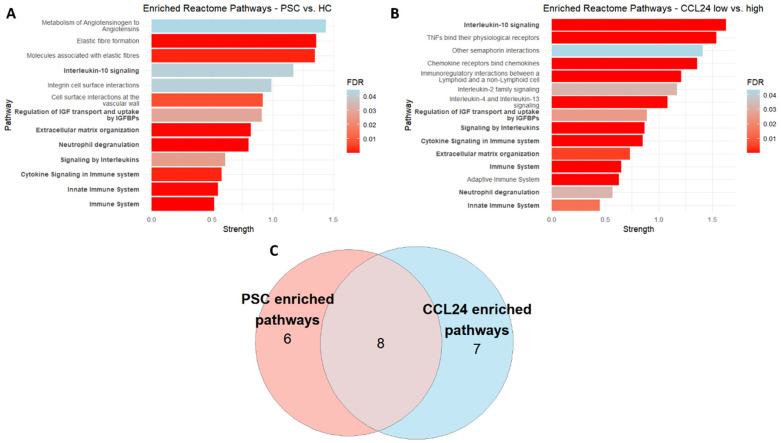
CCL24 is associated with disease-related biological pathways. (A) Reactome pathways enriched for PSC/HC. (B) Reactome pathways enriched for CCL24 high/low (C) Venn diagram of the overlap between pathways enriched for proteins that contributed to the PSC/HC model and proteins that were differentially expressed in PSC patients with high/low levels (by median NPX value) of CCL24.
Figure 5
Figure 5
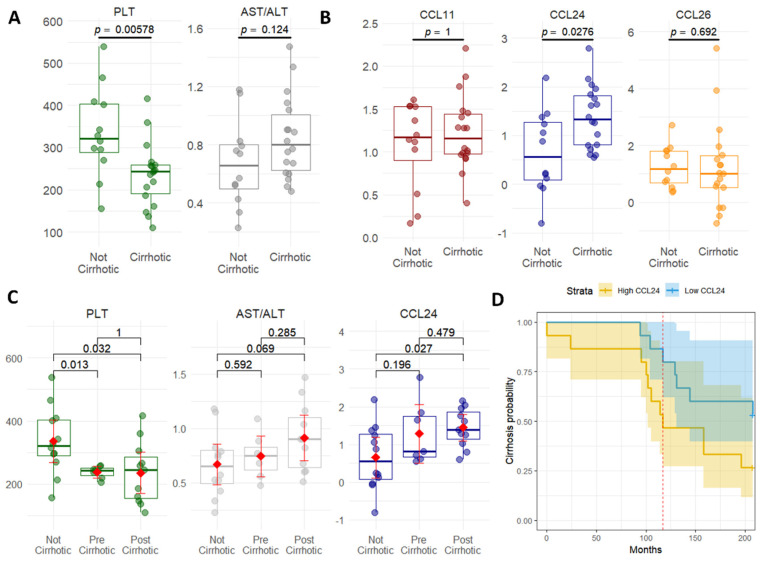
Changes in CCL24 expression reflect cirrhosis presence. (A) Wilcoxon test comparing the mean values of platelets and AST/ALT ratio between PSC patients with and without cirrhosis. (B) Wilcoxon test comparing the mean values of CCL11, CCL24, and CCL26 between PSC patients with and without cirrhosis. (C) Wilcoxon test comparing the mean values of PLT, AST/ALT, and CCL24 between PSC patients without cirrhosis, those who were cirrhotic when serum was taken, and those who developed cirrhosis after serum was taken. Red dot and line represent the mean value. (D) Kaplan–Meier plot stratified by median CCL24 levels showing probability of cirrhosis over time.

References

    1. Pollheimer M.J., Halilbasic E., Fickert P., Trauner M. Pathogenesis of Primary Sclerosing Cholangitis. Best Pract. Res. Clin. Gastroenterol. 2011;25:727–739. doi: 10.1016/j.bpg.2011.10.009. - DOI - PMC - PubMed
    1. Cheung A.C., Lazaridis K.N., LaRusso N.F., Gores G.J. Emerging Pharmacologic Therapies for Primary Sclerosing Cholangitis. Curr. Opin. Gastroenterol. 2017;33:149–157. doi: 10.1097/MOG.0000000000000352. - DOI - PMC - PubMed
    1. Mazhar A., Russo M.W. Systematic Review: Non-Invasive Prognostic Tests for Primary Sclerosing Cholangitis. Aliment. Pharmacol. Ther. 2021;53:774–783. doi: 10.1111/apt.16296. - DOI - PubMed
    1. Portmann B., Zen Y. Inflammatory Disease of the Bile Ducts–Cholangiopathies: Liver Biopsy Challenge and Clinicopathological Correlation. Histopathology. 2012;60:236–248. doi: 10.1111/j.1365-2559.2011.03853.x. - DOI - PubMed
    1. Macias R.I.R., Banales J.M., Sangro B., Muntané J., Avila M.A., Lozano E., Perugorria M.J., Padillo F.J., Bujanda L., Marin J.J.G. The Search for Novel Diagnostic and Prognostic Biomarkers in Cholangiocarcinoma. Biochim. Biophys. Acta Mol. Basis Dis. 2018;1864:1468–1477. doi: 10.1016/j.bbadis.2017.08.002. - DOI - PubMed