


Post-Translational Modifications of Proteins of Malaria Parasites during the Life Cycle
- PMID: 38892332
- PMCID: PMC11173270
- DOI: 10.3390/ijms25116145
Post-Translational Modifications of Proteins of Malaria Parasites during the Life Cycle
Abstract
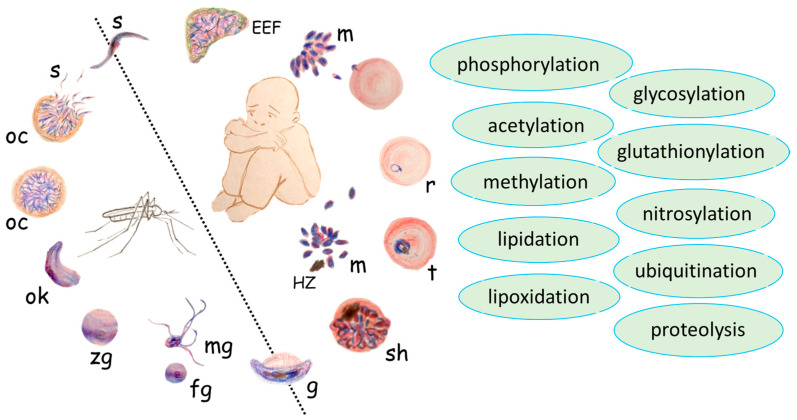
Post-translational modifications (PTMs) are essential for regulating protein functions, influencing various fundamental processes in eukaryotes. These include, but are not limited to, cell signaling, protein trafficking, the epigenetic control of gene expression, and control of the cell cycle, as well as cell proliferation, differentiation, and interactions between cells. In this review, we discuss protein PTMs that play a key role in the malaria parasite biology and its pathogenesis. Phosphorylation, acetylation, methylation, lipidation and lipoxidation, glycosylation, ubiquitination and sumoylation, nitrosylation and glutathionylation, all of which occur in malarial parasites, are reviewed. We provide information regarding the biological significance of these modifications along all phases of the complex life cycle of Plasmodium spp. Importantly, not only the parasite, but also the host and vector protein PTMs are often crucial for parasite growth and development. In addition to metabolic regulations, protein PTMs can result in epitopes that are able to elicit both innate and adaptive immune responses of the host or vector. We discuss some existing and prospective results from antimalarial drug discovery trials that target various PTM-related processes in the parasite or host.
Keywords: Plasmodium; acetylation; glutathionylation; glycosylation; lipidation; lipoxidation; methylation; mosquito Anopheles; phosphorylation; ubiquitination.
Conflict of interest statement
The authors declare no conflicts of interest.
Figures
References
-
- World Malaria Report 2023, Updated 30 November 2023. [(accessed on 23 April 2024)]. Available online: https://www.who.int/teams/global-malaria-programme/reports/world-malaria....
-
- Malaria Report by CDC (The Centers for Disease Control and Prevention). Updated in 2024. [(accessed on 21 April 2024)]; Available online: https://www.cdc.gov/dpdx/malaria/index.html.
Publication types
MeSH terms
Substances
LinkOut - more resources
Full Text Sources
Miscellaneous
