


Targeted Treatment against Cancer Stem Cells in Colorectal Cancer
- PMID: 38892410
- PMCID: PMC11172446
- DOI: 10.3390/ijms25116220
Targeted Treatment against Cancer Stem Cells in Colorectal Cancer
Abstract
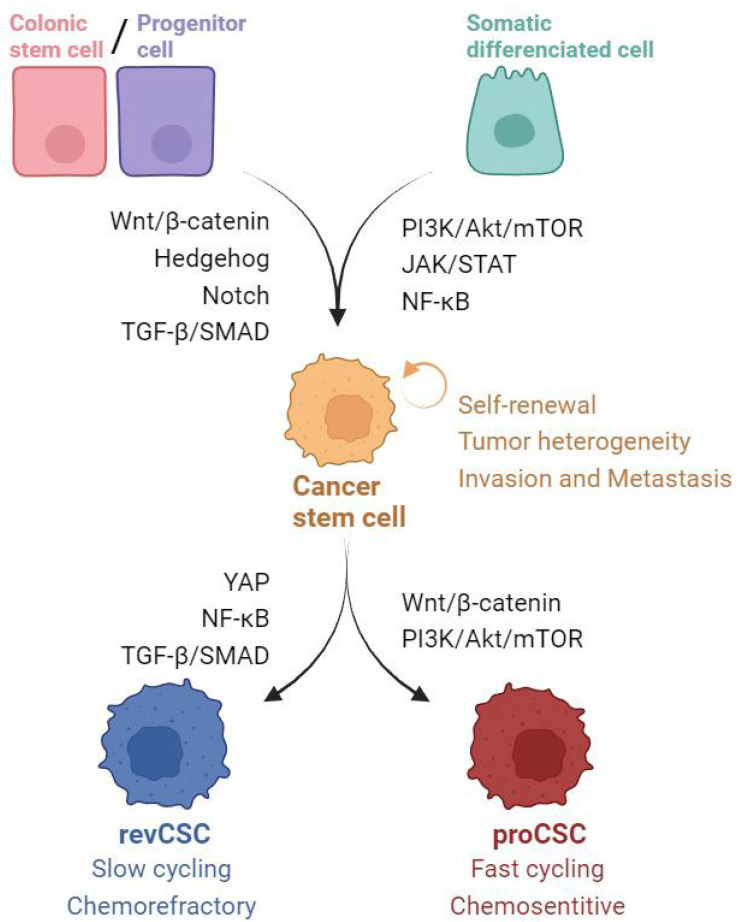
The cancer stem cell (SC) theory proposes that a population of SCs serves as the driving force behind fundamental tumor processes, including metastasis, recurrence, and resistance to therapy. The standard of care for patients with stage III and high-risk stage II colorectal cancer (CRC) includes surgery and adjuvant chemotherapy. Fluoropyrimidines and their combination with oxaliplatin increased the cure rates, being able to eradicate the occult metastatic SC in a fraction of patients. The treatment for unresectable metastatic CRC is based on chemotherapy, antibodies to VEGF and EGFR, and tyrosine-kinase inhibitors. Immunotherapy is used in MSI-H tumors. Currently used drugs target dividing cells and, while often effective at debulking tumor mass, these agents have largely failed to cure metastatic disease. SCs are generated either due to genetic and epigenetic alterations in stem/progenitor cells or to the dedifferentiation of somatic cells where diverse signaling pathways such as Wnt/β-catenin, Hedgehog, Notch, TGF-β/SMAD, PI3K/Akt/mTOR, NF-κB, JAK/STAT, DNA damage response, and Hippo-YAP play a key role. Anti-neoplastic treatments could be improved by elimination of SCs, becoming an attractive target for the design of novel agents. Here, we present a review of clinical trials assessing the efficacy of targeted treatment focusing on these pathways in CRC.
Keywords: cancer stem cell; clinical trial; colorectal cancer; molecular targeted therapies.
Conflict of interest statement
J.M.-P. has received payment or honoraria for lectures, presentations, manuscript writing, or educational events from MSD, Bristol-Myers, Merck, Servier. M.V.-A. has received grants or contracts from Roche and Amgen and consulting fees from Amgen, Sanofi, Servier, and Bayer and payment or honoraria for lectures, presentations, speaker’s bureaus, manuscript writing, or educational events from MSD, Bristol-Myers, Merck, Servier, Amgen and participates on Advisory Boards of Amgen, Servier, and Merck. C.T. and M.A.D.-C. have no conflicts of interest.
Figures
References
Publication types
MeSH terms
Substances
LinkOut - more resources
Full Text Sources
Medical
Research Materials
Miscellaneous
