


Infant Formula with 50% or More of Palmitic Acid Bound to the sn-2 Position of Triacylglycerols Eliminate the Association between Formula-Feeding and the Increase of Fecal Palmitic Acid Levels in Newborns: An Exploratory Study
- PMID: 38892492
- PMCID: PMC11173637
- DOI: 10.3390/nu16111558
Infant Formula with 50% or More of Palmitic Acid Bound to the sn-2 Position of Triacylglycerols Eliminate the Association between Formula-Feeding and the Increase of Fecal Palmitic Acid Levels in Newborns: An Exploratory Study
Abstract
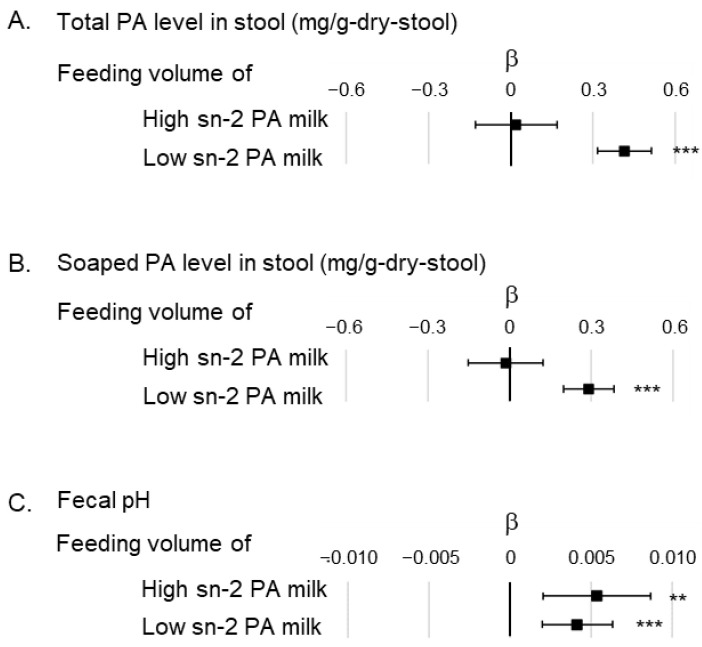
The binding ratio of palmitic acid (PA) at the sn-2 position of triacylglycerols in infant formulas is lower than that in breast milk, resulting in higher levels of fecal PA. Even if the ratio is increased to 40-50%, fecal PA levels in formula-fed infants remain higher than those in breast-fed infants. In Japan, infant formulas with 50% or more of PA bound to sn-2 (high sn-2 PA milk) are commercially available; however, their effects on PA excretion have not been investigated. Therefore, this observational study aimed to preliminarily evaluate whether the feeding volume of high sn-2 PA milk is significantly associated with fecal total/soaped PA levels in newborns. Infant formulas were classified as high (≥50% of PA bound to sn-2) or low sn-2 (<50%) PA milk. Associations between feeding volume of high or low sn-2 PA milk and fecal PA levels were evaluated using multiple regression analysis models. The results showed that the feeding volume of low sn-2 PA milk was positively associated with fecal total/soaped PA levels, while there was no significant association between those of high sn-2 PA milk and fecal total/soaped PA levels. Our preliminary study suggests that high sn-2 PA milk may reduce increased fecal PA levels in formula-fed newborns.
Keywords: breast milk; infant formula; sn-2 palmitate.
Conflict of interest statement
The Food Science Institute Foundation (Ryoushoku-kenkyukai) (Tokyo, Japan) funded this study; however, it had no role in the study design, data collection, data analysis, data interpretation, manuscript writing, or decision to publish. K.S. and S.J. used to be employees of Meiji Co., Ltd. K.S. and S.J. are employees of Meiji Holdings Co., Ltd. The remaining authors declare that the research was conducted in the absence of any commercial or financial relationships that could be construed as a potential conflict of interest.
Figures

References
Publication types
MeSH terms
Substances
LinkOut - more resources
Full Text Sources
Medical
