


Management of Cardiovascular Complications in Antiphospholipid Syndrome: A Narrative Review with a Focus on Older Adults
- PMID: 38892776
- PMCID: PMC11173304
- DOI: 10.3390/jcm13113064
Management of Cardiovascular Complications in Antiphospholipid Syndrome: A Narrative Review with a Focus on Older Adults
Abstract
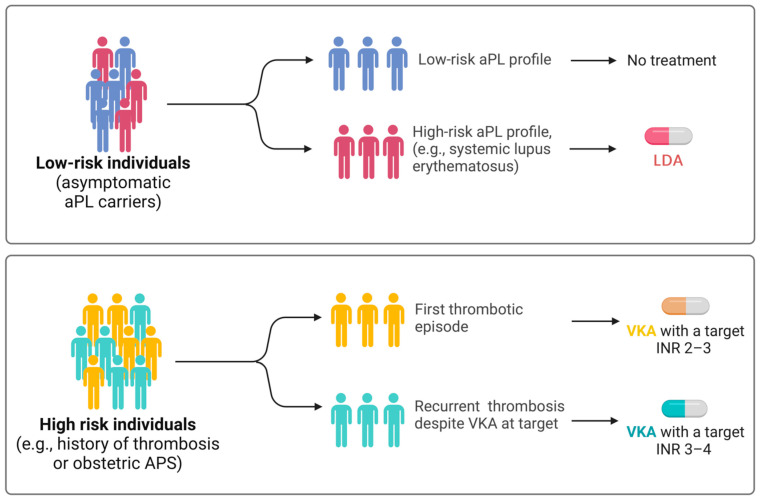
Antiphospholipid syndrome (APS), also known as Hughes syndrome, is an acquired autoimmune and procoagulant condition that predisposes individuals to recurrent thrombotic events and obstetric complications. Central is the role of three types of antiphospholipid antibodies that target phospholipid-binding proteins: lupus anticoagulant (LAC), anti-β2-glycoprotein I (β2-GPI-Ab), and anti-cardiolipin (aCL). Together with clinical data, these antibodies are the diagnostic standard. However, the diagnosis of APS in older adults may be challenging and, in the diagnostic workup of thromboembolic complications, it is an underestimated etiology. The therapeutic management of APS requires distinguishing two groups with differential risks of thromboembolic complications. The standard therapy is based on low-dose aspirin in the low-risk group and vitamin K antagonists in the high-risk group. The value of direct oral anticoagulants is currently controversial. The potential role of monoclonal antibodies is investigated. For example, rituximab is currently recommended in catastrophic antiphospholipid antibody syndrome. Research is ongoing on other monoclonal antibodies, such as daratumumab and obinutuzumab. This narrative review illustrates the pathophysiological mechanisms of APS, with a particular emphasis on cardiovascular complications and their impact in older adults. This article also highlights advancements in the diagnosis, risk stratification, and management of APS.
Keywords: anti-cardiolipin antibodies; anti-β2-glycoprotein I antibodies; lupus anticoagulant; miRNA; monoclonal antibodies; stroke; thrombosis.
Conflict of interest statement
G.B.-Z. has consulted for Amarin, Balmed, Cardionovum, Crannmedical, Endocore Lab, Eukon, Guidotti, Innovheart, Meditrial, Microport, Opsens Medical, Terumo, and Translumina, outside of the present work. P.S. has received speaker fees from AstraZeneca, Amgen, Axis TV, BMS, Les laboratoires Servier, Novartis, Novonordisk, Sanofi, and Vifor, outside of the present work. E.M. has received speaker fees from Abbot, Difass International, Nestlè, and Nutricia and consulting fees from Cepton Strategies and Pfizer, outside of the present work. All other authors report no conflicts of interest.
Figures
References
-
- Miyakis S., Lockshin M.D., Atsumi T., Branch D.W., Brey R.L., Cervera R., Derksen R.H., De Groot P.G., Koike T., Meroni P.L., et al. International consensus statement on an update of the classification criteria for definite antiphospholipid syndrome (APS) J. Thromb. Haemost. 2006;4:295–306. doi: 10.1111/j.1538-7836.2006.01753.x. - DOI - PubMed
-
- Cervera R., Serrano R., Pons-Estel G.J., Ceberio-Hualde L., Shoenfeld Y., de Ramon E., Buonaiuto V., Jacobsen S., Zeher M.M., Tarr T., et al. Morbidity and mortality in the antiphospholipid syndrome during a 10-year period: A multicentre prospective study of 1000 patients. Ann. Rheum. Dis. 2015;74:1011–1018. doi: 10.1136/annrheumdis-2013-204838. - DOI - PubMed
Publication types
Grants and funding
LinkOut - more resources
Full Text Sources
Medical
Miscellaneous
